

For an engineering student, a B.Tech degree does not have to lead only to a private-sector technology job. The Indian Armed Forces offer prestigious officer-entry routes where an engineering qualification serves as the launchpad for high-impact technical, managerial, and leadership careers.
In my experience advising students, the important point is not simply knowing that these opportunities exist. Students need to understand which entry matches their engineering discipline, what the selection process involves, and why defence preparation works best when it runs alongside the engineering degree rather than after graduation.
Table of Contents
1. AFCAT: Air Force Opportunities After B.Tech
2. Army TGC and SSC Tech: Direct Technical Officer Routes
3. Indian Navy: Engineering and Technical Entries
4. Other Graduate Officer Routes: CDS, Coast Guard and NCC
5. Master Comparison: Defence Officer Entries at a Glance
6. What Benefits Can an Engineering Graduate Expect?
7. Preparation Timeline: Start Alongside B.Tech
8. Defence Preparation at Haridwar University
1. AFCAT: Air Force Opportunities After B.Tech
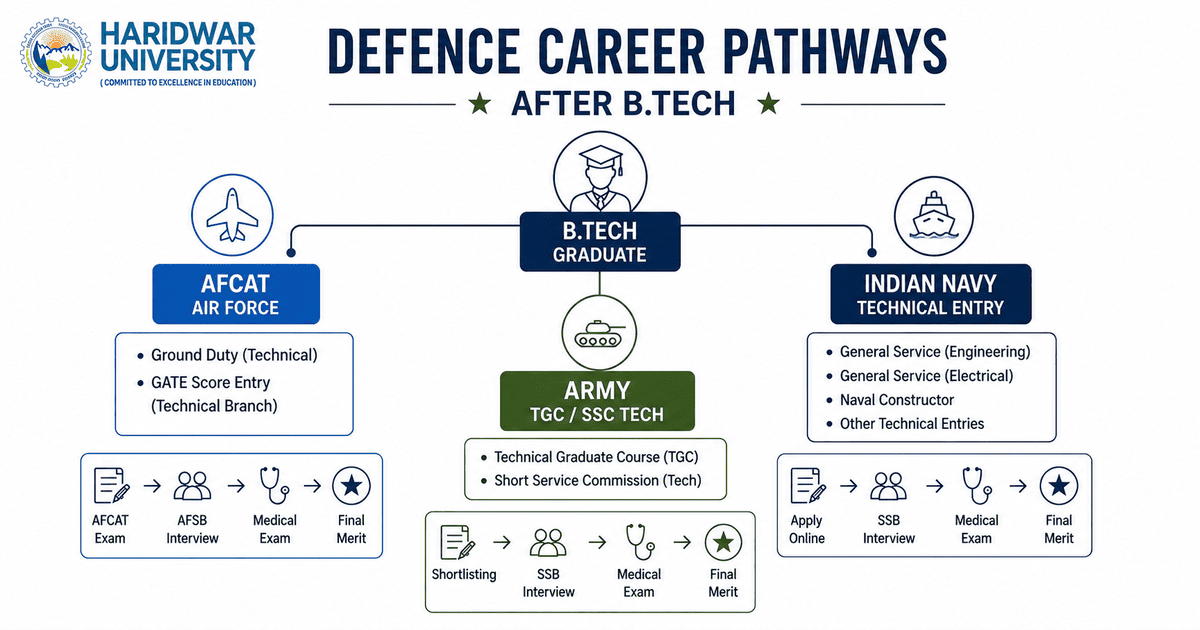
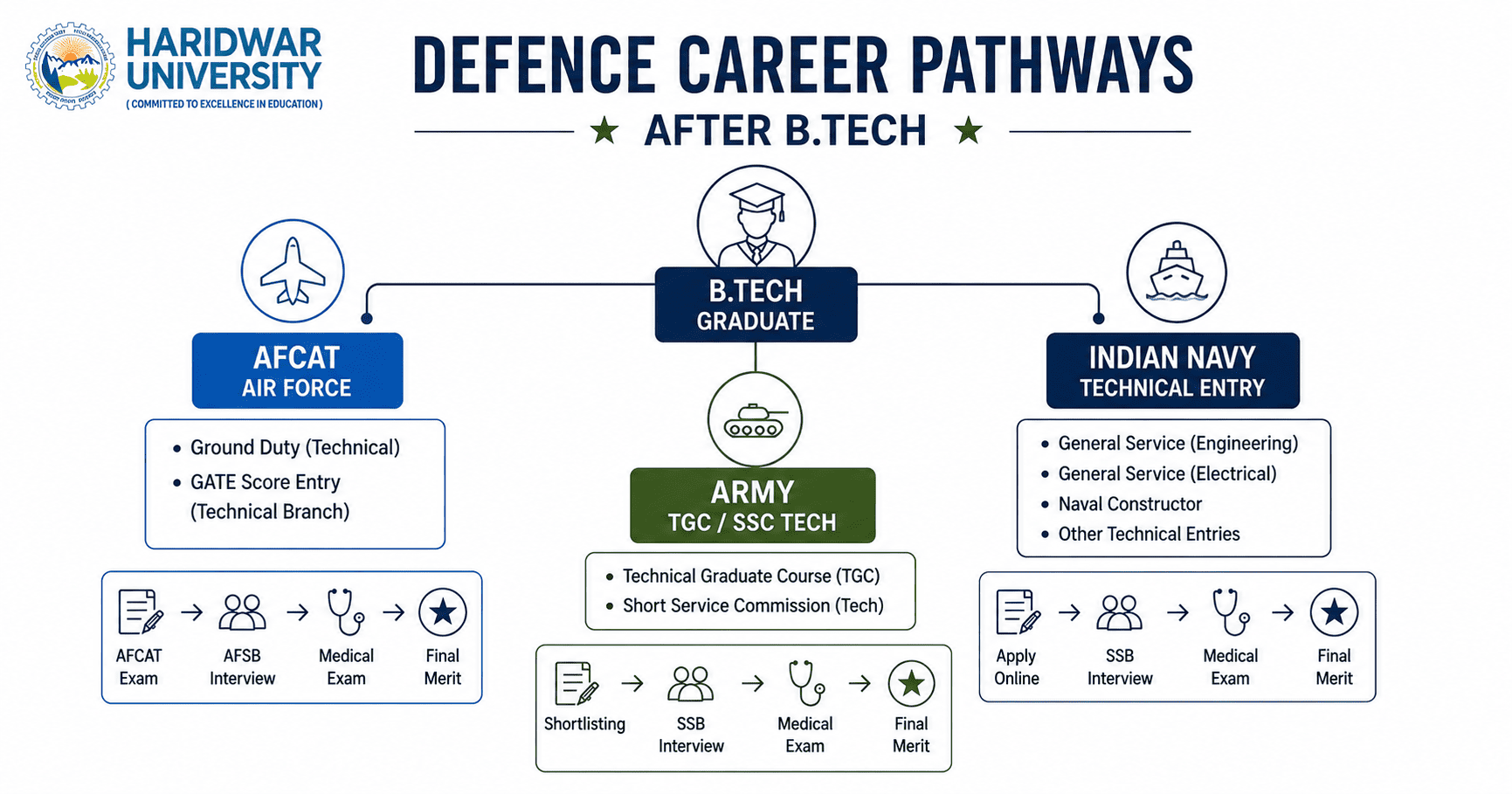
The Air Force Common Admission Test (AFCAT) provides commission routes into the Flying and Ground Duty branches of the Indian Air Force. For engineering graduates, Ground Duty (Technical) is particularly relevant.
The AFCAT 02/2026 notification included Ground Duty Technical entries for Aeronautical Engineering (Electronics) and Aeronautical Engineering (Mechanical). It also introduced a GATE Score Entry for Ground Duty Technical courses commencing in July 2027, open to both men and women.
| Route | Suitable for | Selection Pattern |
|---|---|---|
| AFCAT Ground Duty Technical | Eligible B.E./B.Tech graduates (min 60% aggregate) | AFCAT → AFSB Interview → Medical → All-India Merit |
| GATE Score Entry | Eligible engineering graduates with required GATE score | GATE Shortlisting → AFSB Interview → Medical → Merit |
The 2026 AFCAT notification specified a minimum of 60% marks in the qualifying engineering degree along with mandatory Physics and Mathematics requirements at 10+2 level. Branch-wise eligibility is specific and should always be verified against the official IAF notification.
2. Army TGC and SSC Tech: Direct Technical Officer Routes
The Indian Army offers two direct officer-entry routes tailored specifically for engineering candidates: Technical Graduate Course (TGC) (Permanent Commission) and Short Service Commission (Technical) or SSC Tech.
- Technical Graduate Course (TGC): The 143rd TGC course covered engineering disciplines including Civil, Computer Science, Electrical, Electronics, and Mechanical Engineering. Candidates are shortlisted directly based on engineering marks to attend the Services Selection Board (SSB).
- SSC Tech (Men & Women): Follows an identical direct SSB shortlisting model for eligible male and female engineering graduates.
| Entry | Degree Requirement | Broad Pathway |
|---|---|---|
| TGC (Permanent Commission) | B.E./B.Tech in notified engineering streams | Shortlisting → SSB Interview → Medical → Merit |
| SSC Tech (Short Service Commission) | B.E./B.Tech in notified engineering streams | Shortlisting → SSB Interview → Medical → Merit |
Applications are processed directly through the official Join Indian Army Portal without a separate written exam.
3. Indian Navy: Engineering and Technical Entries
The Indian Navy regularly inducts engineering graduates as commissioned officers across key technical branches:
- General Service (Engineering Branch)
- General Service (Electrical Branch)
- Naval Constructor
- Naval Armament Inspection Cadre (NAIC) & Logistics
Accepted streams include Mechanical, Marine, Electrical, Electronics & Communication, Civil, and allied disciplines. The selection follows: Application → B.Tech Marks Shortlisting → 5-Day SSB Interview → Medical Examination → Final Merit List.
4. Other Graduate Officer Routes: CDS, Coast Guard and NCC
UPSC CDS Examination
Conducted twice annually by UPSC for entry into IMA, INA, AFA, and OTA. The Indian Naval Academy (INA) entry specifically mandates an engineering degree.
IAF NCC Special Entry
For students holding a valid NCC Air Wing 'C' Certificate, providing direct access to AFSB interviews for Flying Branch commissioning (Age: 20–24 years).
Indian Coast Guard (Assistant Commandant)
Technical officer recruitment for marine engineering and aeronautical branches under the Coast Guard (typically 21–25 years).
5. Master Comparison: Defence Officer Entries at a Glance
Here is a unified comparison of all major defence commission routes accessible to engineering students:
| Entry | Service | Suitable for B.Tech Graduates | Selection Route | Age Limit* |
|---|---|---|---|---|
| AFCAT Ground Duty (Technical) | Indian Air Force | Relevant B.E./B.Tech disciplines | AFCAT → AFSB → Medical → Merit | 20–26 years |
| Army TGC | Indian Army | Notified engineering disciplines | Shortlisting → SSB → Medical → Merit | 20–27 years |
| Army SSC Tech | Indian Army | Notified engineering disciplines | Shortlisting → SSB → Medical → Merit | 20–27 years |
| Navy Technical Entries | Indian Navy | Relevant engineering disciplines | Shortlisting → SSB → Medical → Merit | Varies by entry |
| CDS – INA | Indian Navy | Engineering degree (B.Tech) | UPSC CDS → SSB → Medical → Merit | Per CDS notice |
| CDS – IMA | Indian Army | Graduate degree (including B.Tech) | UPSC CDS → SSB → Medical → Merit | Per CDS notice |
| CDS – AFA | Indian Air Force | Degree + 10+2 Physics & Maths | UPSC CDS → AFSB → Medical → Merit | 20–24 years |
| IAF NCC Special Entry | Indian Air Force | B.E./B.Tech + NCC Air Wing 'C' | NCC Entry → AFSB → Medical → Merit | 20–24 years |
| Coast Guard AC (Technical) | Indian Coast Guard | Relevant engineering degree | Selection Stages → Medical → Merit | 21–25 years |
6. What Benefits Can an Engineering Graduate Expect?
A commissioned officer career provides premier compensation, immense respect, leadership responsibility, and structured perks:
Officer Pay & Allowances (7th CPC Level 10)
- Basic Pay Scale: Commissioned at Level 10 (₹56,100 – ₹1,77,500/month).
- Military Service Pay (MSP): Fixed additional ₹15,500 per month.
- Training Stipend: Flight Cadets and Officer Cadets receive ₹56,100 per month fixed stipend during their final training year.
- Allowances & Insurance: Flying allowance, technical qualification pay, transport allowance, comprehensive military healthcare, subsidised housing, and ₹1.25 crore insurance coverage (plus ₹15 lakh additional for Flying Branch).
7. Preparation Timeline: Start Alongside B.Tech
Engineering students should follow a progressive 3-stage readiness framework across their degree:
| B.Tech Stage | Preparation Priority |
|---|---|
| 1st – 2nd Year | Master engineering fundamentals, develop public speaking and communication skills, maintain baseline physical fitness, and follow national/defence current affairs. |
| 3rd Year | Identify eligible entries for your engineering branch, strengthen core technical subjects, prepare for GATE if targeting the IAF GATE route, and begin structured SSB psychological/OIR practice. |
| Final Year | Track notification dates for AFCAT, TGC, and SSC Tech, submit online applications promptly, practice GTO/Interview tasks, and ensure medical/physical readiness. |
For related advice on balancing competitive exam preparation with semester coursework, see our guide on SSC CGL Preparation with Degree.
8. Defence Preparation at Haridwar University
At Haridwar University, we actively encourage engineering students to consider the defence forces alongside corporate placements and postgraduate research. HU offers NBA-aligned engineering programmes with advanced laboratories and industry integration across:
- B.Tech Computer Science & Engineering
- B.Tech Mechanical Engineering (with AI)
- B.Tech Electronics & Communication Engineering
- B.Tech Electrical & Electronics Engineering
- B.Tech Civil Engineering
Learn more about our career training on the HU Training & Placement Overview page.
9. Frequently Asked Questions (FAQs)
Q1: Can I join the defence forces after completing B.Tech?
Yes. B.Tech graduates can apply through several dedicated technical and officer-entry routes, including AFCAT Ground Duty (Technical), Army TGC/SSC Tech, and Indian Navy technical branches, subject to notification eligibility.
Q2: Which B.Tech branches are eligible for defence jobs?
Eligibility varies by entry. Widely eligible branches include Mechanical Engineering, Electrical & Electronics, Electronics & Communication (ECE), Civil Engineering, Computer Science, and IT.
Q3: What is Army TGC after B.Tech?
Technical Graduate Course (TGC) is a direct Permanent Commission entry into the Indian Army for eligible male engineering graduates and final-year students. Selection is based on B.Tech marks shortlisting followed by the 5-day SSB interview and medical test (no written exam).
Q4: Can female B.Tech graduates join the Army through technical entries?
Yes. Female engineering graduates can apply for Army SSC Tech (Women), as well as technical entries in the Indian Air Force (AFCAT Technical) and Indian Navy SSC officer cadres.
Q5: Is GATE useful for defence careers after B.Tech?
Yes. In 2026, the Indian Air Force introduced a GATE-score entry for direct induction into its Ground Duty (Technical) branch, and DRDO/defence PSUs also recruit scientist/engineer positions via GATE.
Q6: When should I start preparing for defence jobs after B.Tech?
Preparation should begin during your undergraduate degree. Build strong academic basics and communication in early years, and focus on physical fitness, SSB psych tests, and notification schedules in 3rd and final years.
10. Plan Your Path at HU
A B.Tech degree from Haridwar University provides the rigorous technical grounding, analytical problem-solving, and personal leadership required to succeed across defence officer selections, government careers, and premier corporate industries.
Build Your Technical Leadership Foundation at HU
Explore our engineering disciplines, advanced research labs, and dedicated placement coaching.