

When students and parents discuss financing higher education, the first question I encourage them to ask is not simply, “Which bank offers the lowest education loan interest rate?” It is, “Which loan structure fits our course costs, financial circumstances, and four-year repayment capacity?”
That distinction matters immensely. Education loan interest rates in India vary widely depending on the lender, loan scheme, institutional category, collateral security, co-borrower credit profile, and applicable interest concessions. A promotional rate advertised for a premier government institution or under a specific central scheme may not be available to every applicant.
In this guide, we compare published rates across leading public and private lenders for 2026, unpack how interest compounding influences total borrowing costs, and outline what families must verify before signing a sanction agreement.
Table of Contents
- • 1. Education Loan Interest Rates in India in 2026
- • 2. Bank-Wise Education Loan Interest Rate Comparison
- • 3. Why Education Loan Interest Rates Differ Between Banks
- • 4. How to Compare Education Loans Beyond the Interest Rate
- • 5. How Interest Rates Affect the Cost of an Education Loan
- • 6. Government Interest Subsidies and Education Loan Support
- • 7. What Students Should Check Before Accepting a Loan Offer
- • 8. Frequently Asked Questions (FAQs)
- • 9. Make the Borrowing Decision with the Full Picture
1. Education Loan Interest Rates in India in 2026
There is no single education loan interest rate that applies across India. Banks publish rates for different schemes, and the applicable rate can depend on the course, institution, loan amount, security and borrower profile.
For example, the State Bank of India’s published education-loan rates distinguish between its Student Loan, Scholar Loan, Global Ed-Vantage and PM-Vidyalaxmi offerings. These are not interchangeable products.
A useful starting point is to understand three terms:
- Starting rate: The lowest advertised rate for a specified product or eligible category. It is not necessarily the rate offered to you.
- Floating rate: A rate that can change according to the lender’s benchmark and applicable spread.
- Scheme-specific rate: A rate linked to particular eligibility criteria, such as an eligible institution or government-backed scheme.
My advice is straightforward: when a bank advertises a rate, read the conditions immediately below it. Those conditions are part of the offer, not fine print to leave until later.
2. Bank-Wise Education Loan Interest Rate Comparison
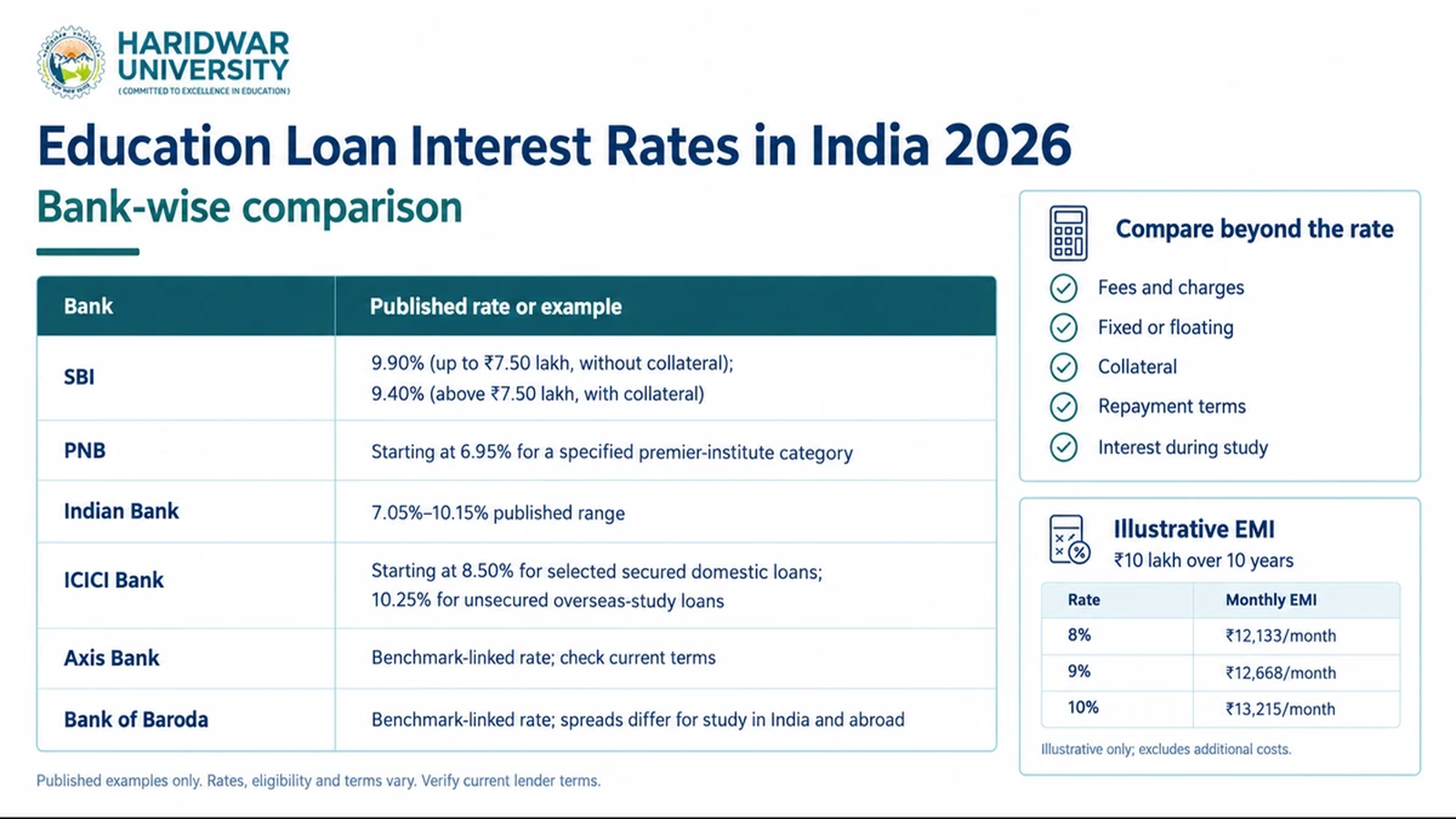
The table below compiles indicative published rates from leading Indian public and private sector banks for the 2026 academic cycle. These figures serve as a comparative baseline; exact terms depend on individual applicant credentials, co-borrower financial health, and sanction conditions:
| Lender / Bank | Published rate or example | What students should note |
|---|---|---|
| State Bank of India (SBI) | Student Loan Scheme: 10.15% without collateral up to ₹7.50 lakh; 9.65% with collateral above ₹7.50 lakh | SBI lists scheme-specific rates and concessions. Its page states rates effective from 15 October 2026 and identifies them as floating. |
| Punjab National Bank (PNB) | PNB Pratibha: published starting floating rate of 7.20% for a specified premier-institute category | The rate is tied to scheme and institute eligibility. It should not be treated as a general rate for all students. |
| Indian Bank | Published education-loan range: 7.05%–10.15% | The applicable rate depends on the relevant loan category and terms. Check the current scheme details. |
| Bank of Baroda (BoB) | Rates are linked to the bank’s lending benchmark, with different spreads for study in India and abroad. | The bank directs applicants to its current interest rate and charges information for the applicable rate. |
| ICICI Bank | Published starting rates include 8.75% for secured loans at selected domestic institutes and 10.50% for unsecured overseas-study loans | The bank differentiates rates by study destination, course, institution category, and security. Its page also provides rate-period information. |
| Axis Bank | Rates are linked to the applicable benchmark and spread | Check the live rate table and charges before comparing an offer. Do not assume one rate applies to every loan amount. |
Important: Published rates and product conditions can change. The figures above were taken from official lender pages available for this review, but their effective dates and scheme definitions are not identical. Check each bank’s current page and obtain a written offer before making a decision. A lower rate shown for a specific category does not establish that the bank is cheapest for every applicant.
For me, the most useful comparison is not a league table with one winner. It is a comparison that helps a student identify which offers they may actually qualify for.
3. Why Education Loan Interest Rates Differ Between Banks
Two students borrowing similar amounts can receive different offers. Several factors explain why.
Loan scheme and institution: Some banks publish preferential rates for specified institutions or courses. Eligibility for such a category must be confirmed with the lender.
Collateral and security: A secured loan and an unsecured loan may carry different rates and conditions. The collateral requirement also affects the financial risk taken by the family.
Study destination and course: Domestic study and overseas study may fall under different products. Certain professional courses may also have separate pricing categories.
Applicant and co-applicant profile: A lender may assess credit history, income, repayment capacity and other information when determining the applicable terms.
Benchmark and concessions: A floating rate may comprise a benchmark plus a spread. Concessions can also depend on the scheme or applicant category.
These differences explain why the lowest rate on a website may not be the rate in a particular student's sanction letter.
4. How to Compare Education Loans Beyond the Interest Rate
Interest matters, but it is only one part of the borrowing decision. Before accepting an offer, I recommend comparing the following:
|
Comparison point |
What to ask the lender |
|
Applicable interest rate |
What exact rate applies to my course, amount and profile? |
|
Rate type |
Is the rate fixed or floating? If floating, what benchmark and spread apply? |
|
Processing and other charges |
What fees, taxes and third-party charges will I pay? |
|
Collateral and co-applicant |
Is security required, and what responsibilities does the co-applicant accept? |
|
Repayment schedule |
When will repayment begin, and how will the EMI be calculated? |
|
Interest during study |
How is interest treated before regular repayment begins? |
|
Prepayment conditions |
Are there charges or other conditions for early repayment? |
Ask each lender for the same information. Comparing a secured domestic-study offer with an unsecured overseas-study offer without accounting for their different conditions can produce a misleading result.
Students should also calculate the amount they actually need to borrow. Haridwar University’s official 2026–27 fee structure and scholarship information can help applicants estimate eligible academic costs and check relevant scholarship conditions. Hostel, transport and other expenses should be considered separately where applicable.
5. How Interest Rates Affect the Cost of an Education Loan
A 1.00% difference in annual interest may appear negligible on paper, but across a 10-year or 15-year repayment schedule, it equates to substantial cumulative financial outflow.
Consider this standardized simulation: a student borrows ₹10,00,000 with a 10-year (120-month) post-moratorium repayment horizon:
| Annual Interest Rate | Estimated Monthly EMI | Total Interest Paid | Total 10-Year Repayment |
|---|---|---|---|
| 8.0% p.a. | ₹12,133 / month | ₹4,55,931 | ₹14.56 Lakh |
| 9.0% p.a. | ₹12,668 / month | ₹5,20,110 | ₹15.20 Lakh |
| 10.0% p.a. | ₹13,215 / month | ₹5,85,809 | ₹15.86 Lakh |
An interest variation of just 2% costs the borrower an extra ₹1,30,000 in interest alone. Furthermore, if interest during the study moratorium is left unpaid, that interest is capitalized into the principal, pushing the total repayment even higher. For a comprehensive walkthrough of grace periods, review our guide to the education loan moratorium period in India.
6. Government Interest Subsidies and Education Loan Support
Indian students can tap into targeted central interest subvention programs that alleviate loan burdens during university study:
- Central Sector Interest Subsidy (CSIS): Funded by the Ministry of Education, this scheme covers full interest during the moratorium period (course duration + 1 year) for professional degree students from Economically Weaker Sections (gross family income up to ₹4.5 lakh annually).
- PM-Vidyalaxmi Scheme: A unified digital portal streamlining education loan access across public banks, providing credit guarantees up to ₹7.5 lakh and an interest subvention of 3% for eligible students from families with annual income up to ₹8 lakh.
- Institutional Merit Scholarships: Institutional scholarships offer non-repayable grant relief. Review the Haridwar University scholarship eligibility and application guide to determine your eligibility for tuition fee waivers based on JEE ranks, CUET scores, or Class 12 board marks.
7. What Students Should Check Before Accepting a Loan Offer
Before executing a credit facility, use this practical financial checklist:
- Verify that the sanction letter explicitly specifies the benchmark rate, current spread, and reset frequency.
- Confirm that all disbursements align with university semester fee due dates rather than arbitrary releases.
- Ensure full transparency on processing fees, statutory stamp duty, and third-party legal inspection charges.
- Determine whether co-borrower insurance is optional or bundled into the principal.
- Check that institutional scholarships are subtracted from total borrowing to minimize interest accumulation.
- Examine the university's placement track record to ensure projected graduate earnings comfortably cover post-moratorium EMIs. For verified campus placement statistics, read our education loan guide for university students.
8. Make the Borrowing Decision with the Full Picture
An education loan can help a student finance higher education, but the right choice requires more than finding the smallest percentage on a comparison page. I encourage students and families to verify current rates, understand the conditions attached to each offer, calculate the likely repayment burden and check whether scholarships or other eligible support may reduce the amount borrowed.
At Haridwar University, our aim is to help applicants make informed decisions about their education plans. Use official fee information to prepare a realistic budget, compare lenders on consistent terms, and seek written clarification from the bank before accepting an offer. A well-informed borrowing decision begins with understanding the full commitment, not simply the advertised rate.
9. Frequently Asked Questions (FAQs)
1. What is the education loan interest rate in India in 2026?
There is no single uniform national rate. Commercial and public sector banks publish rates varying from 7.05% to 11.50% based on eligibility, course type, premier-institute category, loan amount, and collateral.
2. Which bank has the lowest education loan interest rate?
No single bank is universally the cheapest for every applicant. The lowest published promotional rates (often 7.05%–7.20%) usually require admission into designated premier tier-1 institutions or high-value tangible collateral.
3. Are education loan interest rates fixed or floating?
The vast majority of Indian education loans are floating-rate loans pegged to an external benchmark (such as the RBI Repo Rate or EBLR) plus a bank-specific spread. Fixed-rate education loans are uncommon.
4. Does a lower interest rate always mean a cheaper loan?
Not necessarily. Mandatory processing charges, insurance premiums, disbursement scheduling, and interest treatment during the moratorium period significantly affect total out-of-pocket borrowing costs.
5. Can students get an education loan without collateral?
Yes. Under Indian Banks' Association (IBA) model schemes, education loans up to ₹7.50 lakh are typically collateral-free, backed by third-party guarantee schemes such as CGFSEL.
6. Does an education loan charge interest during the study period?
Yes. Simple interest accrues on all disbursed tranches during the course and moratorium period. Servicing this interest monthly keeps the principal from growing and earns a 1% concession with many public banks.
7. Should I apply for an education loan before confirming my course fees?
You should begin lender research early, but base your formal loan application on the confirmed institutional fee schedule and net funding gap after factoring in merit scholarships.
Plan Your Higher Education with Complete Financial Clarity
Haridwar University provides direct admission counseling, transparent fee structures, merit scholarships up to 80% on tuition, and complete institutional loan support documentation.