

When students and parents evaluate a university, they naturally look at programmes, infrastructure, fees and placement opportunities. But there is another part of the academic experience that is harder to capture in a brochure: the people students meet in their classrooms, laboratories and academic departments.
At Haridwar University, our academic community spans engineering, computing, agriculture, pharmacy, allied health sciences and management. Across these areas, Haridwar University faculty members contribute not only to classroom teaching but also to curriculum development, research and student support. The University's Academic Council, for example, has specific responsibilities for maintaining academic standards, reviewing curriculum and promoting faculty development and research.
For Teacher's Day 2026, I want to put that academic community in focus. Rather than presenting a generic list of faculty achievements, this article introduces a selection of teachers whose names and academic roles are publicly documented on the University's website.
Table of Contents
1. The Faculty Behind Different Academic Disciplines
2. From Engineering to Pharmacy: Faculty Across the University
3. Why Faculty Diversity Matters
4. How HU Supports Faculty Development and Research
5. Mentoring Is Part of the Student Support Structure
6. What We Mean When We Talk About Faculty at HU
1. The Faculty Behind Different Academic Disciplines
One of the strengths of a multidisciplinary university is that students do not learn within a single academic perspective. At HU, the faculty listed across our academic schools reflects that range.
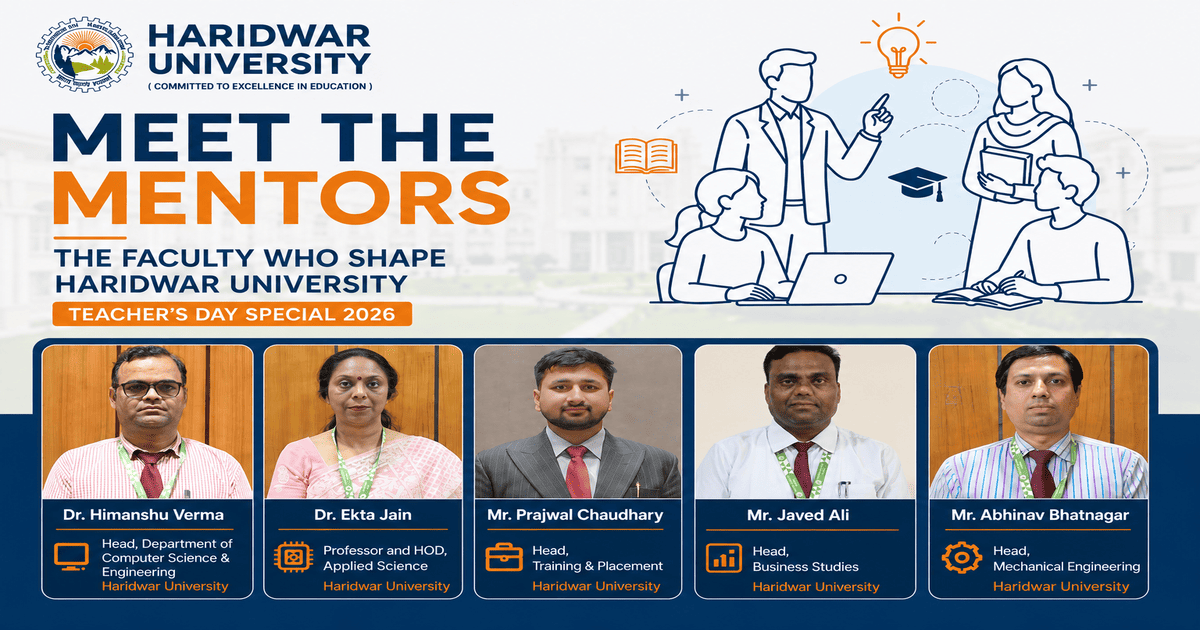
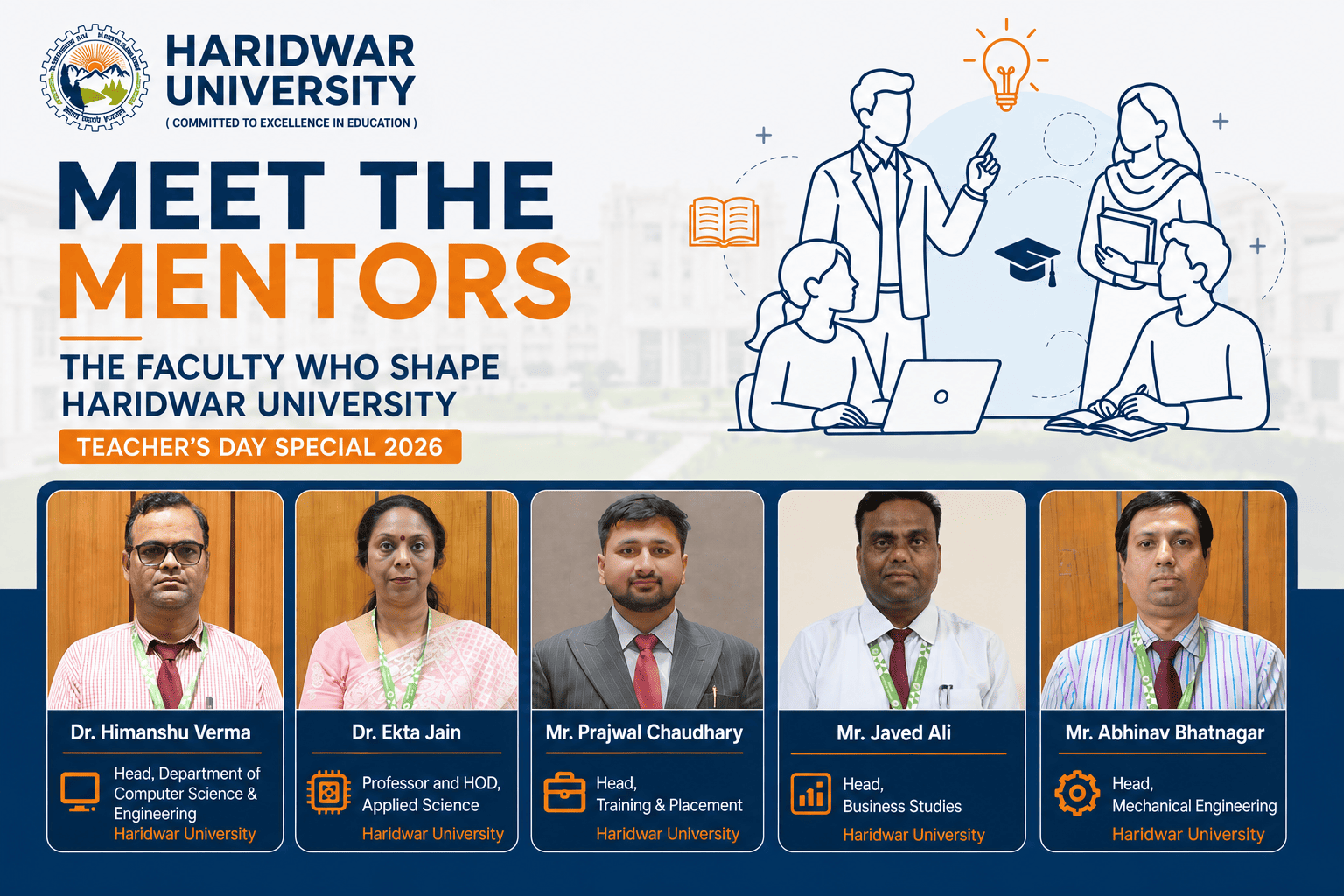
Dr. Himanshu Verma: Building the CSE Perspective
Head, Department of Computer Science and Engineering, Haridwar University
Dr. Himanshu Verma serves as Head, Department of Computer Science and Engineering, Haridwar University. His academic work is connected with the University's broader computing ecosystem, which includes Computer Science and Engineering, Artificial Intelligence & Machine Learning, Cyber Security, Data Science and Computer Applications.
His academic contribution has also extended into student-facing discussions around emerging technology. Dr. Verma has authored HU articles covering areas including CSE career pathways, Artificial Intelligence and Machine Learning, programming languages and the choice between CSE and AI/ML. In one of his 2026 articles, he approaches the CSE-versus-AI/ML decision by asking students to consider whether they want broader computing exposure or an earlier, deeper focus on artificial intelligence.
That is an important distinction for today's students. Computing education is no longer limited to learning programming languages. Students increasingly need to understand how core Computer Science connects with areas such as AI, data, cybersecurity and cloud technologies.
For students considering these pathways, the Roorkee College of Smart Computing provides the University's programme and faculty overview. He has also contributed to HU's student guidance content, including its guide to career options after B.Tech CSE, which extends the academic discussion from classroom learning to possible career pathways.
Mr. Abhinav Bhatnagar: Connecting Mechanical Engineering with AI
Head, Mechanical Engineering, Haridwar University
Mr. Abhinav Bhatnagar serves as Head, Mechanical Engineering, Haridwar University. His academic perspective reflects how Mechanical Engineering is evolving alongside automation, Artificial Intelligence, robotics and data-driven manufacturing.
His contribution to HU's student-facing content focuses on helping students understand this changing landscape. In his 2026 guide to B.Tech Mechanical Engineering with AI Specialization, he explains how traditional mechanical engineering fundamentals can be combined with areas such as robotics, predictive maintenance, smart manufacturing, Industry 4.0, CAD/CAM and AI-enabled design.
This approach is particularly relevant for students who may associate Mechanical Engineering only with conventional manufacturing or machinery. The programme he discusses retains core subjects such as thermodynamics, manufacturing technology, machine design and fluid mechanics while introducing programming, automation and AI-oriented applications.
For students, that balance is an important part of understanding where Mechanical Engineering can lead. The discipline continues to provide a foundation for careers in design, manufacturing, production, maintenance, automation and other engineering domains, while digital technologies are changing how these roles are performed.
2. From Engineering to Pharmacy: Faculty Across the University
If there is one thing a multidisciplinary university makes possible, it is the opportunity to learn from people working across very different academic fields. At HU, that diversity is visible in the faculty listed across its academic colleges. I see this as particularly important for students because the mentor they encounter should be connected to the discipline they are preparing to enter, whether that is electronics, computing, pharmacy, agriculture or management.
Dr. Ekta Jain: Engineering Fundamentals & Emerging Tech
Professor and HOD, Applied Science, Haridwar University
Dr. Ekta Jain connects foundational engineering and applied science with the changing technical requirements students encounter as they move towards specialised engineering disciplines.
Her work also features prominently in HU's student-facing academic content around Electronics and Communication Engineering. In a 2026 HU article, Dr. Jain discusses B.Tech ECE with AI, including VLSI, semiconductor technology, embedded systems, IoT and communication engineering. Her writing gives prospective students a clearer view of how a core engineering discipline is evolving alongside newer technologies.
This perspective is particularly relevant within HU's engineering ecosystem, where the Roorkee College of Engineering offers programmes across ECE, Civil, Electrical & Electronics, and Mechanical Engineering, alongside postgraduate engineering programmes.
Dr. Deovrat Kumar: Guiding Through Pharmacy & Research
Head of Pharmacy, Haridwar University
Dr. Deovrat Kumar reflects the breadth of pharmacy education, from undergraduate pharmaceutical sciences to postgraduate specialisation, research and professional career pathways.
His student-facing work at HU covers several stages of pharmacy education. He has authored guidance on B.Pharm, career options after B.Pharm, D.Pharm and postgraduate study through M.Pharm. In his M.Pharm guide, he explains how postgraduate pharmacy education can help students develop deeper expertise in areas such as formulation, drug delivery, pharmaceutical manufacturing and research.
HU currently lists M.Pharm Pharmaceutics as its postgraduate pharmacy programme, providing a pathway for students interested in advanced formulation science, drug delivery and pharmaceutical research. Dr. Kumar's published guidance addresses not only what students study, but also how different pharmacy qualifications connect with higher education, research and career planning.
Mr. Prajwal Chaudhary: Agriculture & Career Readiness
Head, Training & Placement, Haridwar University
Mr. Prajwal Chaudhary serves as Head, Training & Placement, Haridwar University. His work at HU extends into student career guidance, bridging classroom education with professional skills.
In his role as Head, Training & Placement, he has authored HU's comprehensive guide on B.Tech internships, which looks at how students can use internships to gain practical exposure alongside their academic programme.
I consider this connection between academic learning and practical exposure particularly important. An internship is more valuable when students understand what they are expected to learn from the experience, rather than treating it simply as another certificate to add to a CV.
Mr. Javed Ali: Management Learning Closer to Industry
Head, Business Studies, Haridwar University
Mr. Javed Ali brings an academic focus closely connected with the changing expectations of the business world, where students increasingly need to combine management fundamentals with practical, technology-enabled skills.
His contribution to HU's student guidance content includes “MBA Marketing at Haridwar University: Specialization Guide & Career Roles (2026)”. The article discusses the Marketing pathway within HU's MBA with AI and connects management education with areas such as digital marketing, customer intelligence and contemporary business roles.
For students choosing a management specialisation, this kind of guidance helps answer a practical question: what does the subject lead to beyond the classroom? Connecting the curriculum with potential career directions makes the academic choice more tangible.
3. Why Faculty Diversity Matters
These examples show why I believe a university's faculty should be viewed as more than a list of names and designations. An ECE student may be preparing for semiconductor, embedded or communication careers, while a pharmacy student is learning about drug formulation, pharmaceutical sciences and patient-focused practice. The academic requirements are very different, and so are the contexts in which students apply what they learn.
That is why HU's academic structure brings together faculty across specialised schools while maintaining department-level academic leadership. The objective is not simply to offer more courses, but to build academic communities around those disciplines.
And beyond individual departments, there is another question that matters: how does a university create an environment in which its faculty can continue developing as teachers and researchers? That takes us from individual mentors to the academic systems that support them.
4. How HU Supports Faculty Development and Research
A university's academic environment depends not only on who teaches, but also on whether teachers have opportunities to keep developing their academic practice. At HU, faculty development is formally included within the responsibilities of the Academic Council, alongside academic standards, curriculum development and the promotion of research.
Key Pillars of HU's Research & Development Framework:
- Research Promotion Policy: Encourages faculty research and student research skills, providing publication incentives for eligible research work and support related to seminars, conferences, academic leave and research activities.
- Research Publications Portal: Brings together faculty and student research across disciplines, with publications organised by year and subject area.
- Curriculum Innovation: Regular updates to syllabus aligning theoretical knowledge with Industry 4.0, emerging AI tools, and applied laboratory experiments.
For students, this matters because a research-active academic environment can bring questions beyond the prescribed syllabus into classroom and project discussions. It also creates opportunities to see how academic knowledge is developed, tested and applied.
5. Mentoring Is Part of the Student Support Structure
Faculty influence is not limited to lectures and examinations. At HU, academic and learning difficulties are specifically addressed through faculty mentors, while the University's counselling service provides one-to-one and group psychological counselling.
The University also organises remedial classes for students who score below 40% in Mid-Term Examinations, with the stated purpose of helping students address gaps in understanding and improve their learning and skills.
💡 A Registrar's Perspective: Students do not always struggle because they lack ability. Sometimes the difficulty is a missed concept, an unfamiliar academic environment or simply not knowing when to ask for help. A structured mentoring system gives students a route to seek that help before a small academic gap becomes a larger one.
The University's student-support structure also includes grievance redressal, medical assistance and other welfare mechanisms. In other words, mentoring sits within a wider support system rather than functioning as an isolated activity.
6. What We Mean When We Talk About Faculty at HU
The six faculty members featured in this article represent only a small part of HU's academic community. Their departments are different, their subject areas are different and the students they teach have different professional goals.
That diversity is precisely what makes the faculty experience worth highlighting on Teacher's Day:
- A Computer Science student may be thinking about software, AI or data.
- An ECE student may be looking towards electronics, semiconductors and emerging technologies.
- A Pharmacy student may be preparing for a profession connecting pharmaceutical science with healthcare.
- Agriculture and Management students bring yet another set of academic and professional questions.
The role of the teacher, therefore, is not simply to deliver the same model of education to everyone. It is to help students understand the discipline they have chosen, develop the skills required within it and gradually become more independent learners.
7. A Teacher's Day Reflection
Teacher's Day is often reduced to a thank-you message, but for a university, it is also an opportunity to recognise the academic work that happens throughout the year.
At Haridwar University, that work includes classroom teaching, academic planning, research, curriculum development, mentoring and student support. The University's faculty pages, academic bodies and research records show these different dimensions of academic life.
As Registrar, I believe the strongest academic communities are built when teachers continue to learn alongside their students. A good university therefore needs more than programmes and infrastructure. It needs teachers who contribute to the academic culture around those programmes.
This Teacher's Day, that is what we celebrate: the people behind the classroom, the mentor behind the guidance and the academic community behind the student's journey.
8. Frequently Asked Questions (FAQs)
Who are the faculty members at Haridwar University?
Haridwar University has faculty across engineering, computer science, agriculture, pharmacy, allied health sciences, management and other academic areas.
Does Haridwar University have faculty mentors for students?
Yes. HU provides faculty mentors to support students facing academic and learning difficulties.
What role do faculty members play beyond classroom teaching?
Faculty contribute to academic planning, curriculum development, research, mentoring and student support in addition to teaching.
Does HU support faculty research?
Yes. HU's Research Promotion Policy provides a framework for faculty research and includes incentives for eligible research publications.
Does Haridwar University provide remedial academic support?
Yes. HU provides remedial classes for students who score below 40% in Mid-Term Examinations.
Can students get guidance about career choices from HU faculty?
Yes. HU faculty members also contribute to career-oriented academic guidance through programme, skills and career-related content published on the University's website.
Where can I find faculty information for different HU departments?
Faculty information is available through the respective academic college and department pages on the Haridwar University website.
9. Meet the Faculty at Haridwar University
To explore HU's academic departments, faculty members and programmes, explore our faculty and discover the people who contribute to learning across the University.
Discover our academic ecosystem on the About Us Page or explore admission details via our Admission Overview.
Learn From Dedicated Mentors at Haridwar University
Connect with faculty members across Engineering, Computer Science, Pharmacy, Management, Agriculture, and Health Sciences.