

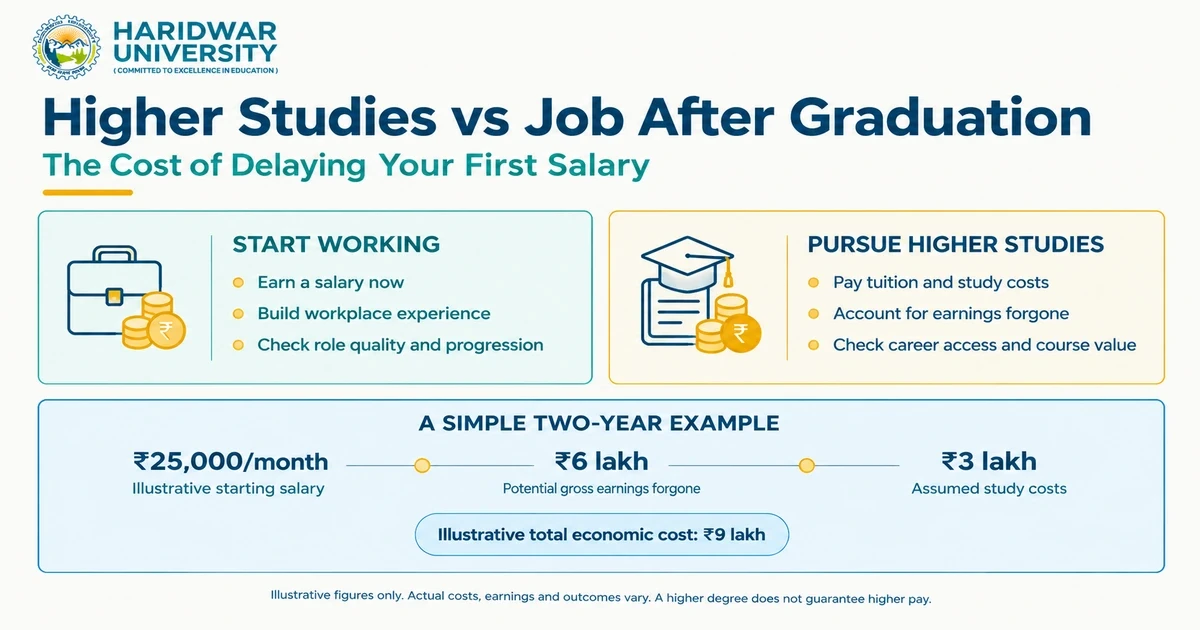
A postgraduate degree can open prestigious professional doors, but it also postpones your first full-time salary by one or two critical years. Conversely, stepping into employment immediately delivers monthly income and workplace exposure, yet accepting an unstructured role too early may restrict your access to specialized, high-growth technical domains. The crossroad between a job versus higher studies after graduation is therefore not simply about which path advertises higher salaries. It is about what each route costs, what capabilities it unlocks, and how many years it will realistically take to recover your investment.
Rather than asking the ambiguous question “Which is universally better?”, start with an operational query: What will the next two years cost me financially and professionally, and what roles will they qualify me to perform? In India, where families frequently fund higher degrees through hard-earned savings, personal assets, or educational loans, assessing the hidden opportunity cost of delayed earnings is essential.
Table of Contents
- The Decision Depends on the Job and the Qualification
- The Real Cost of Delaying Your First Salary
- A Worked Example of the Opportunity Cost
- When Starting Work First Makes Financial Sense
- When Higher Studies Can Justify the Investment
- A Third Route: Work First and Study Strategically
- A Practical Framework for Making the Decision
- Frequently Asked Questions (FAQs)
- Make the Next Two Years Count
1. The Decision Depends on the Job and the Qualification
One of the most frequent missteps graduates make is treating “a job” and “higher studies” as monolithic choices. A graduate engineering trainee role in a product company with structured mentorship is radically different from an ad-hoc administrative position with negligible skill acquisition. Similarly, an AI-integrated master’s program with corporate internships differs completely from a generic postgraduate degree pursued merely to postpone entering the job market.
| Decision Factor | Starting Work First | Pursuing Higher Studies Immediately |
|---|---|---|
| Immediate Income | Monthly salary starts immediately upon onboarding. | Full-time earnings are delayed by 1 to 2 academic years. |
| Direct Outlays | Commuting, work wardrobe, and initial relocation costs. | Tuition fees, hostel charges, books, exam fees, and living costs. |
| Experience Gained | Builds workplace credibility, project deliverables, and corporate references. | Provides advanced theoretical depth, capstone research, and academic credentials. |
| Career Accessibility | Promotions depend on job execution, domain experience, and leadership. | Meets statutory or corporate prerequisites for specialized roles. |
| Primary Risk | Stagnating in a dead-end role with limited upward mobility. | Incurring substantial educational debt without measurable placement ROI. |
National labor insights reinforce this nuance. The State of Working India 2026 study published by Azim Premji University illustrates that while educational attainment strongly correlates with higher lifetime earnings, Indian youth do not transition into secure, well-compensated formal employment at an identical pace. Evaluate the specific job offer or university program on its own merits, rather than relying on abstract category prestige.
2. The Real Cost of Delaying Your First Salary
The financial cost of pursuing a postgraduate qualification (such as an M.Tech, MBA, or MCA) extends far beyond the tuition printed on the admission slip. To perform an accurate financial appraisal, calculate these four interdependent components:
The Four-Pillar Cost Equation
- Direct Institutional Fees: Tuition, semester examination charges, lab access, and registration dues.
- Incremental Living Expenses: Hostel accommodation, dining fees, and travel costs necessitated specifically by enrolling in full-time education away from home.
- Foregone Gross Earnings (Opportunity Cost): The salary income you could have earned had you accepted a graduate job instead of studying.
- Financing and Interest Costs: Accumulating interest if an educational loan or household credit was used to bridge the academic fee.
Foregone earnings are frequently ignored because they represent money never held. Yet mathematically, if a fresh graduate could realistically earn ₹25,000 per month, stepping away from the workforce for one year represents ₹3,00,000 in foregone gross earnings; a two-year master’s equals ₹6,00,000.
Furthermore, two years of full-time work often yield annual appraisal increments, corporate bonuses, and internal promotion opportunities. Therefore, the honest comparison is never tuition fees versus starting salary—it is your total economic investment against the plausible salary premium unlocked by the advanced degree.
3. A Worked Example of the Opportunity Cost
To understand the arithmetic of break-even recovery, consider this realistic, illustrative model of an Indian graduate choosing between joining an entry-level technical role versus enrolling in a two-year master’s programme:
Financial Breakdown of the 2-Year Study Commitment
Computing the Break-Even Payback Period
Now observe the recovery horizon: suppose the completed postgraduate degree enables the graduate to secure a role earning ₹10,000 more per month than their peers who remained on the work-first route.
At an incremental premium of ₹10,000 per month, recovering the total economic investment of ₹9,00,000 requires:
The strategic insight is not that higher studies take over seven years to pay off—career growth is non-linear, and promotions can accelerate rapidly. Rather, the lesson is that the size of the salary differential matters as much as the tuition cost itself. An investment in an advanced degree is justified when it opens doors to careers that would otherwise remain inaccessible; it is difficult to justify if it merely leads to identical entry-level roles.
4. When Starting Work First Makes Financial Sense
Commencing employment immediately after graduation is exceptionally smart under specific, identifiable conditions:
Hands-on software development, data analytics, sales engineering, supply chain logistics, or clinical lab work create verifiable portfolios that future corporate recruiters value far more than abstract classroom theory.
If senior engineers or department heads in your target industry hold bachelor’s degrees and advanced via proven competence, pausing employment for a master’s yields diminishing immediate returns.
Alleviating family debt or creating financial independence should always take precedence over borrowing further for postgraduate studies.
When evaluating a starting salary of ₹15,000 to ₹25,000 per month, consider the local purchasing power. Living with family in a tier-2 city on ₹20,000 allows substantial savings, whereas earning ₹30,000 in Bengaluru or Mumbai can leave little after metro rent, security deposits, and commuting. Compare take-home compensation against essential outlays, not headline CTC figures alone.
At Haridwar University, we emphasize statistical transparency. Our comprehensive Haridwar University Placement Report and institutional Placement Overview highlight verified hiring patterns across IT, core manufacturing, and banking, illustrating why median compensation and career learning curves matter far more than isolated highest packages.
5. When Higher Studies Can Justify the Investment
Enrolling in full-time higher studies is thoroughly justified when the postgraduate qualification directly reshapes your professional ceiling. Key scenarios include:
- Statutory or Hard Prerequisites: Careers in university teaching, clinical research, specialized VLSI design, or pharmaceutical R&D mandate master’s degrees (M.Tech, M.Pharm, or Ph.D.).
- Strategic Domain Pivoting: A graduate wishing to pivot from generic engineering to corporate business analytics or marketing management finds a structured catalyst in programs like our MBA with AI.
- Institutional Ecosystem Access: High-tier master’s programs provide access to advanced research labs, corporate hackathons, and campus placement pools inaccessible to off-campus applicants.
5 Questions to Ask Before Paying a Master’s Admission Deposit
- Which specific job titles explicitly mandate this master’s degree in active job postings?
- What are the verified placement statistics (median CTC, recruiters, sector distribution) of recent graduates?
- Does the curriculum incorporate applied capstone projects, internships, or industry tool certifications?
- What is the full financial outlay, including hostel, examination fees, and loan repayment charges?
- Will this degree distinguish me in the job market, or will I be competing against bachelor’s graduates for identical roles?
6. A Third Route: Work First and Study Strategically
You do not have to treat earning and learning as mutually exclusive binaries. A highly effective, mature pathway followed by top professionals is to work for 12 to 24 months, identify genuine industry skill gaps, and return to higher studies with precision.
Why Working First Transforms Your Future Degree
- Clarity of Specialisation: Two years inside an enterprise prevents you from selecting a master’s stream based on vague assumptions.
- Self-Funded Financial Cushion: Accumulated savings reduce reliance on educational loans, minimizing post-graduation financial stress.
- Executive Placement Advantage: MBA and M.Tech candidates with prior corporate experience consistently command higher compensation and leadership roles during campus recruitments.
- Alternative Study Formats: Working professionals can leverage executive weekend master’s, accredited online postgraduate degrees, or corporate-sponsored upskilling.
Proactive advice: Set a strict 12-month calendar review. Assess whether your current role continues to challenge you. If learning flattens and promotions stall, that clear evidence justifies applying for advanced master’s degrees.
7. A Practical Framework for Making the Decision
When choices feel overwhelming, replace subjective anxiety with objective scoring. Rate each option on a scale of 1 to 5 across these five decisive pillars:
| Evaluation Pillar | Critical Aspects to Verify | Score (1 to 5) |
|---|---|---|
| 1. Financial Position | Family savings, debt burden, immediate income needs, and ability to comfortably handle course fees. Consult our Fees & Scholarships directory. | [ / 5 ] |
| 2. Career Accessibility | Does this specific route unlock mandatory prerequisites for your long-term dream role? | [ / 5 ] |
| 3. Skill Acquisition Value | Quality of hands-on projects, industry technologies, and practical mentorship gained. | [ / 5 ] |
| 4. Long-Term Progression | Verifiable evidence of promotional velocity, industry demand, and 5-year salary trajectory. | [ / 5 ] |
| 5. Personal Readiness | Current academic stamina, enthusiasm for classroom examinations, and mental resilience. | [ / 5 ] |
Weight the factors according to your household realities. If immediate financial support is vital, prioritize employment. If research or specialized technical engineering is non-negotiable, focus on accredited master’s programs across our academic program offerings.
8. Frequently Asked Questions (FAQs)
1. Is a job or higher studies better immediately after graduation?
Neither choice is universally superior. A relevant entry-level job delivers financial independence and practical experience, while an advanced degree qualifies you for research or corporate management roles. Your individual financial circumstances, the quality of your specific job offer, and your target industry requirements should govern the decision.
2. Is ₹15,000 to ₹25,000 a reasonable starting salary for a fresher in India?
It depends heavily on geographical living costs, living arrangements, and the learning curve of the role. In a tier-2 city or living at home, ₹20,000 can be sustainable while building high-demand skills; in an expensive metro, living expenses can consume the entire amount. Focus on whether the role develops skills that accelerate your salary over the next 24 to 36 months.
3. Does a postgraduate degree guarantee a higher starting salary?
No. Compensation is determined by technical competencies, industry demand, corporate scale, and market dynamics. An unaccredited master’s degree without practical internship exposure often commands starting compensation similar to undergraduate freshers. Always evaluate verified institutional placement records.
4. How do I calculate the opportunity cost of higher education?
Calculate the realistic gross salary you would have earned during the two years of study, add the total direct tuition and incremental living expenses, and subtract any stipends or part-time earnings. The resulting total reflects your true economic investment.
5. Is it better to gain work experience before enrolling in an MBA?
Working for 1 to 2 years before an MBA is highly advantageous. It allows you to understand corporate workflows, appreciate managerial challenges, save for tuition, and make an informed specialization choice. Candidates with prior corporate experience also enjoy distinct advantages during campus placements.
6. Can I pursue higher studies while continuing to work full-time?
Yes. Recognized weekend executive programs, corporate-sponsored sponsorships, and accredited online postgraduate degrees allow you to earn full salary while upgrading academic qualifications. Confirm institutional approvals and workload expectations before enrolling.
7. How can I judge whether a postgraduate course offers genuine return on investment (ROI)?
Compare the total economic outlay (fees, living expenses, forgone earnings) against the verified median compensation of past alumni, recruitment company profiles, and active industry demand for the specialization. Avoid relying solely on outlier “highest package” advertisements.
9. Make the Next Two Years Count
The choice between higher studies and stepping into a graduate job is ultimately a decision about timing, financial resilience, and personal readiness. Entering the workforce builds immediate self-reliance and practical acumen. Pursuing postgraduate study is a strategic accelerator when backed by an accredited curriculum, rigorous practical projects, and a clear career thesis.
Do not pursue a master’s merely to procrastinate difficult career choices, and do not settle for an uninspiring job solely because it offers an immediate paycheck. Calculate your numbers objectively, verify the skills that recruiters reward, and choose the pathway that builds the strongest foundation for your future.
Accelerate Your Career Trajectory at Haridwar University
Whether your pathway leads to immediate corporate placements or specialized master’s degrees in Engineering, Management, and Computing, Haridwar University delivers industry-aligned curricula, verified placement drives, and substantial merit scholarships.