

Completing Class 10 brings a critical crossroad for students aspiring to build careers in technical fields: should you pursue a 3-year polytechnic engineering diploma straight after school, or finish Classes 11 and 12 before enrolling in a B.Tech degree?
The right choice involves much more than calculating how quickly you want to start earning. It fundamentally dictates your foundational subject preparation, academic qualifications, lateral-entry pathways, total educational expenditure, and long-term eligibility for senior engineering roles. Rather than evaluating courses in isolation, students and parents should examine the complete multi-year roadmap. For students exploring undergraduate engineering options, our B.Tech admission and eligibility guide provides essential context on entrance pathways across India.
Table of Contents
- Understanding the Two Engineering Pathways
- Comparing Duration, Eligibility and Study Focus
- Understanding the Route from Diploma to B.Tech (Lateral Entry)
- Comparing Education Costs and Time to Employment
- Career Opportunities and Salary Expectations
- Choosing the Path That Fits Your Goals
- Frequently Asked Questions (FAQs)
- Choose the Route That Keeps Your Engineering Goals Within Reach
1. Understanding the Two Engineering Pathways
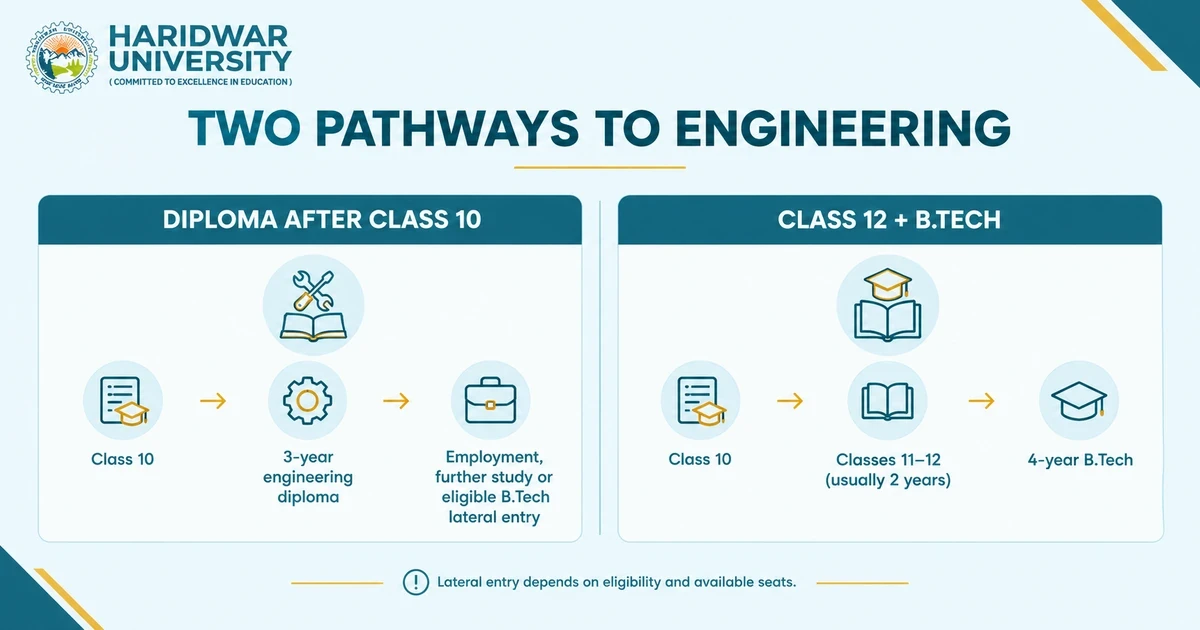
Students often compare a polytechnic diploma directly with a B.Tech degree as if both begin at the identical academic milestone. In reality, Class 10 graduates must choose between two distinct sequences:
Route 1: Polytechnic Diploma After Class 10
Class 10 → 3-Year Polytechnic Diploma → Technical Employment OR Lateral Entry into 2nd Year B.Tech (3 Years).
This vocational pathway immerses students directly into workshops, laboratories, and specialized branch subjects from age 15 or 16.
Route 2: Senior Secondary (11th & 12th) Followed by B.Tech
Class 10 → Classes 11 & 12 (PCM) → 4-Year B.Tech Degree.
This traditional route provides comprehensive theoretical grounding in higher physics, chemistry, and advanced calculus before selecting a specialized engineering discipline.
Notice an important reality: taking a diploma after Class 10 does not prevent you from earning a full engineering degree. Under AICTE regulations, eligible diploma holders can transition into a degree through B.Tech lateral entry directly into the second year.
2. Comparing Duration, Eligibility and Study Focus
While duration offers a helpful numerical comparison, the core differences lie in pedagogical focus, curriculum depth, and learning style:
| Factor | Diploma After Class 10 | Class 12 Followed by B.Tech |
|---|---|---|
| Total Study Duration | 3 Years for Diploma (or 6 years total if pursuing lateral entry B.Tech) | 6 Years total (2 years Class 11–12 + 4 years B.Tech) |
| Entry Requirement | Class 10 board exam passing certificate (State Polytechnic entrance / Merit) | Class 12 with Physics & Mathematics (JEE Main / CUET / State Entrance) |
| Pedagogical Focus | Hands-on workshop skills, laboratory testing, equipment operation, applied techniques | Rigorous scientific theory, mathematical modeling, system design, architectural research |
| Branch Specialisation | Chosen immediately at age 15/16 during polytechnic admission | Chosen at age 17/18 with greater academic maturity |
| Career Progression | Technician, Junior Engineer (JE), site supervisor, or lateral entry to B.Tech | Graduate Engineer Trainee (GET), Systems Engineer, Project Lead, Master's / MS |
According to the All India Council for Technical Education (AICTE) Approval Process Handbook, engineering and technology diploma programmes follow a standardized 3-year semester structure. Students with clear mechanical, electrical, or software interests often thrive in the experiential environment of polytechnics.
3. Understanding the Route from Diploma to B.Tech (Lateral Entry)
A common misconception among parents is that selecting a polytechnic diploma permanently closes the door to an engineering degree. Under AICTE's lateral-entry guidelines, polytechnic diploma graduates can directly enter the 3rd semester (2nd year) of an approved B.Tech programme.
Key Lateral-Entry Rules to Keep in Mind
- Quota Restrictions: AICTE permits institutions to allocate up to 10% of their sanctioned intake exclusively for lateral entry admissions.
- Minimum Marks: Candidates must score a minimum aggregate percentage (typically 45% for general category, 40% for reserved categories) in their 3-year diploma.
- Branch Mapping: Your diploma branch must align with the intended degree discipline (e.g., Mechanical Diploma to B.Tech Mechanical Engineering, or Computer Diploma to B.Tech CSE).
Both pathways require exactly 6 years after Class 10 to obtain a B.Tech degree: either 3 years diploma + 3 years B.Tech, or 2 years Class 11–12 + 4 years B.Tech. The difference lies purely in the curriculum sequence.
4. Comparing Education Costs and Time to Employment
Financial planning must consider the complete educational cycle rather than comparing single-year fee slips. When budgeting, factor in tuition, hostel living, examination fees, and books.
Financial Considerations Between Pathways
- Diploma as a Standalone Terminal Qualification: A 3-year polytechnic course at a government or private institute represents a lower initial capital outlay, allowing graduates to begin earning as junior technicians by age 18 or 19.
- Diploma + Lateral Entry B.Tech: When a diploma holder continues into B.Tech, the family funds 3 years of polytechnic fees followed by 3 years of engineering degree tuition. For a transparent analysis of degree expenses, review our breakdown of B.Tech fees in India.
- Direct 12th + B.Tech: Families fund standard secondary school fees for Classes 11 and 12, followed by 4 years of university degree fees. University merit concessions can significantly lower this total; check Haridwar University scholarship slabs for up to 80% tuition waivers.
5. Career Opportunities and Salary Expectations
A technical diploma qualifies candidates for practical operational roles, whereas a B.Tech degree opens pathways to design engineering, software architecture, and management cadres:
Computer Science & IT
Diploma holders often start in hardware support, network maintenance, or junior web testing. B.Tech CSE graduates enter core software engineering, cloud computing, and AI/ML development. Explore specialized tracks in our guide to career options after B.Tech CSE.
Mechanical Engineering
Polytechnic holders work as maintenance supervisors, CNC machine operators, and quality inspectors. Degree holders lead CAD/CAM design, robotics development, and thermal systems engineering. Read our detailed review of career options after B.Tech Mechanical.
Civil Engineering
Diploma holders oversee site execution, surveying, and material quality on construction projects. B.Tech Civil engineers lead structural design, BIM modeling, and project management. Learn more in our overview of career options after B.Tech Civil Engineering.
Government Recruitment: In public sector recruitment (such as SSC JE, State PWD, and Railway RRB), Junior Engineer posts accept both 3-year diploma holders and degree holders. However, Assistant Engineer (AE) and executive engineering positions generally mandate a full B.Tech degree.
6. Choosing the Path That Fits Your Goals
Use this practical decision matrix to select the pathway aligned with your profile:
Choose a Diploma After 10th If:
- You have a defined passion for mechanical, civil, electrical, or computer hardware fields.
- You prefer hands-on machinery, workshop fabrication, and applied laboratory learning over pure theory.
- You wish to qualify for technical employment earlier (by age 18–19).
- You plan to leverage lateral entry into B.Tech while potentially financing your own higher studies.
Choose Class 12 + B.Tech If:
- You want more time to discover your scientific strengths before locking in an engineering branch.
- You aim to compete in national entrance exams like JEE Main, JEE Advanced, or CUET.
- Your primary goal is a comprehensive 4-year engineering degree with direct corporate campus placements.
- You intend to pursue postgraduate research, MS degrees abroad, or an MBA directly after graduation.
7. Frequently Asked Questions (FAQs)
Is a polytechnic diploma after 10th better than 12th for engineering?
Neither route is universally superior. A diploma provides earlier practical exposure and workshop skills. The 12th-plus-B.Tech route offers broader academic preparation and direct eligibility for premier engineering entrances. Choose based on your learning style and career timeframe.
How many years does an engineering diploma take after Class 10?
In India, an AICTE-approved polytechnic diploma typically requires 3 years (6 semesters) of full-time study following Class 10.
Can I join B.Tech directly after completing a polytechnic diploma?
Yes. Under AICTE lateral-entry regulations, diploma holders with qualifying marks can enter directly into the 2nd year (3rd semester) of a B.Tech degree, completing their engineering graduation in 3 additional years.
Is a polytechnic diploma holder legally considered an engineer?
Diploma holders possess technical certifications qualifying them for Junior Engineer (JE), technician, and site supervisor designations. However, senior engineering cadres and licensed professional engineer titles require a four-year B.Tech / B.E. degree.
Which engineering diploma branch commands the highest starting salary?
Compensation depends on regional industrial demand and practical technical aptitude. Computer engineering, mechanical tooling, and electrical power systems consistently offer strong junior opportunities across private manufacturing and IT sectors.
Can I qualify for government jobs after a polytechnic diploma?
Yes. Major public bodies including Indian Railways (RRB JE), State Electricity Boards, PWDs, and central PSUs regularly recruit polytechnic diploma holders for technical supervisor and Junior Engineer positions.
Does taking a diploma reduce the overall cost of obtaining a B.Tech degree?
Not necessarily. While diploma tuition is often lower than private senior-secondary schooling, continuing into B.Tech involves 3 additional years of degree tuition and living expenses. Calculate the cumulative 6-year expense across both pathways before deciding.
8. Choose the Route That Keeps Your Engineering Goals Within Reach
Choosing between an engineering diploma after Class 10 and the Class 12-plus-B.Tech pathway is ultimately about aligning your learning preferences with your long-term career ambition. A motivated student can achieve engineering excellence through either route.
Investigate approved institutions, examine curriculum syllabuses, verify lateral-entry recognition, and budget for the complete multi-year commitment. The most effective route is the one that fuels your curiosity and keeps your engineering aspirations firmly within reach.
Shape Your Engineering Future at Haridwar University
Offering direct B.Tech admissions, streamlined lateral-entry programmes, modern research labs, and merit scholarships for aspiring engineers.