

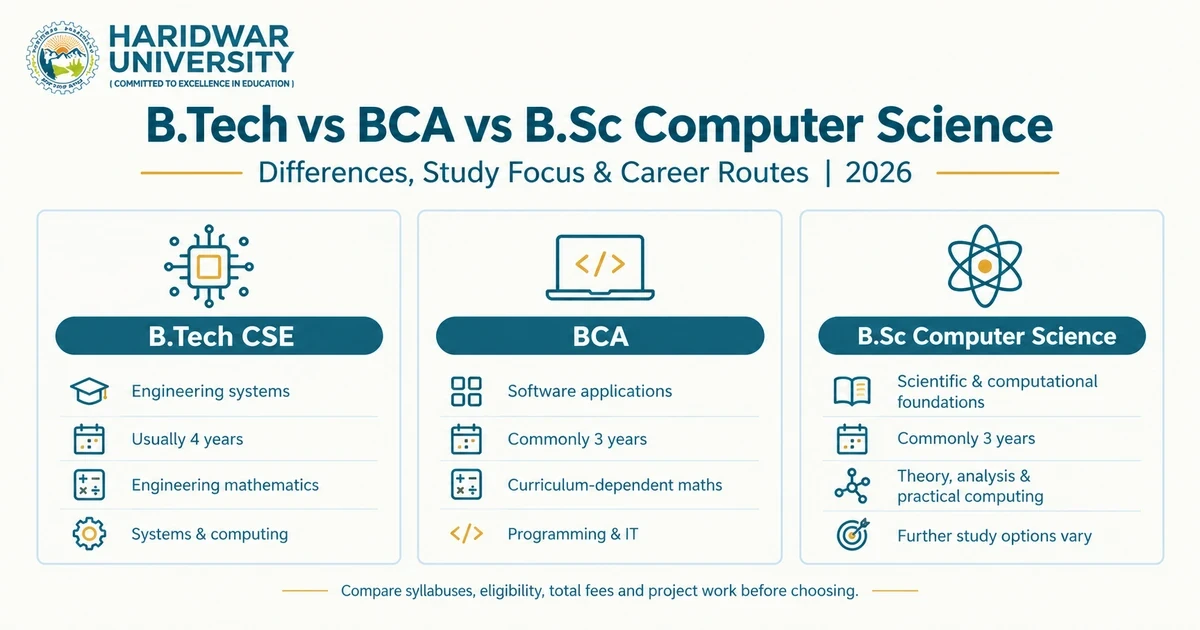
Choosing a computing degree after Class 12 is not simply a question of which course promises the highest starting salary. B.Tech vs BCA vs B.Sc Computer Science represents three distinct educational approaches to technology: engineering complex systems, building software applications, or exploring computational principles through a scientific curriculum.
The choice directly impacts what you study across semesters, how much engineering mathematics you encounter, the time and financial investment required, and which postgraduate routes remain open. Rather than asking which degree is universally "best", ask: What type of technical work do you want to master, and which degree provides that foundational pathway? This guide compares all three programmes within the Indian education landscape, evaluating syllabuses, eligibility, costs, placement scope, and career trajectories.
Table of Contents
1. The Main Differences Between the Three Degrees
B.Tech Computer Science and Engineering (CSE) is a professional engineering degree that bridges hardware architecture, operating systems, and advanced software engineering. BCA (Bachelor of Computer Applications) is an application-focused degree tailored directly toward modern software programming, web development, and database administration. B.Sc Computer Science approaches computing through computational logic, discrete mathematics, and scientific analytical principles.
| Factor | B.Tech CSE | BCA | B.Sc Computer Science |
|---|---|---|---|
| Typical Duration | 4 Years (8 Semesters) | 3 Years (6 Semesters) | 3 Years (6 Semesters) |
| Core Emphasis | Engineering systems, hardware-software integration, system design | Software programming, application development, IT solutions | Computational theory, scientific algorithms, data analysis |
| Mathematics Depth | Extensive engineering calculus, linear algebra, differential equations | Application-oriented business & computational mathematics | Discrete mathematics, probability, mathematical statistics |
| Hardware Coverage | Comprehensive (microprocessors, digital logic, VLSI basics) | Minimal (focused primarily on software layers) | Moderate (computer architecture & logic design) |
| Next Steps / Higher Studies | Direct IT placement, M.Tech, MS abroad, MBA | Software jobs, MCA, M.Sc IT, MBA | Tech entry jobs, M.Sc Computer Science/Data Science, MCA |
| Ideal Candidate | Students seeking a deep engineering & systems foundation | Students wanting early entry into software programming & web/mobile dev | Students interested in data analytics, research, and scientific computing |
For a direct university-level comparison between the two four-year and three-year computing courses, read our detailed analysis on BCA vs B.Tech CSE at Haridwar University.
2. Curriculum, Mathematics and Learning Style
A degree's title offers only a surface summary. The actual semester-wise coursework, laboratory hours, and project milestones define the learning experience:
B.Tech CSE: Engineering Breadth & Systems Rigour
Undergraduates study core algorithms, operating systems, compiler design, computer networks, and database architecture alongside physics, electronic circuits, and advanced engineering mathematics. This rigorous foundation prepares engineers to build low-latency systems, infrastructure frameworks, and distributed enterprise platforms.
BCA: Application-Led Computing & Rapid Development
The BCA curriculum prioritizes software tools, modern programming paradigms (Python, Java, C++, JavaScript), full-stack web architectures, mobile application development, and cloud computing. The learning style is intensely hands-on, focusing on functional software delivery.
B.Sc Computer Science: Theory, Analytics & Data Science
Programmes like B.Sc CS (Data Science) emphasise mathematical modeling, probability theory, statistics, data visualization, and machine learning algorithms. Students develop strong conceptual acumen for research, computational analysis, and algorithmic design.
The Mathematics Myth: Do not choose BCA solely thinking it requires zero mathematics, nor avoid B.Tech merely out of fear. All computing demands logical problem-solving and boolean analysis. Instead, assess whether you prefer pure mathematical engineering derivations or practical software implementations.
3. Eligibility, Duration and Total Cost
Eligibility criteria and financial requirements form critical practical filters for families planning higher education:
Eligibility Standards in India
- B.Tech CSE: 10+2 with Physics, Mathematics, and Chemistry/Computer Science, typically requiring entrance exams like JEE Main or institutional tests. For full stream options, consult our guide to courses after 12th science.
- BCA: 10+2 from any recognized stream (Science, Commerce, or Arts with Mathematics/Computer Applications preference depending on the institution).
- B.Sc Computer Science: 10+2 with Mathematics and Science subjects, admitting students with analytical and quantitative backgrounds.
Always check official university prospectuses for specific minimum percentage criteria and subject requirements before applying.
Tuition Investment: Haridwar University Example (2026–27)
Under Haridwar University's published Fees and Scholarships schedule, investment structures reflect degree length and lab intensity:
- B.Tech Hons. CSE (4 Years): ₹1,32,000 for Year 1; ₹1,15,000/year for Years 2–4 (Total ~₹4.77 Lakh).
- BCA (3 Years): ₹82,000 for Year 1; ₹65,000/year for Years 2–3 (Total ~₹2.12 Lakh).
- B.Sc CS Data Science (3 Years): ₹72,000 for Year 1; ₹55,000/year for Years 2–3.
Because BCA and B.Sc programmes are completed in 3 years, students save one full year of tuition and campus hostel living costs, enabling earlier workforce entry or investment into specialized master's training like MCA.
4. Salary and Career Scope in India
No degree title alone guarantees a high compensation package. Remuneration in the tech industry is fundamentally determined by demonstrated problem-solving skills, algorithm fluency, project portfolios, open-source contributions, and practical internships.
| Degree | Common Entry-Level Roles | Career Growth Trajectories |
|---|---|---|
| B.Tech CSE | Software Development Engineer (SDE-1), Systems Engineer, Cloud Associate, Cybersecurity Analyst | Lead Architect, AI/ML Engineering Lead, DevOps Director, CTO, Technical Product Manager |
| BCA | Web Developer, Frontend/Backend Engineer, Mobile App Developer, Software QA Tester, Database Admin | Full-Stack Architect, Cloud Solutions Specialist, Technical Team Lead (especially after MCA/certifications) |
| B.Sc Computer Science | Junior Data Analyst, Research Assistant, Python Programmer, Business Intelligence Trainee | Data Scientist, Machine Learning Researcher, Quantitative Analyst, Big Data Engineer |
To explore placement roadmaps for software applications, review our guide to career options after BCA. While top engineering graduates from premier campuses command elevated starting packages, skilled BCA and B.Sc developers frequently out-earn peers within 3 to 4 years of real-world industry experience.
5. Choosing a Degree Based on Your Goals
Select your undergraduate computing degree using this structured framework:
Choose B.Tech CSE if:
You completed 10+2 with Physics and Mathematics, enjoy hardware-software integration, are prepared for extensive engineering mathematics, and target product engineering firms or global graduate studies (MS/M.Tech).
Choose BCA if:
You want to build practical software, web platforms, and mobile apps immediately, prefer an application-first curriculum, seek a 3-year graduation timeline, or plan to pursue an MCA later for specialized mastery.
Choose B.Sc Computer Science if:
You are fascinated by computational theory, statistical analysis, artificial intelligence, and data science, and aspire toward research analytics, academic roles, or M.Sc specializations.
6. Frequently Asked Questions (FAQs)
Is B.Tech CSE automatically better than BCA?
Neither degree is inherently superior. B.Tech CSE provides broader engineering coverage and hardware integration over 4 years. BCA delivers concentrated, application-oriented software skills over 3 years. The ideal fit depends on your stream eligibility and career goals.
Which is better, BCA or B.Sc Computer Science?
BCA suits candidates aiming for software engineering, web application development, and direct corporate IT roles. B.Sc Computer Science benefits students focused on mathematical algorithms, data science, and analytical research.
Can BCA graduates secure software developer jobs in top IT companies?
Yes. Major IT service companies (TCS, Wipro, Infosys, Cognizant) and modern software startups hire BCA graduates for full-stack, frontend, and backend engineering roles based on coding assessments and project portfolios.
Is mathematics mandatory in Class 12 for BCA and B.Sc Computer Science?
B.Tech CSE mandates Physics and Mathematics in Class 12. For BCA and B.Sc CS, eligibility varies across institutions; many universities admit candidates from Commerce or Arts with basic computer subjects. Always verify specific institutional prospectuses.
Which degree is most suitable for Artificial Intelligence and Data Science?
All three paths offer entry into AI/ML. B.Tech CSE offers deep algorithmic system design; specialized B.Sc Data Science provides robust statistical foundations; and specialized BCA focuses on applying pre-built AI models in enterprise software.
Is a Master's degree (MCA or M.Tech) mandatory after graduating?
No. Many graduates start working immediately after their bachelor's degree. Pursuing an MCA or M.Sc later can accelerate promotions into technical architecture and management roles.
Can a BCA graduate pursue M.Tech in India or abroad?
In India, M.Tech generally requires a 4-year degree (B.Tech) or a master's degree (MCA / M.Sc). BCA graduates typically complete an MCA first to become eligible for GATE and M.Tech programmes.
7. Choose the Degree That Fits Your Career Direction
Your decision between B.Tech CSE, BCA, and B.Sc Computer Science should balance your academic strengths, subject preferences, and career timeframe. Carefully compare practical lab facilities, industry certifications, internship frameworks, and fee structures across prospective universities.
Remember: a degree opens doors, but your personal dedication to coding, project building, and continuous learning determines your long-term success in the technology sector.
Launch Your Technology Career at Haridwar University
Explore industry-aligned computing degrees in B.Tech CSE, BCA, and B.Sc Data Science featuring advanced AI labs, corporate mentorship, and outstanding placement support.