

Choosing between B.Pharm and D.Pharm is not simply a decision between a degree and a diploma. It is a fundamental choice about how long you are prepared to study, how much you can comfortably invest financially, and which professional roles you wish to pursue across India’s rapidly expanding pharmaceutical and healthcare sectors.
I encourage prospective students to look far beyond marketing claims that one course is universally “better.” A D.Pharm qualification provides a shorter, practical entry route into community dispensing and hospital pharmacy, while a B.Pharm offers four rigorous years of undergraduate study, opening pathways into pharmaceutical manufacturing, research, regulatory affairs, and clinical trials. Neither credential guarantees an effortless career; success depends on institutional recognition, practical competencies, and deliberate planning.
Table of Contents
- Understanding the Difference Between B.Pharm and D.Pharm
- Comparing Course Duration and Eligibility Requirements
- Understanding Fees and the Total Cost of Study
- Comparing Salary Expectations and Career Scope
- Choosing Between B.Pharm and D.Pharm for Long-Term Goals
- Planning Further Study After D.Pharm or B.Pharm
- Frequently Asked Questions (FAQs)
- Make Your Decision Around the Career You Want
1. Understanding the Difference Between B.Pharm and D.Pharm
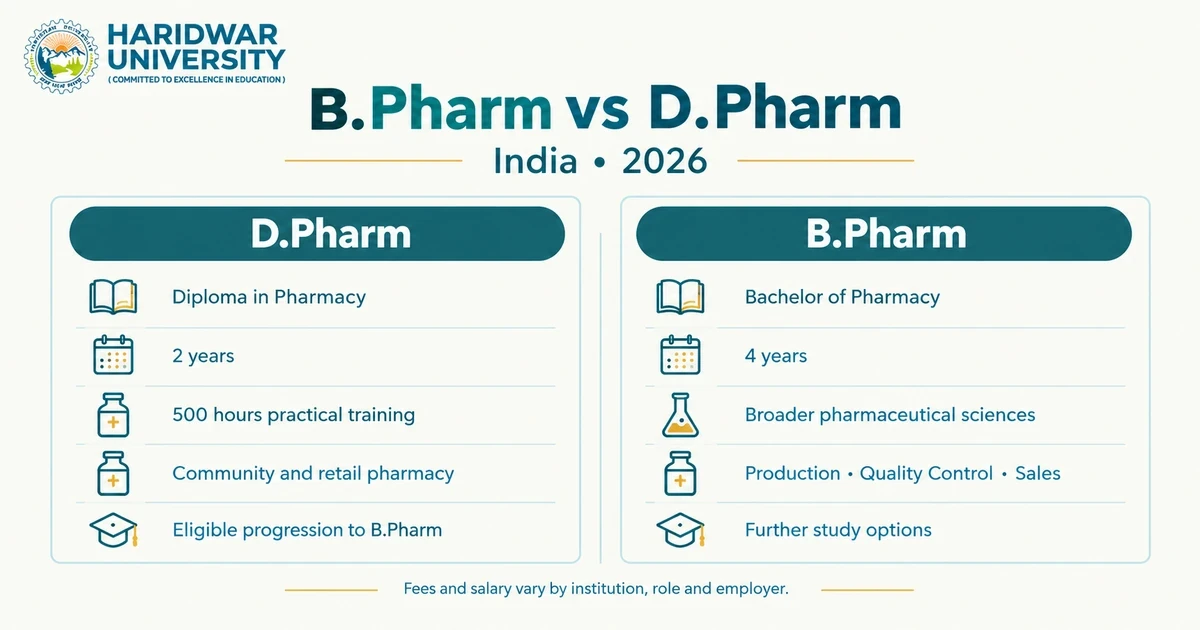
B.Pharm stands for Bachelor of Pharmacy, a comprehensive four-year professional undergraduate degree. D.Pharm stands for Diploma in Pharmacy, a focused two-year foundational programme structured around pharmaceutical chemistry, pharmaceutics, and dispensing practice.
Both qualifications fall under the statutory jurisdiction of the Pharmacy Council of India (PCI). The PCI establishes curriculum standards, laboratory norms, and the mandatory training required to register as a registered pharmacist with State Pharmacy Councils across India.
| Comparison Factor | D.Pharm (Diploma in Pharmacy) | B.Pharm (Bachelor of Pharmacy) |
|---|---|---|
| Qualification Level | Undergraduate Diploma (Polytechnic/Technical) | Full Professional Bachelor’s Degree |
| Academic Duration | 2 Academic Years (Annual Examination system) | 4 Academic Years (8 Semesters) |
| Practical Training | Mandatory 500 hours over not less than 3 months in approved hospitals/dispensaries | Continuous semester laboratory practicals, industrial training, and final-year project work |
| Core Curriculum Focus | Pharmacy foundations, patient dispensing, community pharmacy management, toxicology | Advanced medicinal chemistry, pharmacology, novel drug delivery, AI integration, pharmacovigilance, industrial operations |
| Primary Career Roles | Community retail pharmacist, hospital pharmacist, wholesale distributor, medical representative | Production chemist, QA/QC analyst, drug inspector, clinical research associate, pharma regulatory affairs, higher R&D |
| Further Academic Pathways | Eligible for B.Pharm 2nd Year via Lateral Entry | Direct eligibility for M.Pharm, Pharm.D (Post-Baccalaureate), MBA Pharma, MS, Ph.D. |
This functional distinction matters immensely: B.Pharm and D.Pharm are not interchangeable credentials in corporate industrial manufacturing, regulatory oversight, or advanced academic contexts. Candidates must verify the exact qualification required for their target career rather than assuming equivalent employment scope.
2. Comparing Course Duration and Eligibility Requirements
While D.Pharm is often marketed as a “quick two-year course,” students must account for the full statutory timeline. Under the PCI Education Regulations, 2020, a diploma candidate cannot qualify for registration without completing 500 hours of practical training distributed over not less than three months in an approved government hospital or recognized pharmacy.
In contrast, the Bachelor of Pharmacy (B.Pharm) curriculum is structured over four academic years (eight semesters), incorporating university examinations, semester lab evaluations, continuous internal assessments, and industry internship rotations.
Standard Admission Eligibility Criteria
- Class 12 Qualifying Subjects: Successful completion of 10+2 with Physics and Chemistry as compulsory subjects, alongside either Mathematics or Biology (PCM/PCB).
- Minimum Marks: Typically a minimum aggregate of 45% to 50% in qualifying science subjects (with relaxations for reserved categories as prescribed by state/university guidelines).
- Alternative Science Pathways: Students evaluating broader medical and technological avenues should explore our detailed guide on courses after 12th science at Haridwar University to compare pharmacy against nursing, computer science, and engineering.
3 Details to Verify Before Enrolling in Any Pharmacy College
- PCI & AICTE Approval: Verify that the specific programme and intake capacity are officially sanctioned on the PCI institutional portal.
- Current Admission Regulations: Confirm whether entry requires national/state entrance scores or direct merit-based registration.
- Hospital Tie-ups for Practical Training: Ensure the college maintains functional clinical MoUs to fulfill mandatory internship requirements without administrative delays.
3. Understanding Fees and the Total Cost of Study
There is no uniform fee structure across Indian pharmacy institutions. Government colleges offer heavily subsidized seats but with rigorous entrance cut-offs, while private institutions vary substantially depending on laboratory infrastructure, research amenities, and geographical location.
Because D.Pharm spans only two academic years, it substantially compresses total financial exposure—saving two complete years of tuition, hostel rent, food, and daily commuting. However, students should compute the true total cost of education rather than comparing base tuition alone:
The Complete Cost Checklist to Budget
- Annual Tuition & Admission Charges: Calculated over 2 years (D.Pharm) vs. 4 years (B.Pharm).
- Institutional Overheads: Examination fees, enrollment charges, uniform fees, and library deposits.
- Laboratory Consumables & Records: Chemical charges, dissection/glassware deposits, aprons, and practical logbooks.
- Living & Hostel Expenses: On-campus hostel or private rental boarding, dining fees, and travel expenses.
- Practical Training Logistics: Commuting and living expenses during the 500-hour hospital posting.
As an institutional benchmark, Haridwar University publishes completely transparent, all-inclusive academic fee structures. In our updated Fees & Scholarships schedule, B.Pharm (with AI integration) is priced at ₹1,27,000 for Year 1 (inclusive of tuition, exam, admission, and uniform fees) and ₹1,10,000 for each subsequent year. Meanwhile, D.Pharm offers an economical two-year pathway. Substantial first-year merit scholarships (up to 80%) and a dedicated 25% girls’ scholarship further ease the financial investment.
Strategic takeaway: The cheapest course is not automatically the most economical if it does not lead to the career, license, or corporate role you envision.
4. Comparing Salary Expectations and Career Scope
A frequent online search is “B.Pharm vs D.Pharm salary”, expecting a simple fixed number. In real-world employment markets, compensation varies widely based on job designation, manufacturing hub (e.g., Baddi, Haridwar, Ahmedabad, Hyderabad), employer scale, technical expertise, and individual sales or analytical skills.
Verified Industry Compensation Benchmark
According to verified industry employment metrics reported on AmbitionBox’s Pharmacist Salary in India index (drawing upon 23,300+ submitted employee profiles), annual compensation for practicing pharmacists spans from ₹1.2 Lakh to ₹4.1 Lakh per annum, with an industry median hovering around ₹2.4 Lakh. These figures represent aggregate pharmacist roles rather than starting guarantees, and earnings scale significantly as professionals progress into clinical management, industrial quality assurance, or proprietary chemist entrepreneurship.
Career Directions After D.Pharm
- Retail & Community Pharmacist: Dispensing medications, managing patient prescription compliance, and inventory control.
- Hospital Pharmacist: Operating hospital outpatient/inpatient dispensaries in public and private medical facilities.
- Pharmacy Entrepreneurship: Establishing and operating your own retail chemist outlet or wholesale pharmaceutical agency upon registration.
- Medical Sales Representative: Promoting pharmaceutical formulations directly to healthcare practitioners.
Read our in-depth analysis on career options after D.Pharm: jobs, chemist store & B.Pharm pathways.
Career Directions After B.Pharm
- Formulation & Manufacturing: Production chemist roles in tablet compression, injectables, and sterile formulation plants.
- Quality Control (QC) & Quality Assurance (QA): Analytical testing using HPLC/GC, documentation audits, and cGMP compliance.
- Government Sector Roles: Eligibility for competitive Drug Inspector examinations and Government Medical Store Depot (GMSD) officers.
- Clinical Research & Pharmacovigilance: Clinical trial monitoring, adverse drug reaction reporting, and medical copywriting.
- Regulatory Affairs: Compiling drug master files (DMF) and dossiers for global FDA and EMA market clearances.
Explore our complete overview on career after B.Pharm: pharma, research & industry paths.
5. Choosing Between B.Pharm and D.Pharm for Long-Term Goals
Rather than picking a course because someone told you it is faster or more prestigious, work backwards from your five-year professional vision.
When D.Pharm Is Your Best Choice
D.Pharm is ideal if your immediate objective is to obtain a pharmacist license, establish a retail or wholesale pharmacy business, or begin earning within two to three years. It allows you to enter the workforce quickly while retaining the option to pursue a degree later through lateral entry.
When B.Pharm Is Your Best Choice
B.Pharm is the required route if you aspire to work in corporate pharmaceutical manufacturing, analytical laboratories, clinical research organizations, or multinational pharma firms. It is also the prerequisite if you plan to pursue postgraduate degrees such as M.Pharm, an MBA in pharmaceutical management, or study abroad.
5 Reflective Questions to Finalize Your Decision
- Financial Runway: Can you and your family comfortably fund four full years of undergraduate study, or is an early entry into the profession preferable?
- Target Role: Does your intended career require a bachelor’s degree (e.g., manufacturing QA/QC, clinical research, drug inspector)?
- Entrepreneurship vs. Industry: Is your dream to own a local community pharmacy or work within multinational corporate pharma plants?
- Higher Studies Vision: Do you anticipate pursuing an M.Pharm, MS abroad, or a Ph.D. in drug discovery in the future?
- Institutional Accreditation: Does the institution hold valid PCI approval and modern laboratory infrastructure for the chosen program?
6. Planning Further Study After D.Pharm or B.Pharm
Graduating with a D.Pharm does not permanently restrict your academic growth. The regulatory framework in India provides an established bridge: B.Pharm Lateral Entry.
The D.Pharm to B.Pharm Lateral Entry Route
Under PCI guidelines, candidates who have successfully passed their two-year D.Pharm from a PCI-approved institution with the requisite minimum marks are eligible for direct admission into the second year (third semester) of B.Pharm.
Haridwar University provides an active, approved pathway through our dedicated B.Pharm Lateral Entry with AI programme. This allows diploma holders to complete their full bachelor’s degree in three additional years without repeating foundational first-year coursework.
Postgraduate Horizons After B.Pharm
For B.Pharm graduates, academic progression unlocks advanced specializations:
- M.Pharm: Specializations in Pharmaceutics, Pharmacology, Pharmaceutical Chemistry, or Pharmacognosy. Explore M.Pharm in Pharmaceutics at Haridwar University.
- Pharm.D (Post-Baccalaureate): A 3-year clinical doctorate focusing on hospital ward rounds, clinical pharmacokinetics, and patient care.
- MBA in Pharmaceutical Management: Bridging scientific product knowledge with healthcare brand marketing, supply chain logistics, and business development.
- Overseas Master’s & Research: Pursuing MS degrees in drug delivery, biotechnology, or toxicology across European and American universities.
7. Frequently Asked Questions (FAQs)
1. Which is better, B.Pharm or D.Pharm?
Neither course is universally better. D.Pharm is a shorter, 2-year diploma focused on retail and hospital dispensing, while B.Pharm is a comprehensive 4-year undergraduate degree required for industrial production, drug testing, QA/QC, and postgraduate research. Your career ambition, financial budget, and timeline should dictate your decision.
2. Is D.Pharm enough to become a registered pharmacist in India?
Yes. D.Pharm is recognized by the Pharmacy Council of India (PCI) as the minimum statutory qualification to register as a pharmacist with State Pharmacy Councils, provided you successfully complete the 500-hour hospital practical training requirement and fulfill state council guidelines.
3. Is B.Pharm four years and D.Pharm two years?
Yes. Under PCI regulations, B.Pharm consists of four academic years divided into eight semesters. D.Pharm consists of two academic years of classroom and laboratory instruction, followed by mandatory hospital practical training.
4. Which course offers better salary prospects?
While entry-level starting salaries in basic retail dispensing can be comparable between D.Pharm and B.Pharm graduates, B.Pharm offers far higher long-term earnings potential because degree holders can advance into industrial formulation, quality assurance leadership, product management, and regulatory compliance roles.
5. Can I study B.Pharm after completing D.Pharm?
Yes. Under PCI regulations, diploma holders can enter B.Pharm directly into the second year (third semester) through lateral entry, completing their bachelor’s degree in three additional years.
6. Are D.Pharm and Pharm.D the same qualification?
No, they are completely different. D.Pharm is a 2-year undergraduate diploma, whereas Pharm.D (Doctor of Pharmacy) is a 6-year clinical doctorate program designed for hospital clinical pharmacy, patient ward counseling, and pharmacotherapy management.
7. Should I choose a college based solely on low fees?
No. You must verify that the institution holds valid Pharmacy Council of India (PCI) approval, offers well-equipped modern pharmaceutics and chemistry labs, has hospital tie-ups for practical training, and supports placement drives. A lower tuition fee at an unapproved college can jeopardize your pharmacist registration entirely.
8. Make Your Decision Around the Career You Want
The choice between B.Pharm and D.Pharm becomes crystal clear when you view your entire educational journey as an investment in professional capability. If you need a shorter path to launch a chemist business or work as a registered hospital pharmacist, D.Pharm is a smart, direct vehicle. If your ambitions encompass pharmaceutical manufacturing, analytical QC, drug research, or global healthcare careers, B.Pharm provides the indispensable four-year foundation.
Calculate your overall investment, verify approved institutional credentials, and commit to the academic pathway that aligns with your long-term professional aspirations.
Shape Your Pharmaceutical Career at Haridwar University
PCI-approved programmes, industry-driven curriculum with AI integration, state-of-the-art pharmaceutics laboratories, and dedicated placement support. Take the next step toward your pharmacy career today.