

How to Get a Job at a University in India: Roles Beyond Teaching
Mr. Prajwal Chaudhary
Head, Training & Placement, Haridwar University
When students hear "university career", they often picture a lecture hall, a chalkboard and an academic teaching timetable. But a modern university is also an extensive operating organisation that must admit thousands of applicants, conduct fair examinations, run sophisticated laboratories, maintain digital networks, coordinate corporate placement drives, manage financial budgets, support sponsored research, and keep hundreds of mission-critical processes running smoothly every single day.
If you are searching for how to get a job at a university in India, the first step is to stop treating "university job" as a single profession. The right path depends on the operational function you want to enter, your educational background, practical proficiencies, and the specific recruitment regulations governing each vacancy.
The sheer scale of higher education illustrates why professional university careers extend far beyond teaching. The Ministry of Education’s AISHE 2021–22 report recorded 1,168 universities or university-level institutions, 45,473 colleges, and 12,002 standalone institutions across India. This massive institutional network represents a dynamic, competitive employment market for skilled professionals across administrative, technical, and student-support services.
Table of Contents
- 1. University Careers Extend Beyond Teaching
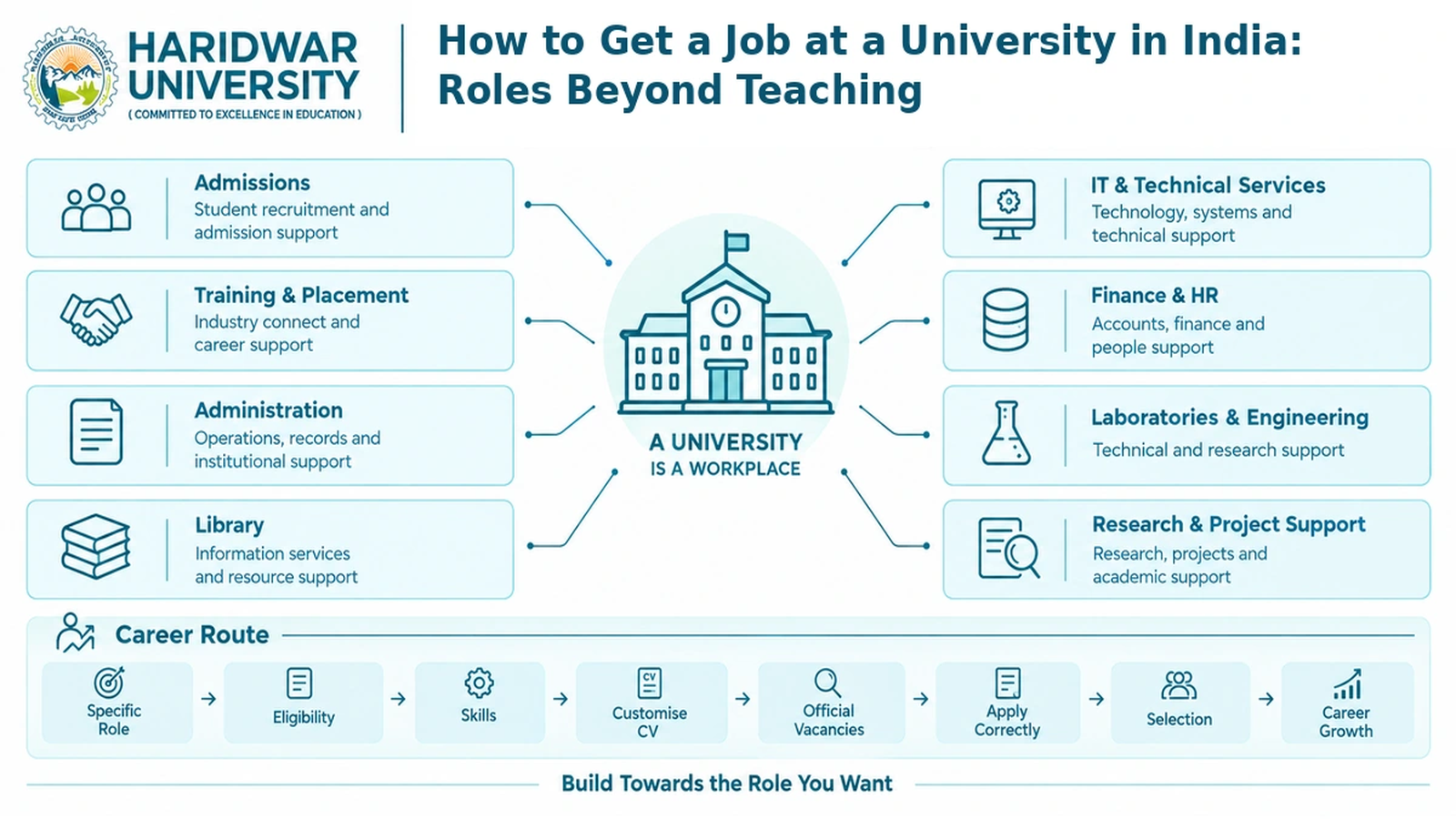
- 2. The Main Non-Teaching Roles Available at Universities
- 3. Qualifications for Different University Jobs
- 4. Skills That Help Candidates Get University Jobs
- 5. How Freshers Can Start a University Career
- 6. Government and Private University Recruitment Follow Different Paths
- 7. How to Find and Apply for University Jobs
- 8. How to Prepare for University Job Selection
- 9. How University Careers Can Progress Over Time
- 10. Haridwar University’s Approach to Career and Professional Development
- 11. Frequently Asked Questions (FAQs)
- 12. Build Towards the Role You Want
1. University Careers Extend Beyond Teaching
I often advise jobseekers to view a higher education institution as a complete professional ecosystem rather than solely as an academic classroom venue.
Public institutions clearly demonstrate this operational breadth. For example, Nalanda University's jobs and internships page frequently advertises non-teaching openings spanning library systems, general administration, campus engineering, information technology, finance, corporate outreach, and technical labs. Similarly, the Central University of Punjab's non-teaching recruitment portal regularly issues notifications for administrative, technical, and professional staff cadres alongside traditional faculty advertisements.
| Career Area | Examples of Work & Functions |
|---|---|
| Academic & Teaching | Assistant Professors, Associate Professors, Professors, Research Scholars, Teaching Assistants |
| Professional & Support Functions | Admissions & Outreach, Training & Placements, Registrar Office, IT & Systems, Finance & Accounts, HR, Library Science, Laboratory Maintenance, Examination Section, Student Welfare |
2. The Main Non-Teaching Roles Available at Universities
While organizational designations vary across state universities, central universities, and private institutions, several operational divisions recruit consistently:
- Admissions & Outreach: Admission counsellors and outreach executives communicate with prospective students and parents, manage inbound CRM inquiries, verify eligibility certificates, and coordinate admission documentation.
- Training & Placement (T&P): Placement managers and executive coordinators interface directly with corporate HR heads, schedule on-campus recruitment drives, verify student eligibility criteria, and run pre-placement training modules.
- General Administration & Academic Affairs: Administrative officers, executive assistants, section officers, and registrar-office staff oversee scheduling, academic council documentation, university correspondence, and institutional statutory records.
- Library & Knowledge Services: Professional librarians, deputy librarians, and library assistants manage digital databases (IEEE, Scopus, JSTOR), maintain cataloguing software, and archive institutional dissertations.
- IT, Software & Networking: Network administrators, ERP managers, database engineers, and technical support specialists manage university servers, Wi-Fi infrastructure, student LMS portals, and examination security.
- Finance, Accounts & Audit: Finance officers, accountants, and auditors oversee tuition collection, university payroll, vendor procurement, research grant disbursals, and annual statutory audits.
- Laboratories & Engineering Operations: Technical officers, lab superintendents, junior engineers, and facility managers maintain research instrumentation, mechanical workshops, and campus electrical infrastructure.
- Sponsored Research & Project Administration: Research project managers, grant administrators, and technical research associates support externally funded projects (DST, DBT, SERB, ICSSR).
3. Qualifications for Different University Jobs
There is no single universal qualification for a university staff job. Entry requirements align directly with the specific operational function:
- Administrative & Admissions Roles: Often open to any bachelor's graduate (BA, B.Sc, B.Com, BBA) possessing strong written and spoken English, digital literacy, and organizational poise.
- Finance & Accounts: Requires a B.Com, M.Com, MBA (Finance), or semi-qualified CA/ICWA with expertise in Tally, GST, and enterprise financial compliance.
- IT & Technical Infrastructure: Typically demands a BCA, B.Tech (CSE/IT), MCA, or diploma in computer engineering with networking certifications (CCNA, Linux administration).
- Library Services: Statutorily mandates Bachelor of Library & Information Science (B.Lib.I.Sc) or Master of Library & Information Science (M.Lib.I.Sc).
- Corporate Relations & Placements: Favours MBA graduates with specialization in HR, Marketing, or corporate communications.
Core Principle: Never prepare blindly for a generic "university post". Always download the official recruitment notification and cross-check age limits, minimum percentage benchmarks, experience requirements, and statutory selection criteria.
4. Skills That Help Candidates Get University Jobs
An academic degree proves eligibility; demonstrable functional competence secures the appointment. Hiring committees in higher education prioritize candidates who exhibit:
- Advanced Spreadsheet Competence: Mastery over Excel (VLOOKUP/XLOOKUP, pivot tables, data validation, conditional formatting) is universally expected across admissions, exams, finance, and placement desks.
- Institutional Correspondence: Formal writing ability—drafting clear memos, official emails, meeting minutes, and regulatory letters without grammatical ambiguity.
- Software & CRM Comfort: Experience operating enterprise resource planning (ERP) suites, student management software, or lead-management CRMs.
- Professional Discretion & Integrity: University staff handle confidential transcripts, sensitive financial data, examination questions, and personal student records. Absolute confidentiality is non-negotiable.
For practical strategies on formatting your career profile and showcasing projects effectively, read our comprehensive Resume & LinkedIn Guide for Placement Preparation.
5. How Freshers Can Start a University Career
Fresh graduates often wonder if universities hire candidates without prior experience. While senior administrative posts demand seasoned professionals, dozens of entry-level positions actively recruit freshers:
- Junior Admission Executive / Student Counsellor
- Administrative Assistant / Junior Office Assistant
- Helpdesk & Technical Support Executive
- Junior Placement Coordinator
- Library Trainee / Assistant
- Lab Assistant / Workshop Technician
To explore diverse academic degree options across engineering, computing, management, commerce, and agricultural sciences that build these foundational capabilities, review Haridwar University's comprehensive academic programmes directory.
6. Government and Private University Recruitment Follow Different Paths
Understanding the institutional structure dictates your search methodology:
Central & State Government Universities
Operate on formal, notification-driven timelines. Vacancies are published in the Employment News and official portals, followed by online application submissions, written screening tests (testing general awareness, reasoning, English, and domain knowledge), skill/typing tests, and document verification.
State Private & Deemed Universities
Follow corporate recruitment cycles. Openings are posted on institutional career pages, LinkedIn, and education job portals. Selection emphasizes immediate functional suitability, personal interviews, practical skill evaluations (such as an on-the-spot Excel assignment), and institutional cultural fit.
7. How to Find and Apply for University Jobs
Follow this disciplined weekly application routine:
- Curate a Target Institution List: Bookmark the official careers pages of 15 to 20 universities within your desired geographic region and check them weekly.
- Leverage National Public Portals: Monitor the Ministry of Labour & Employment’s National Career Service (NCS) and its dedicated Government Job Vacancies Portal, which aggregates recruitment notices across educational bodies.
- Tailor Every Resume: Match your resume keywords precisely to the job description—highlighting counselling metrics for admissions, technical stacks for IT, or ledger reconciliation for accounts.
- Guard Against Employment Fraud: NCS explicitly cautions jobseekers that genuine public recruitment is transparent and merit-based. Never pay fees to unauthorized intermediaries promising guaranteed university appointments.
8. How to Prepare for University Job Selection
Interviewers in university hiring look for composure, institutional familiarity, and problem-solving readiness. Prepare structured evidence from your past experience:
- A complex coordination problem you resolved under tight time constraints.
- An instance where you handled a frustrated student, parent, or client professionally.
- A spreadsheet or digital workflow you streamlined to eliminate manual errors.
- How you maintain accountability when managing high volumes of administrative documentation.
For insights into how modern recruitment panels structure aptitude assessments and interview rounds, explore our detailed guide on Placement Drives and Recruitment Processes at Haridwar University.
9. How University Careers Can Progress Over Time
A university staff career offers tangible professional growth. An entry-level coordinator or executive can advance along defined organizational ladders:
Administration: Junior Assistant → Executive Assistant → Section Officer → Assistant Registrar → Deputy Registrar → Registrar
Training & Placements: Placement Coordinator → Assistant Manager (Corporate Relations) → Manager → Head of Training & Placements → Director (Corporate Interface)
IT Services: Systems Support Engineer → Network Administrator → ERP Manager → Chief Information / Technology Officer (CIO/CTO)
Higher education also affords valuable cross-functional exposure. Admissions teams collaborate with marketing and digital media; placement professionals interface with multinational corporate leaders; IT teams interact with every operational department. This multidisciplinary grounding builds versatile managerial capital.
10. Haridwar University’s Approach to Career and Professional Development
At Haridwar University, we treat career readiness as a continuous educational journey. Our centralized Training & Placement Office drives comprehensive skill enhancements, industry workshops, internship placements, and corporate partnerships across all colleges.
For students seeking structured business, operational, and management qualifications, the Roorkee College of Business Studies offers cutting-edge BBA with AI and MBA with AI programmes featuring specializations in Finance, Human Resources, and Marketing.
11. Frequently Asked Questions (FAQs)
Can I get a university job without becoming a teacher?
Yes. Universities recruit for admissions, administration, placements, IT, libraries, finance, HR, laboratories, examinations, research support and other functions.
What qualifications are needed for university staff jobs?
It depends entirely on the vacancy. Some positions may accept a graduate qualification, while technical, library, finance, engineering or senior administrative roles can require specialised qualifications or experience.
Are university jobs available for freshers?
Some vacancies can be suitable for fresh graduates, but eligibility must be checked against the individual recruitment notice. Experience requirements vary considerably between roles.
Where should I look for university jobs in India?
Start with official university careers or recruitment pages. For government opportunities, also monitor the National Career Service and relevant institutional recruitment portals.
Are government university jobs different from private university jobs?
Yes. Recruitment procedures, eligibility conditions, employment terms and selection stages can differ. Government and Central University recruitment generally follows formal advertised procedures, while private institutions can use institution-specific processes.
What skills are useful for non-teaching university jobs?
Communication, documentation, digital literacy, spreadsheets, teamwork and role-specific technical skills are broadly useful. The priority skills depend on the position.
How can I improve my chances of getting a university job?
Choose a specific function, study its eligibility requirements, build relevant skills, gain practical experience where possible, maintain a targeted CV and monitor official vacancies consistently.
12. Build Towards the Role You Want
A university is far more than its lecture rooms. Behind every seamless admission cycle, error-free examination schedule, successful campus placement season, and funded research initiative is a committed network of professionals ensuring the institution thrives.
Instead of searching generically for "a university job", identify the specific functional domain where your talents align, acquire the prerequisite software and communication proficiencies, and prepare deliberately. A long-term career in higher education management provides stability, multidisciplinary impact, and continuous personal growth.
Build Future-Ready Career Skills at Haridwar University
Prepare for leadership across corporate, technical, and institutional management careers. Explore multidisciplinary undergraduate and postgraduate programmes backed by robust corporate placement mentorship.