

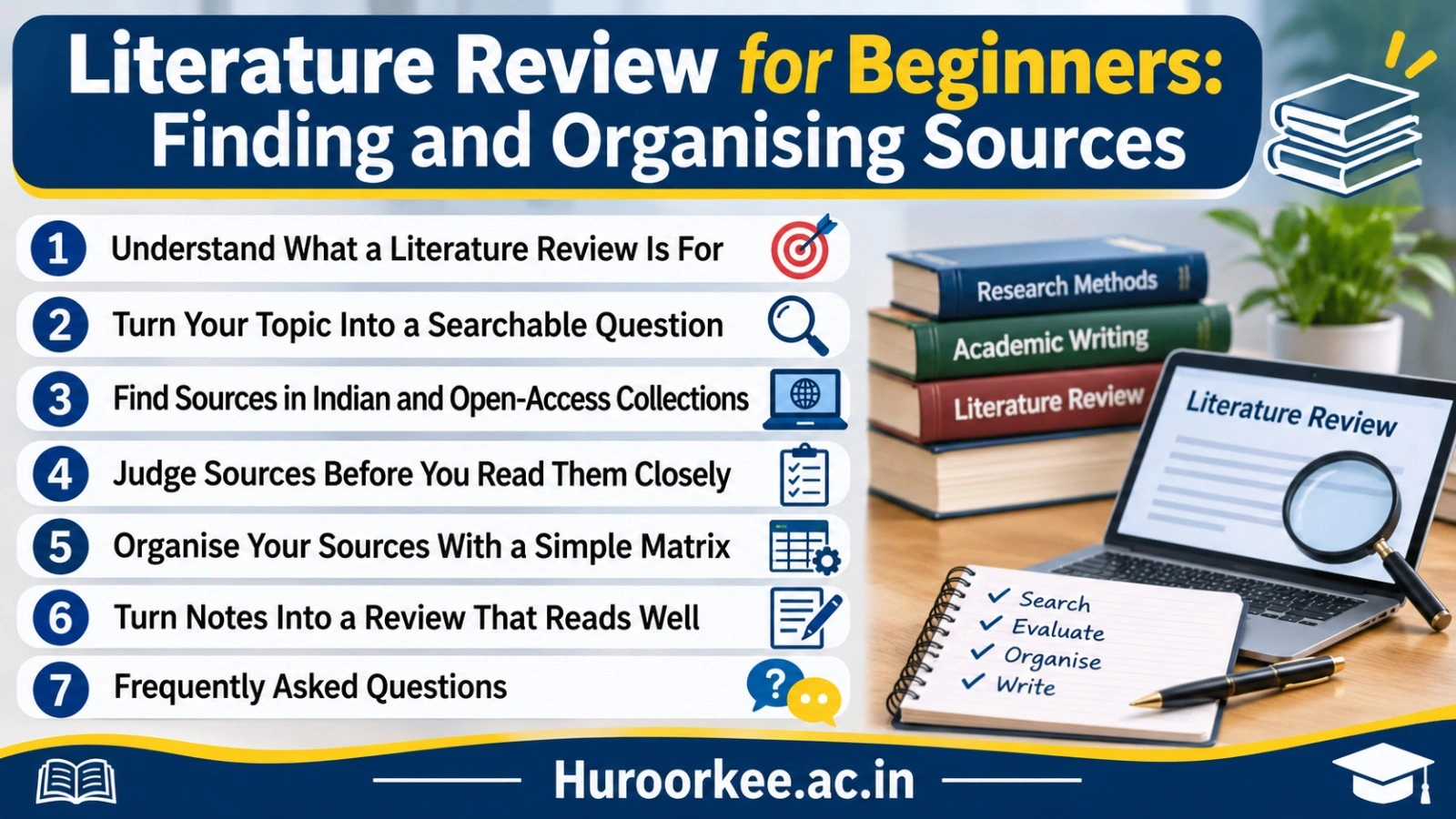
Literature Review for Beginners: Finding and Organising Sources
Dr. Rajiv Mahajan
Vice-Chancellor, Haridwar University
Most beginners open ten tabs, download twenty PDFs and then stall, because nobody explained what a review is meant to produce. This guide to Literature Review for Beginners: Finding and Organising Sources works the other way round. It starts with the question, moves to where Indian students can actually find papers, and ends with a simple system for keeping track of what you read.
The table below shows the main places to look, and the sections after it show how to use them effectively in your academic research.
| Where to Look | What You Get | Keep in Mind |
|---|---|---|
| Shodhganga | Open-access Indian doctoral theses and dissertations, with simple, advanced and subject search | Treat a thesis as a reliable map to the original peer-reviewed papers it cites |
| e-ShodhSindhu & ONOS | Full-text peer-reviewed journals and e-books through institutional subscriptions | Access depends on your university network and library credentials; consult your librarian |
| National Digital Library of India (NDLI) | Unified search across hundreds of Indian academic repositories, institutional archives and books | Accuracy and metadata rest with each content provider; always verify original publishers |
| Library Catalogue & Supervisor's List | Core reference textbooks, dissertations and foundational papers your department trusts | An excellent starting foundation, but rarely covers recent state-of-the-art debates |
Table of Contents
- 1. Understand What a Literature Review Is For
- 2. Turn Your Topic Into a Searchable Question
- 3. Find Sources in Indian and Open-Access Collections
- 4. Judge Sources Before You Read Them Closely
- 5. Organise Your Sources With a Simple Matrix
- 6. Turn Notes Into a Review That Reads Well
- 7. Frequently Asked Questions (FAQs)
1. Understand What a Literature Review Is For
More than a summary
A literature review maps what is already known about your topic, where researchers disagree, and what remains unanswered. It is not an unconnected sequence of paper summaries. The test is simple: by the end, a reader should see clearly why your own research question deserves to be investigated.
Know your reader
A thesis chapter, a project report and a journal paper all use reviews differently. Ask your supervisor how long yours should be, how far back in time to look, and which citation style is expected. Five minutes of questions now can save weeks of rewriting later, because a review built for the wrong purpose rarely survives the first round of departmental feedback.
2. Turn Your Topic Into a Searchable Question
"Renewable energy" is a broad subject. "How do hybrid solar-wind systems perform in sub-Himalayan hill regions?" is a precise question you can search and evaluate.
Pick keywords and synonyms
List the two or three core concepts in your research question, then write down synonyms, related terms and variant spellings for each. "Organisation" and "organization" return different datasets in certain databases, and an older paper may use a phrase that the engineering field has since replaced.
Set limits before you search
Decide on a publication date range, subject area, and language, and document them systematically. A search with no limits returns overwhelming noise, while an unrecorded search cannot be replicated or reported in your methodology. Note down each database queried, each search string used, and the date you ran it.
Test your search early
Run an initial test search and scan the top 20 results. If half of them are off-topic, your keywords are too broad; if almost nothing appears, your search query is too narrow or Boolean operators are over-constraining. Adjust, re-run, and keep the exact query that returns papers you genuinely need to read.
3. Find Sources in Indian and Open-Access Collections
You do not need expensive individual subscriptions for most of what a beginner needs. Start with three nationwide academic resources, then add whatever your university library provides.
- Shodhganga: Shodhganga, maintained by the INFLIBNET Centre, is a vast digital repository of Indian electronic doctoral theses and dissertations, freely accessible to all researchers. Read the literature review chapter of a recent thesis in your exact discipline, then follow its bibliography back to original foundational papers.
- e-ShodhSindhu and One Nation One Subscription (ONOS): e-ShodhSindhu is a Ministry of Education consortium initiative executed by INFLIBNET that provides eligible universities access to top international e-journals and e-books. Under the One Nation One Subscription framework, access is routed through your institution's IP or proxy credentials, so consult your campus librarian to configure remote or on-campus access.
- National Digital Library of India (NDLI): The National Digital Library of India, sponsored by the Ministry of Education and developed at IIT Kharagpur, offers single-window search across educational resources, institutional repositories and datasets. Keep in mind that reliability rests with the contributing source, so always trace findings to primary publishers.
- Your university library: Schedule ten minutes with your institutional librarian early in your semester. Inquire which commercial database packages your university subscribes to (IEEE Xplore, ScienceDirect, SpringerLink), whether off-campus VPN/Shibboleth access is configured, and how inter-library loans work for papers behind paywalls.
4. Judge Sources Before You Read Them Closely
Reading every single paper from start to finish is physically impossible, so learn to triage. Read the abstract first, followed by the introduction problem statement, the conclusion findings, and the charts or tables. Only then decide whether the manuscript earns your full attention.
Ask four quick triage questions:
- Who wrote it and where was it published? Is the venue a recognized, indexed peer-reviewed journal or an unvetted predatory source?
- How recent is it? Does the field still accept its findings, or have subsequent studies refined or overturned them?
- Does it directly address your research question? Does the methodology or theoretical framework align with your inquiry?
- Does it show its methodology and data clearly? Can you trace how the conclusions were reached, or are key variables obscured?
Follow the citation trail
Once you identify a high-quality seminal paper, mine its reference list for earlier foundational discoveries and use citation indexing tools to see which recent researchers have cited it. This citation snowballing approach is faster and more focused than endless random keyword searches.
Read with your question in hand
Take notes against your research problem, not against the paper in isolation. For every paper you retain, write three concise sentences: one on what it contributes, one on what limitation it exhibits, and one on how it links to your overall inquiry. Those three sentences will form the building blocks of your synthesis.
5. Organise Your Sources With a Simple Matrix
Beginners usually lose time during synthesis, not during the initial search. A literature matrix solves this bottlenecks permanently. Build a spreadsheet table with one row per study and consistent columns:
| Source Reference | Research Aim | Methodology & Tools | Key Findings | Limitations & Fit |
|---|---|---|---|---|
| Author, Year, Title, Journal/DOI | The specific hypothesis or technical question the paper addressed | Sample size, simulation model, experimental apparatus, datasets used | Empirical quantitative results stated in your own paraphrased words | Methodological weaknesses, boundary constraints, and how it directly informs your study |
| Example: Sharma & Patel (2024), Solar Energy | Evaluating bifacial PV cell degradation under Himalayan temperature swings | Field sensor array, 12-month data logging, MATLAB thermal modeling | Bifacial gain was 14.2% higher in snowy conditions; micro-cracks increased at -5°C | Did not test wind-load vibration; provides direct justification for structural analysis chapter |
Cite as you go
Record the complete bibliographic reference the moment you add a source, in the exact style specified by your university department. Trying to reconstruct lost citations and volume numbers at midnight before a deadline is how integrity errors happen. HU's guide to citing sources in APA, IEEE and MLA illustrates each formatting style side by side.
Name files and folders sensibly
Save downloaded PDFs with a standardized naming convention: Author-Year-Keyword.pdf. Group them into directories by thematic area rather than one massive downloads folder. While tools like Zotero or Mendeley are excellent, a structured spreadsheet matrix and clean folder hierarchy give beginners an immediate, clutter-free start.
6. Turn Notes Into a Review That Reads Well
Organise by theme, not by paper
Group your matrix rows into distinct analytical themes: theoretical models, experimental methods, conflicting results, and prevailing consensus. Build each section of your draft around an argument or insight, drawing upon multiple citations to support each point. A paragraph that simply summarizes one study after another in chronological sequence is an annotated bibliography; a paragraph that synthesizes and compares their perspectives is a true literature review.
End with the research gap
Close your review by stating what current research has left unsettled and precisely how your project fills that void. If your identified gap is merely "nobody has carried out this calculation in our district", probe deeper to identify fundamental methodological, performance or environmental variables that demand fresh empirical validation.
Where this applies at HU
At Haridwar University, postgraduate and doctoral scholars engage in rigorous literature reviews across advanced engineering, computing, pharmacy and sciences. On the official fees and scholarships page, M.Tech. CSE is listed at ₹78,000 (first year) and ₹70,000 (subsequent years), MCA with AI at ₹92,000 and ₹75,000, and Ph.D. programmes at ₹1,00,000 and ₹90,000. GATE-qualified M.Tech. scholars are eligible for AICTE stipends.
Should any administrative or digital access hurdle arise during your research workflow, the Student Care Centre in each academic block ensures active support. That is the true heart of conducting a literature review: a sharp question, reliable repositories, a systematic matrix, and a synthesized critique that sets the stage for genuine discovery.
7. Frequently Asked Questions (FAQs)
1. Where should a beginner start with a literature review?
Start with a narrow research question, then search Shodhganga, your library's subscribed databases and NDLI, logging findings into a structured matrix. That gives your reading direction from day one.
2. How many sources do I need for a literature review?
There is no arbitrary target count. Departmental guidelines define the scope: an undergraduate major project may require 20 to 30 quality papers, while a master's dissertation or doctoral thesis requires comprehensive domain coverage.
3. How far back in time should I search?
Most technical disciplines prioritize papers published within the last 3 to 5 years to capture recent advancements, while retaining foundational papers from earlier decades that established core principles.
4. Is a literature review the same as an article summary?
No. An article summary examines an individual paper in isolation. A literature review synthesizes multiple studies by comparing approaches, identifying consensus, highlighting contradictions, and pinpointing research gaps.
5. Can I cite Shodhganga theses as academic sources?
Yes, Shodhganga theses are public scholarly works. However, they serve best as roadmaps to primary journal articles; cite the thesis directly only when referencing its specific empirical contribution or methodology.
6. What if my college does not subscribe to expensive journals?
Take advantage of national consortia like e-ShodhSindhu and One Nation One Subscription, utilize open-access repositories like NDLI, arXiv, and ResearchGate, and consult your librarian for inter-library sharing.
7. Should I use generative AI to summarize research papers?
Check institutional policies first. AI tools frequently hallucinate citations, misread technical boundary conditions, or introduce fabricated findings. Always verify claims against primary published texts.
8. How do I avoid plagiarism in my review?
Paraphrase arguments in your own authentic words, cite every concept or statistic to its original author, and maintain matrix notes in your own words so that uncredited phrasing never enters your final draft.
9. How long does it take to complete a good literature review?
It depends on the scope of the project. A standard chapter often takes 3 to 6 weeks of iterative searching, critical appraisal, matrix mapping and thematic drafting. Starting early prevents end-of-semester rushes.
Pursue Advanced Research & Innovation at Haridwar University
Join a community of scholars with high-performance computing clusters, doctoral research fellowships, access to national library consortia, and expert supervisor mentorship. Admissions open for the 2027-28 academic session.