


A B.Pharm degree gives a student the foundation of pharmaceutical sciences. An M.Pharm is where that foundation becomes more specialised. In my experience, the students who benefit most from postgraduate pharmacy study are not necessarily those looking for another qualification. They are the ones who already know that they want to go deeper into formulation, drug delivery, research, quality systems or pharmaceutical development.
At Haridwar University, the currently listed postgraduate pharmacy programme is M.Pharm Pharmaceutics, a two-year programme focused on advanced formulation science, drug delivery and pharmaceutical manufacturing.
Table of Contents
- What is M.Pharm?
- M.Pharm specializations: what does HU offer?
- M.Pharm Pharmaceutics curriculum at Haridwar University
- M.Pharm eligibility and admission at HU
- M.Pharm fees at Haridwar University
- M.Pharm career options after graduation
- M.Pharm salary in India in 2026
- Can M.Pharm lead to a PhD?
- Who should choose M.Pharm Pharmaceutics?
- FAQs
- M.Pharm at HU: the practical takeaway
1. What is M.Pharm?
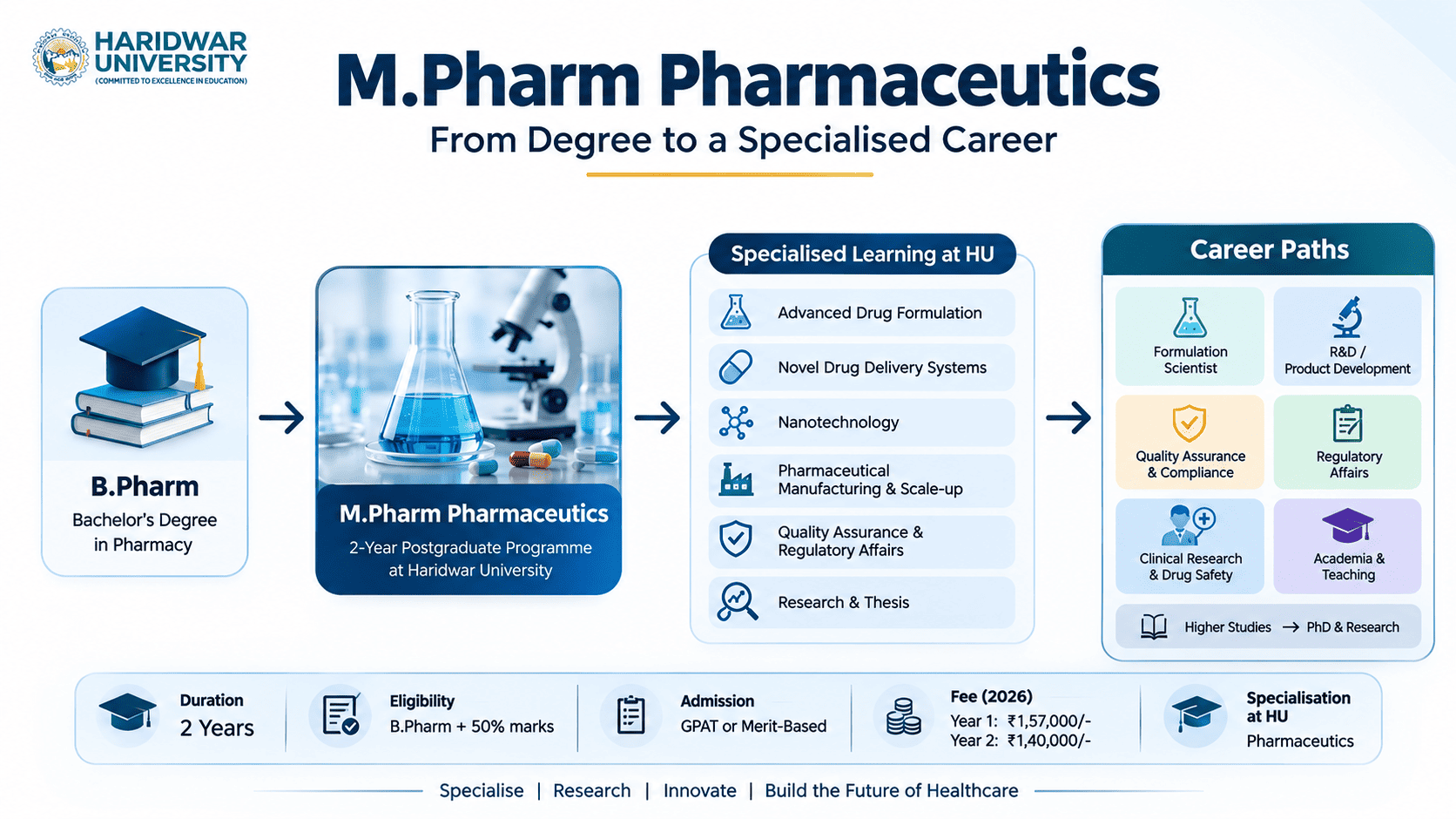
M.Pharm, or Master of Pharmacy, is a postgraduate pharmacy qualification designed to develop advanced knowledge beyond the B.Pharm level. A two-year PG programme normally runs across four semesters. HU's academic guidelines specify that two-year postgraduate programmes comprise four semesters.
At HU, the Pharmaceutics programme places particular emphasis on:
- Advanced drug formulation
- Novel drug delivery systems
- Nanotechnology
- Biopharmaceutics and pharmacokinetics
- Pharmaceutical manufacturing and scale-up
- Quality assurance and regulatory affairs
- Industrial pharmacy
- Research in formulation and drug delivery
- Thesis-based research
The programme therefore combines classroom learning with laboratory work and research rather than treating postgraduate study as an extension of undergraduate theory.
2. M.Pharm specializations: what does HU offer?
There is an important distinction here. M.Pharm as a qualification can be studied in several specialisations across Indian universities, including areas such as Pharmaceutics, Pharmacology, Pharmaceutical Chemistry and Quality Assurance.
Haridwar University's current programme listing, however, specifically lists M.Pharm Pharmaceutics. I would not describe Pharmacology, Pharmaceutical Chemistry or Quality Assurance as separate M.Pharm programmes at HU unless the university publishes those programmes as current offerings.
That makes the Pharmaceutics pathway particularly relevant for students interested in formulation, drug delivery, manufacturing processes and pharmaceutical product development.
3. M.Pharm Pharmaceutics curriculum at Haridwar University
The curriculum starts with broad pharmaceutical and biomedical subjects before moving into more specialised pharmaceutics work.
| Semester | Selected subjects / focus |
|---|---|
| Semester 1 | Pharmaceutics, Pharmaceutical Chemistry, Pharmacognosy, Human Anatomy & Physiology, Social Pharmacy, including laboratory work |
| Semester 2 | Pharmacology, Community Pharmacy & Management, Biochemistry & Clinical Pathology, Pharmacotherapeutics, Hospital & Clinical Pharmacy, Pharmacy Law & Ethics, including laboratory work |
| Advanced focus | Molecular Pharmaceutics, Nano Technology and Targeted Drug Delivery Systems, Advanced Biopharmaceutics & Pharmacokinetics, Computer Aided Drug Delivery System, Cosmetic and Cosmeceuticals |
| Research component | Thesis-based research and work in drug formulation and drug delivery |
HU's examination documentation confirms subjects such as Molecular Pharmaceutics, Nano Technology and Targeted Drug Delivery Systems, Advanced Biopharmaceutics & Pharmacokinetics, Computer Aided Drug Delivery System, and Cosmetic and Cosmeceuticals in the M.Pharm Pharmaceutics programme.
What stands out to me is the progression from pharmaceutical fundamentals to drug-delivery technologies. That is useful for students who want their postgraduate work to lead towards formulation research rather than simply another general pharmacy qualification.
4. M.Pharm eligibility and admission at HU
The basic eligibility published by Haridwar University is straightforward:
| Requirement | HU requirement |
|---|---|
| Previous qualification | B.Pharm from a recognised institute |
| Minimum marks | 50% in B.Pharm or equivalent CGPA |
| Admission route | GPAT or merit-based admission |
| Programme duration | 2 years |
These requirements are published on HU's M.Pharm programme information and fee documentation.
For a student already holding B.Pharm, this means the decision is less about meeting another undergraduate-style eligibility test and more about choosing whether a specialised postgraduate route fits the intended career direction.
5. M.Pharm fees at Haridwar University
For the currently published fee structure, HU lists the following charges for M.Pharm Pharmaceutics:
| Fee component | Amount |
|---|---|
| 1st-year total | ₹1,57,000 |
| 2nd-year total | ₹1,40,000 |
HU states that the published charges include tuition, enrolment, admission, examination and uniform fees. Transportation is charged separately depending on availability and route.
Students should always verify the applicable fee structure for their admission session before making a payment, since university fees can be revised.
6. M.Pharm career options after graduation
I would divide the career possibilities into a few practical directions rather than presenting M.Pharm as a qualification that automatically leads to one job title.
| Career direction | Typical work |
|---|---|
| Formulation Scientist | Drug formulation, dosage forms, formulation optimisation and development |
| R&D | Product development, novel drug delivery and experimental research |
| Quality Assurance | Quality systems, documentation, compliance and manufacturing standards |
| Regulatory Affairs | Regulatory documentation, submissions and compliance |
| Clinical Research | Trial coordination, documentation, research operations and data processes |
| Academia | Teaching, research and progression towards doctoral study |
The Pharmaceutics curriculum at HU specifically connects formulation, novel drug delivery, manufacturing, quality assurance, regulatory affairs and research, making these areas natural career directions for students who build relevant skills during the programme.
7. M.Pharm salary in India in 2026
Salary should be treated as market information, not as a guaranteed outcome of an M.Pharm degree or a claim about Haridwar University graduates.
Recent employee-reported salary data illustrates the range. AmbitionBox's 2025 data places Formulation Scientist salaries in India at approximately ₹2.1 lakh to ₹11.3 lakh per year for employees with one to nine years of experience, based on 843 salaries.
For Regulatory Affairs Associates, the reported range is approximately ₹2.4 lakh to ₹8.4 lakh per year for less than one to six years of experience, based on more than 1,100 salaries.
Clinical research shows a similarly broad spread. AmbitionBox reports ₹2.1 lakh to ₹8.4 lakh per year for Clinical Research Associates with less than one to six years of experience, based on more than 2,700 salaries.
| Experience | Broad market picture |
|---|---|
| Fresher / early career | Often around ₹2–4 lakh annually depending on role and employer |
| Mid-career | Commonly moves into the ₹4–8 lakh range in several technical and research roles |
| Experienced / specialised | Can cross ₹8 lakh, with senior or specialised roles extending considerably higher |
These are market salary ranges, not HU-specific salary claims. Location, employer, technical skills, specialisation and previous experience can materially change compensation.
8. Can M.Pharm lead to a PhD?
Yes. For students who want to continue into academic or research careers, M.Pharm can form the postgraduate foundation for doctoral study.
Haridwar University's doctoral guidelines allow candidates with a two-year master's degree after a four-year bachelor's degree to seek PhD admission with at least 55% marks, subject to the applicable rules. The university's PhD process includes research coursework, an entrance route through HURET for applicable candidates, and an interview. Candidates qualifying national-level examinations such as UGC-NET/JRF, CSIR-NET/JRF and GPAT can receive exemption from the first-stage HURET written test under the university's published guidelines.
For a pharmacy graduate interested in research, therefore, the progression can be quite direct:
9. Who should choose M.Pharm Pharmaceutics?
I would recommend looking at M.Pharm through the lens of the work you want to do.
Choose the programme if you are interested in:
- Formulation and dosage-form development
- Drug delivery technologies
- Nanotechnology and targeted delivery
- Pharmaceutical manufacturing and scale-up
- Research and experimental work
- Quality and regulatory systems
- A future PhD or academic research career
If your objective is simply to add another qualification without a clear interest in specialised pharmaceutical work, the two-year investment deserves more careful consideration.
For students comparing undergraduate and postgraduate routes, our earlier guide on B.Pharm at Haridwar University and the article on Career After B.Pharm from Haridwar University provide useful context on the degree that leads into M.Pharm and the career directions available afterwards.
10. FAQs
1. What is the duration of the M.Pharm at Haridwar University?
M.Pharm Pharmaceutics is a two-year postgraduate programme.
2. Which M.Pharm specialisation is offered at Haridwar University?
HU currently lists M.Pharm Pharmaceutics, with emphasis on formulation science, drug delivery, nanotechnology and pharmaceutical development.
3. What is the eligibility for M.Pharm at HU?
Candidates need a B.Pharm degree from a recognised institute with at least 50% marks or equivalent CGPA.
4. Is GPAT required for M.Pharm admission at HU?
HU lists GPAT or merit-based admission as the admission route.
5. What subjects are covered in M.Pharm Pharmaceutics?
The programme covers areas including advanced pharmaceutics, drug delivery, pharmacokinetics, nanotechnology, pharmaceutical manufacturing and research.
6. What are the career options after M.Pharm Pharmaceutics?
Graduates can pursue roles in formulation, R&D, quality assurance, regulatory affairs, clinical research and academia, depending on their skills and experience.
7. Can I pursue a PhD after M.Pharm?
Yes. M.Pharm can provide a postgraduate pathway towards PhD and research or academic careers, subject to the eligibility and admission requirements of the institution.
8. What is the fee for M.Pharm at Haridwar University?
The currently published fee structure lists ₹1,57,000 for the first year and ₹1,40,000 for the second year.
11. M.Pharm at HU: the practical takeaway
For me, the strongest feature of the M.Pharm Pharmaceutics programme is its clear technical direction. It is not positioned as a generic postgraduate pharmacy course. The published curriculum moves towards formulation science, novel drug delivery, nanotechnology, pharmacokinetics, manufacturing and research.
Students considering the programme should therefore ask one practical question before applying: Do I want my next two years to make me more specialised in pharmaceutical development and research?
If the answer is yes, M.Pharm Pharmaceutics can be a logical next step after B.Pharm.
Interested in pursuing postgraduate pharmacy study?
Explore the full course overview, curriculum, and fee details for Haridwar University.
Explore M.Pharm Pharmaceutics at Haridwar University