

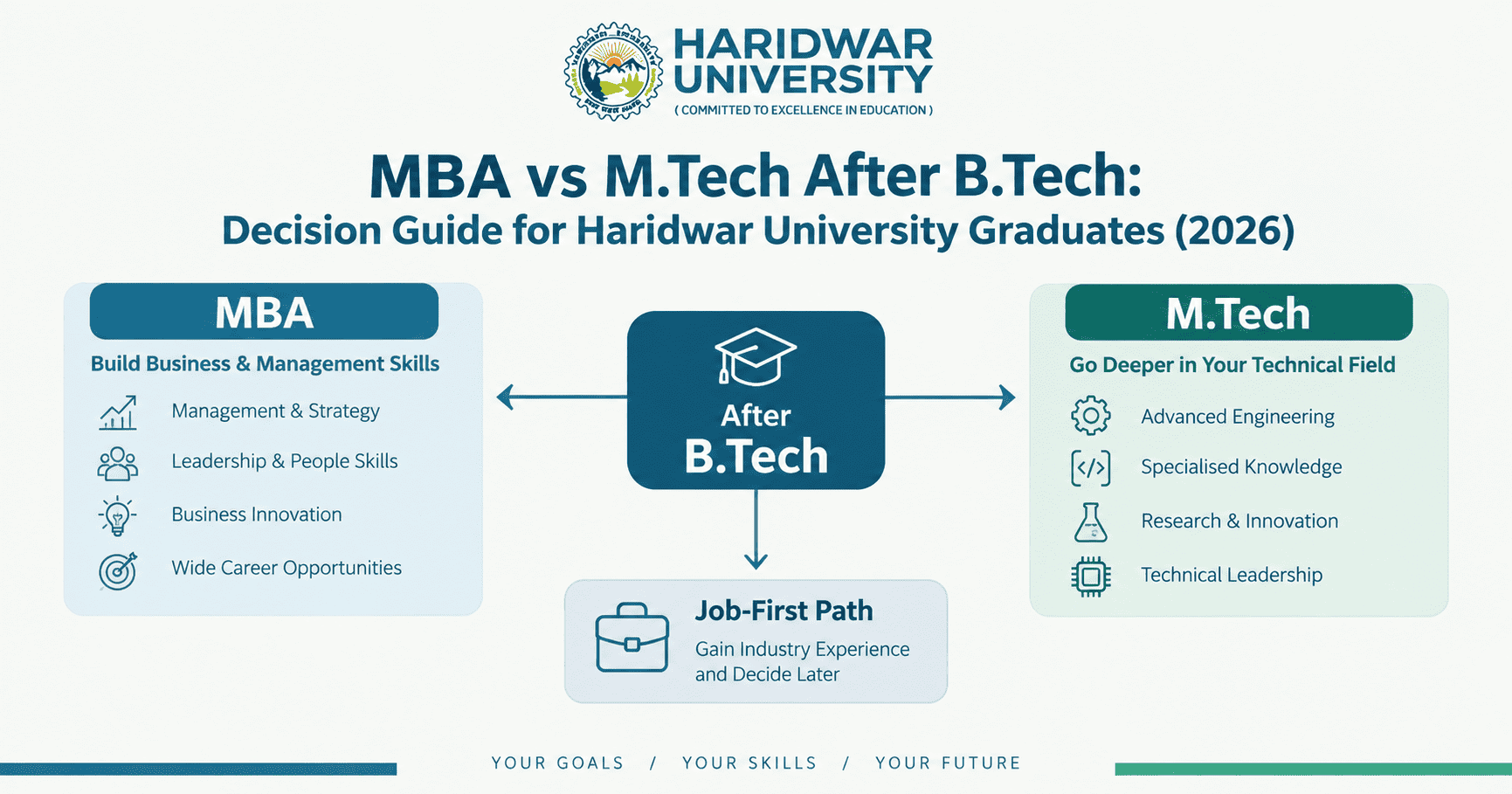
Finishing a B.Tech does not automatically mean that another degree is the next mandatory step. Some engineering graduates crave deeper technical expertise and specialized system design. Others discover a passion for business strategy, people leadership, market dynamics, or commercial decision-making. For them, MBA vs M.Tech after B.Tech is fundamentally a question about career direction, not about which qualification sounds more attractive on paper.
I recommend starting with the specific career you want to build, then comparing the curriculum, entrance route, fees, duration, and long-term work profile. A crucial third option also deserves serious attention: working first in industry and choosing postgraduate study after gaining hands-on professional clarity. That is why sound decisions must be anchored in daily work realities, not degree labels.
Table of Contents
- MBA Vs M.Tech After B.Tech: What Actually Changes
- Choose Based on Your Career Direction
- CAT and MAT vs GATE: Understanding the Entrance Routes
- MBA and M.Tech Cost and Duration at Haridwar University
- What Salary Data Shows Over the First Five Years
- When a Job-First Path May Make More Sense
- MBA and M.Tech Options at Haridwar University
- A Practical Decision Framework for B.Tech Graduates
- Frequently Asked Questions (FAQs)
- Explore PG Programmes at Haridwar University
MBA Vs M.Tech After B.Tech: What Actually Changes
The simplest distinction is this: an M.Tech generally takes an engineering graduate further into a technical discipline, while an MBA adds management and business capability to an existing technical background.
An M.Tech makes sense if you genuinely enjoy engineering subjects, advanced design, experimental research or specialized system development. An MBA makes sense if you are increasingly drawn to business decisions, market analysis, corporate finance, marketing campaigns, team leadership, operations or the commercialization of technology.
Neither route automatically guarantees a prestigious job title or an enormous salary. Your undergraduate branch, postgraduate specialization, institution, personal skills, internship experience, location and hiring employer all matter immensely.
Choose Based on Your Career Direction
I suggest asking yourself one practical question: “What do I want to spend most of my working day becoming better at?”
- If the answer is engineering analysis, technical design, prototyping, complex simulations, specialized hardware/software architecture or research, then M.Tech deserves your serious consideration.
- If you enjoy explaining ideas, pitching solutions, understanding consumer markets, organizing project teams, solving business roadblocks, or connecting tech products with commercial revenue, then an MBA is the more aligned direction.
This does not mean an engineering graduate cannot enter managerial roles without an MBA, nor does it mean an M.Tech graduate can never become a director or corporate executive. Careers are rarely linear. However, a postgraduate degree should deliberately accelerate the direction you want to pursue, rather than being chosen simply because it happens to be the next available academic credential.
For students pursuing management, Haridwar University currently offers an MBA with AI at the Roorkee College of Business Studies, offering specializations in Finance, HR, and Marketing. Its curriculum integrates core management principles with AI-enabled business applications and analytics. For technical progression, the Roorkee College of Engineering lists M.Tech specializations in ECE, Civil, Mechanical, and Electrical & Electronics Engineering, alongside Computer Science options.
CAT and MAT vs GATE: Understanding the Entrance Routes
The entrance pathways for management and technical postgraduate programmes reflect their differing academic goals:
Management Entrances: CAT & MAT
CAT (Common Admission Test): Major national entrance examination used by IIMs and premier business schools. Evaluates quantitative ability, data interpretation, logical reasoning, and verbal skills.
MAT (Management Aptitude Test): Conducted by AIMA four times a year. Open to graduates from any discipline (and final-year undergraduates). Features 150 questions across 5 sections to be completed in 120 minutes. Accepted by hundreds of participating business schools nationwide.
Technical Entrance: GATE
GATE (Graduate Aptitude Test in Engineering): The benchmark national examination for technical postgraduation. Evaluates in-depth undergraduate engineering mathematics, core branch concepts, and analytical problem-solving.
Students in their 3rd year or higher of an eligible undergraduate programme, as well as graduates, can appear. Scores are used for M.Tech admissions, PSU recruitments, and government research fellowships.
Haridwar University GATE Scholarship Provision: HU's published Fees & Scholarships page lists an AICTE scholarship for GATE-qualified M.Tech candidates. This is a financial scholarship incentive, not a rigid barrier indicating that GATE is mandatory for every HU M.Tech seat. Applicants should verify programme-specific criteria during admission counselling.
MBA and M.Tech Cost and Duration at Haridwar University
Financial commitment is one of the most critical aspects of post-graduation planning. Both MBA and M.Tech programmes span 2 academic years (4 semesters), but their fee structures differ based on laboratory facilities and pedagogical focus.
According to the university's published 2026–27 Fee Structure, the programme fee comparison is outlined below:
These figures represent published academic programme charges. Additional costs such as hostel accommodation, transport, examination fees, or personal living expenses should be budgeted separately.
What Salary Data Shows Over the First Five Years
Salary comparison is often where this debate becomes misleading. There is no honest single number for an “MBA salary” or an “M.Tech salary” because graduates enter completely different job functions and industrial sectors.
A more realistic approach is to examine market compensation ranges across representative roles. According to verified industry benchmark data from AmbitionBox across Indian corporate employers:
These figures reflect market compensation ranges for roles, not guaranteed entitlements of an MBA or M.Tech degree. As recruitment reports from Michael Page India emphasize, formal education is only one element of career trajectory; continuous skill acquisition, domain adaptability, and demonstrable on-the-job execution dictate long-term compensation growth. Choose your postgraduate degree for the day-to-day work it equips you to execute, not for an arbitrary headline package.
When a Job-First Path May Make More Sense
There is nothing incomplete or inferior about entering the workforce immediately after B.Tech. In fact, for many engineers, working first provides the highest return on investment.
I strongly encourage considering the job-first route if:
- You already have an active campus placement offer.
- You want to observe how industrial engineering and tech teams function before choosing a specialization.
- You feel uncertain whether your long-term inclination is managerial leadership or specialized engineering.
One or two years of professional industry experience exposes you to enterprise clients, product release deadlines, agile sprint management, and workplace expectations that cannot be replicated in a lecture hall. It also brings immense clarity to any subsequent master's degree: an engineer who discovers a flair for project coordination will approach an MBA with laser-focused purpose, while one who encounters complex technical roadblocks will select an M.Tech specialization with clear industry relevance.
MBA and M.Tech Options at Haridwar University
For students whose career roadmap calls for immediate or near-term postgraduate study, Haridwar University provides comprehensive academic pathways across both management and engineering disciplines:
Roorkee College of Business Studies
MBA with AI: Offers dual-specializations in Finance, Human Resources, and Marketing.
Combines fundamental management theory with practical exposure to artificial intelligence tools, predictive business analytics, live corporate internships, and managerial decision-making.
Roorkee College of Engineering
M.Tech Programmes: Offers advanced degrees across core engineering disciplines.
Specializations include Electronics & Communication Engineering (ECE), Civil Engineering (CE), Mechanical Engineering (ME), Electrical & Electronics Engineering (EEE), and Computer Science (CS/CSE) with state-of-the-art laboratory research infrastructure.
A Practical Decision Framework for B.Tech Graduates
Before submitting an application or paying entrance exam fees, write down your honest answers to these five diagnostic questions:
Frequently Asked Questions (FAQs)
Is MBA better than M.Tech after B.Tech?
Neither is universally superior. They cater to completely different career tracks: M.Tech deepens technical and research expertise in engineering, while an MBA equips engineers with business management, finance, marketing, and leadership capabilities.
Can a B.Tech graduate do an MBA?
Yes, absolutely. A B.Tech satisfies the bachelor's degree requirement for MBA entrance examinations including CAT and MAT, which welcome graduates from all academic disciplines.
Is GATE necessary for M.Tech?
GATE is the primary national examination for M.Tech admissions and AICTE postgraduate scholarships, but admission policies differ across universities. At Haridwar University, GATE qualification enables candidates to access AICTE scholarships, though direct institutional admissions may also be available based on undergraduate merit.
Which is more expensive at HU, MBA or M.Tech?
Based on HU's published 2026–27 fee structure, the MBA with AI programme costs ₹3.37 lakh over two years (₹1.77L in Yr 1, ₹1.60L in Yr 2), whereas M.Tech programmes total ₹1.48 lakh across two years (₹78K in Yr 1, ₹70K in Yr 2).
Should I work before doing an MBA or M.Tech?
Working for 1–2 years is highly advantageous if you want industry exposure or feel uncertain about your specialization. Practical experience helps you apply postgraduate concepts with contextual understanding, although it is not a mandatory prerequisite for all programmes.
Does an MBA guarantee a management job?
No degree can guarantee an executive title. Employment outcomes depend on individual analytical capability, interview performance, institutional networking, internships, and macroeconomic hiring demand.
Does M.Tech guarantee a higher salary?
No. While specialized engineering roles in VLSI, AI/ML, or structural engineering can offer attractive compensation, market salaries depend on domain mastery, corporate sector, technical project portfolio, and problem-solving capability.
Explore PG Programmes at Haridwar University
A postgraduate degree should be a deliberate, strategic investment in your future, not an automatic continuation of undergraduate life. If you have completed or are completing B.Tech, compare the daily work you want to do, the skills you need to build, and the investment you are prepared to make.
Explore Haridwar University's accredited postgraduate programmes, review the curriculum, and speak with academic advisors to choose the path that empowers your ambitions.
Explore Postgraduate Programmes at Haridwar University
Take the next step in your career with industry-aligned MBA and M.Tech programmes designed for modern professional leadership.