

Choosing between regular and lateral entry B.Tech is not simply a matter of deciding whether you want to spend four years or three years at university. The academic pathway you qualify for fundamentally determines where you enter the curriculum, which statutory eligibility regulations apply, and how you must prepare for the technical workload ahead.
In my view as Head of Admissions, the most useful comparison is not about declaring one route universally “better.” It is about understanding what changes when you transition into engineering via a polytechnic diploma, what remains identical across both pathways, and what institutional criteria you must verify before submitting your application.
Table of Contents
- Understanding Regular and Lateral Entry B.Tech
- Key Differences Between the Two Routes
- Eligibility and Admission Requirements
- What Stays the Same Across Both Routes
- Academic Preparation Before Joining
- How to Choose the Right Route for You
- Frequently Asked Questions (FAQs)
- Make Your Decision After Checking the Details
1. Understanding Regular and Lateral Entry B.Tech
A regular B.Tech programme begins immediately after Class 12. Students enter in Semester I and progress systematically through eight semesters. The initial year focuses heavily on engineering mathematics, foundational physics, chemistry, basic programming, and introductory workshop practices before advancing into branch-specific specialisations.
Lateral entry B.Tech is a formal regulatory pathway enabling eligible candidates—predominantly holders of a three-year state technical board diploma in engineering or technology—to enter directly into the second year (Semester III) of the B.Tech curriculum.
Regulatory Framework: AICTE Guidelines
Under the statutory framework outlined in the AICTE Approval Process Handbook (2024–2027), universities are sanctioned to admit diploma holders into the second year of engineering up to a specified percentage of approved intake capacity. However, exact branch-to-branch mapping and bridge course policies are governed by individual university regulations.
For university-specific implementation, review our comprehensive Lateral Entry B.Tech Guide at Haridwar University to inspect admission procedures and available branches.
2. Key Differences Between the Two Routes
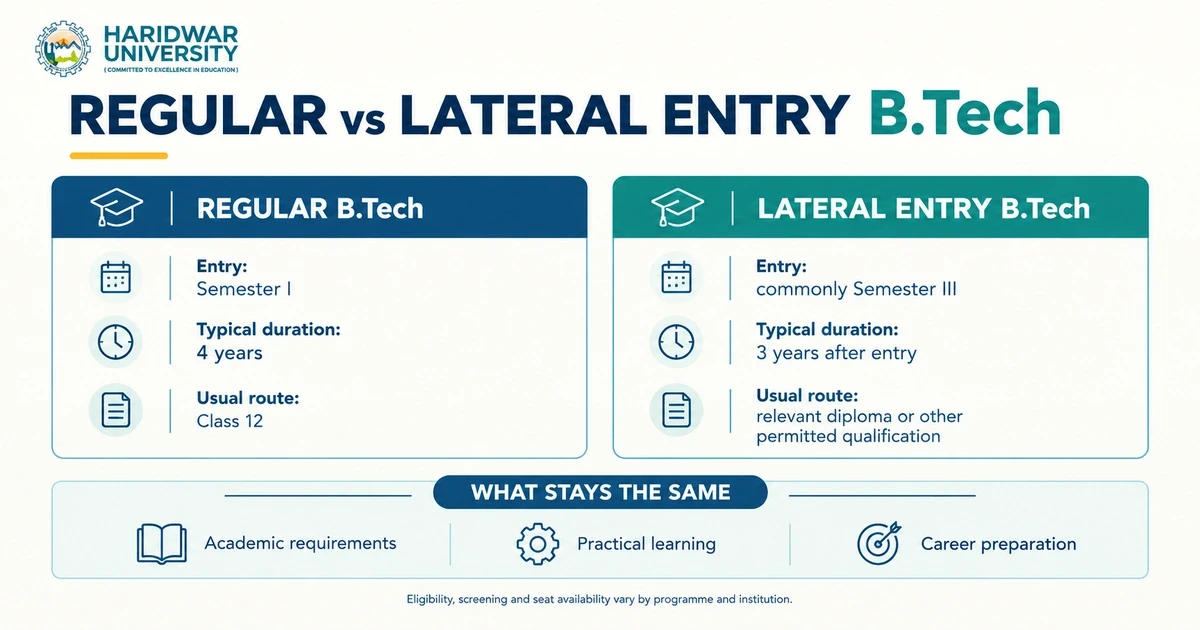
While both pathways culminate in an identical Bachelor of Technology degree, the student journey, duration, and academic entry point diverge significantly:
| Comparison Area | Regular B.Tech | Lateral Entry B.Tech |
|---|---|---|
| Entry Point | First Year, Semester I | Second Year, Semester III (Direct entry) |
| Degree Duration | 4 Academic Years (8 Semesters) | 3 Academic Years (6 Semesters) |
| Qualifying Credential | 10+2 with Physics, Mathematics, and Chemistry/CS | 3-Year Polytechnic Engineering Diploma (or B.Sc. with Maths) |
| Curriculum Starting Point | Engineering sciences, basic calculus, programming basics | Advanced departmental core engineering subjects from Day 1 |
| Admission Channel | JEE Main, state counseling, or 10+2 merit screening | State lateral entrance exam (LEET) or university diploma screening |
| Key Academic Challenge | Adapting to college pace and technical problem-solving | Bridging higher engineering mathematics and theoretical derivations |
The duration difference is obvious, but the academic transition requires deliberate planning. A polytechnic graduate often brings superior practical workshop skills, yet may need to strengthen calculus, differential equations, and theoretical modeling. Lateral entry is not simply a course with one year subtracted; it is an accelerated entry directly into rigorous departmental coursework.
3. Eligibility and Admission Requirements
Meeting a baseline qualification does not guarantee automatic admission into every engineering branch. At Haridwar University, admission to lateral entry programmes follows a transparent, merit-based screening process governed by strict regulatory standards.
5 Critical Details to Verify Before Applying for Lateral Entry
- Diploma Accreditation: The awarding polytechnic board or institution must be recognized by AICTE and the relevant State Board of Technical Education.
- Qualifying Aggregate: Most universities require a minimum aggregate of 45% to 50% in the qualifying diploma examination (with prescribed category relaxations).
- Branch Compatibility: Verify whether your diploma branch maps to your desired B.Tech stream (e.g., Computer Science, Mechanical, Civil, Electrical).
- Bridge Course Mandate: In accordance with university academic regulations, candidates who have not covered specific first-year prerequisites must clear prescribed bridge courses within one academic year of admission.
- Seat Availability: Lateral entry seats are strictly capped by statutory intake ceilings, making early registration vital.
For branch-specific curriculum outlines, explore our dedicated programme page for B.Tech (Hons.) Lateral Entry in Computer Science & Engineering and browse the complete catalog of undergraduate engineering programmes at Haridwar University.
4. What Stays the Same Across Both Routes
While the entry route differs, students should understand that the final degree certificate, academic standards, and professional standing remain identical:
Graduates from both routes receive the exact same Bachelor of Technology degree awarded by Haridwar University. The degree holds identical statutory validity under the UGC Act for government examinations and private employment.
Corporate recruitment drives evaluate cumulative CGPA, coding competencies, technical interview performance, and capstone projects. Lateral-entry students sit for identical on-campus placement drives alongside their four-year classmates.
Both regular and lateral-entry graduates are fully eligible to appear for national examinations including GATE, CAT, UPSC Engineering Services (ESE), state PSCs, and overseas master’s admissions (MS/M.Tech).
5. Academic Preparation Before Joining
The primary hurdle for a lateral-entry student is not entering in Semester III—it is hitting the ground running from the first lecture. To bridge the transition smoothly, I recommend focusing on three strategic areas:
Engineering mathematics in semesters III and IV builds directly on differential calculus, linear algebra, and complex numbers. Dedicate time before classes begin to revise these mathematical foundations.
Review the university’s curriculum for Semesters I and II to identify specific topics (e.g., Object-Oriented Programming, Data Structures, or Engineering Mechanics) that your diploma syllabus may have covered with less theoretical depth.
If the academic department prescribes non-credit or remedial bridge courses, clear them within the first academic year to avoid scheduling bottlenecks during final-year project work.
For candidates still weighing whether to pursue a polytechnic diploma after high school or complete Class 12 first, our comparative analysis on Diploma After 10th vs 12th + B.Tech provides deep institutional insights into career timelines, salary outcomes, and financial tradeoffs.
6. How to Choose the Right Route for You
The choice between regular and lateral entry is determined by your current educational qualification and long-term career timeline:
- Choose Regular B.Tech (4 Years): If you have completed 10+2 with PCM and desire a structured, foundational progression through all four years of engineering education, campus life, and introductory sciences.
- Choose Lateral Entry B.Tech (3 Years): If you hold an approved polytechnic engineering diploma, possess strong practical workshop competencies, and want an accelerated, cost-effective pathway to complete your undergraduate engineering degree in three years.
Before finalizing your enrollment, compare annual tuition, hostel options, and scholarship slabs on Haridwar University’s published Fees & Scholarships Portal (featuring 10% to 80% merit scholarships and 25% girls’ education waivers).
7. Frequently Asked Questions (FAQs)
1. Can I get direct admission into the second year of B.Tech?
Yes. Under the lateral entry scheme approved by AICTE and state technical universities, eligible diploma holders in engineering or technology can secure direct admission into the third semester (second year) of B.Tech.
2. Is lateral entry B.Tech strictly reserved for polytechnic diploma holders?
While diploma holders constitute the vast majority of applicants, the AICTE framework also permits candidates holding a B.Sc. degree with Mathematics to apply, subject to fulfilling specific subject bridge requirements.
3. Is a lateral entry B.Tech degree completed in three years?
Yes. Because lateral entrants bypass the first year and join directly in Semester III, they complete six academic semesters spanning three calendar years to graduate.
4. Can I change my engineering branch during lateral entry?
Branch crossover depends on university regulations and AICTE subject-mapping guidelines. Many institutions permit allied branch transitions (e.g., Electrical to Computer Science or Mechanical to Production), but applicants must verify institutional approval beforehand.
5. Are lateral-entry graduates eligible for campus placement drives?
Yes. Lateral entry students participate in the same campus placement drives as regular four-year students. Hiring decisions depend on technical problem-solving skills, projects, and maintaining consistent academic criteria.
6. Are the overall fees lower for lateral entry B.Tech?
Yes, the cumulative financial commitment is lower because lateral entry students pay for three academic years instead of four, saving one complete year of tuition, hostel, and living expenses.
7. Is regular B.Tech considered better by employers than lateral entry?
No. Both routes award the identical B.Tech degree. Corporate employers prioritize practical engineering ability, software proficiency, internship experience, and communication skills rather than the route of entry.
8. Make Your Decision After Checking the Details
Regular and lateral entry B.Tech represent two structured, valid entry points to the same destination: becoming a qualified, career-ready graduate engineer. Neither option should be judged by duration alone. The vital test is whether your current academic background fits the entry criteria and whether you are prepared for the rigorous coursework ahead.
Verify branch availability, confirm bridge course requirements, and choose the academic route that gives you the highest confidence to succeed.
Launch Your Engineering Career at Haridwar University
Whether entering via 10+2 regular admission or direct second-year lateral entry, Haridwar University offers AICTE-approved B.Tech programmes, cutting-edge computing laboratories, and dedicated placement training.