

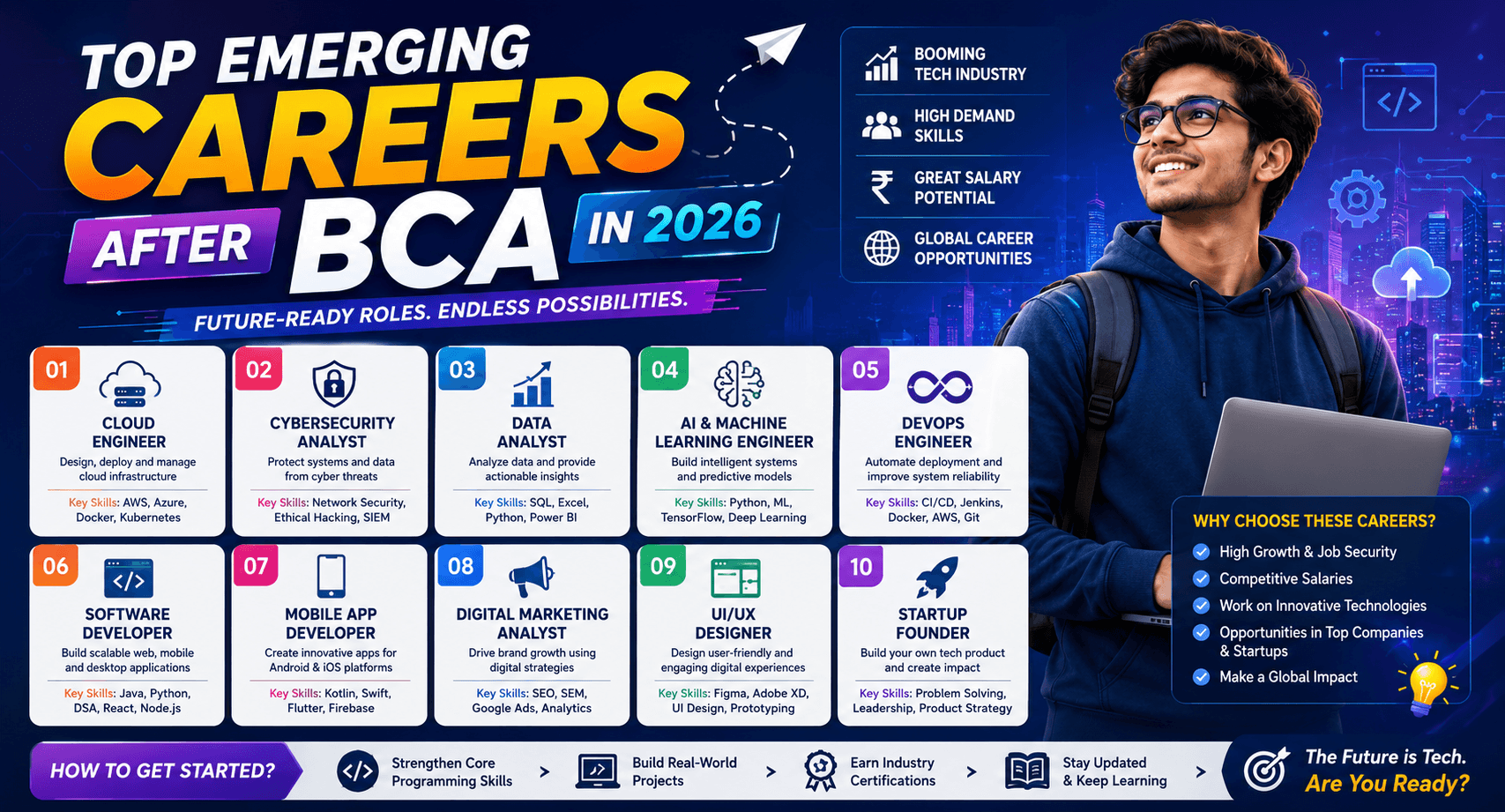
Top Emerging Careers After BCA in 2026
Dr. Rohit Kumar
HOD - Computer Applications, Haridwar University
Table of Contents
- 1. Industry Overview: The Changing Tech Landscape
- 2. Beyond the Obvious: Software Developer Role
- 3. 8 Emerging Careers After BCA
- 4. Salary Ranges with Sources (2026 Data)
- 5. Skills Needed for Each Role
- 6. Recommended Learning Path
- 7. Specialization-Focused BCA Tracks at Haridwar University
- 8. Fees, Scholarships & Admission Entrance Test
- 9. Frequently Asked Questions (FAQs)
1. Industry Overview: The Changing Tech Landscape
Every year around admission season, I get some version of the same question from parents and students: "BCA karne ke baad job milegi na?" Fair question. But the honest answer in 2026 is that the job itself looks nothing like what it did a decade ago.
Emerging careers after BCA aren't limited to a desk job writing Java code anymore — graduates are landing roles in cloud infrastructure, security operations, AI product teams, and a fair number are skipping the job hunt altogether to build their own companies.
Part of this is just how the industry has moved. NASSCOM's Strategic Review 2026 points to continued hiring growth as Global Capability Centres expand across India and AI gets baked into everyday business tools. What that means practically for a student finishing their BCA this year is simple: the degree gets you in the room, but the specialization you pick decides which room you end up in.
That's really what this article is about — eight roles I keep seeing BCA graduates move into, roughly what they pay, what skills actually matter, and a learning path you can follow without needing four more years of college.
2. Beyond the Obvious: Software Developer Role
I'll say this plainly because I think it needs saying: software developer is still a perfectly good outcome for a BCA graduate. Nothing wrong with it. But treating it as the only outcome undersells what the degree actually prepares you for.
Course structures have changed a lot even in the last few years. Students now touch cloud platforms, basic security concepts, data tools, and sometimes even front-end design before they graduate — not as electives buried somewhere, but as part of the core learning. Recruiters have noticed too. When I sit in on placement drives now, companies aren't just asking "can this person code," they're asking "what can this person actually own" — infrastructure, security, data, design, whatever it may be. If you're comparing colleges with this kind of specialization-first approach in mind, it's worth looking at options such as the best BCA college in Uttarakhand to see how the course structure lines up with where the jobs actually are.
3. 8 Emerging Careers After BCA
Here's the list, in no particular order of importance — pick based on what you enjoy doing, not just what pays best.
1. Cloud Engineer
If you like the idea of building the invisible plumbing that keeps apps running — servers, storage, networking — this is worth a look. Companies keep shifting workloads onto AWS, Azure, and Google Cloud, and someone has to actually run that infrastructure. What's nice about this path is that a certification can get you further than a degree alone would; I've seen BCA graduates land cloud roles straight out of college purely on the strength of an AWS Associate cert and a couple of home-lab projects. Current pay bands for the role are tracked on Glassdoor's cloud engineer salary page, if you want a sense of where offers usually land.
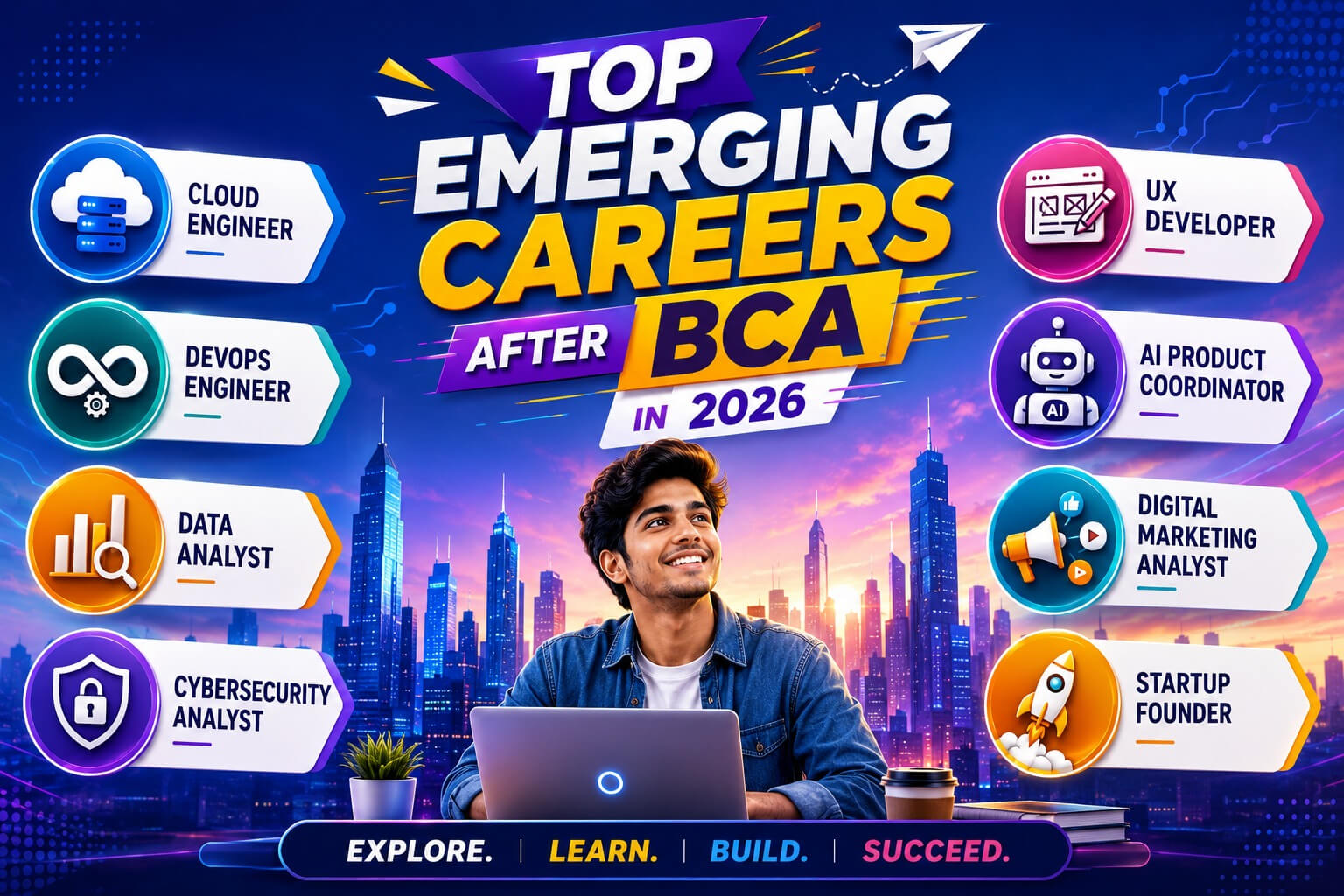
2. DevOps Engineer
DevOps is the role that sits between "we wrote the code" and "the code is actually running in production." It's built around CI/CD pipelines — the automated process that ships software out the door reliably instead of manually. Docker, Kubernetes, Git, and some comfort with Bash or Python scripting will get your foot in the door. Anecdotally, this is one specialization where strong Linux fundamentals from college translate almost directly into job readiness.
3. Data Analyst
This is probably the easiest entry point on this list, honestly. Companies sit on mountains of data — sales numbers, customer behaviour, website traffic — and need someone to make sense of it. You don't need to be a Python wizard to start; SQL, Excel, and a BI tool like Power BI or Tableau will carry you a long way. That accessibility is exactly why it's become one of the more popular emerging careers after BCA among students who want results fast.
4. Cybersecurity Analyst
A few years back, cybersecurity felt like a specialist track for people who really loved networking protocols. Not anymore. Ransomware attacks and data breaches have become board-level concerns, and organisations — especially in banking and healthcare — are hiring analysts to keep watch, respond to incidents, and stay compliant with frameworks like the RBI's cybersecurity guidelines. PayScale's cybersecurity analyst page has reasonably current numbers if you're curious what the role pays.
5. UX Developer
Somewhere between the designer who makes things look good and the developer who makes things work, there's the UX developer — someone who can take a wireframe and actually build it, cleanly and accessibly. You'll need HTML, CSS, and JavaScript at minimum, plus enough front-end framework knowledge to not feel lost, and ideally some grounding in how users actually behave. Students who enjoy both the visual and technical sides of a project tend to do well here.
6. AI Product Coordinator
This one's newer, and I still find myself explaining it to parents during counselling sessions. As companies wire AI features into their products, somebody has to sit between the engineers building the model and the business side deciding what it should actually do — managing timelines, stress-testing features before they ship, translating "this is technically hard" into terms a non-technical stakeholder understands. Demand here is climbing fast, and it lines up with what the government's IndiaAI portal has been reporting about India's AI talent gap. One honest caveat: it's not a standardised job title yet, so pay data is thinner than the other roles on this list; the closer, better-tracked comparison is Associate AI Product Manager, where fresher offers have been running noticeably higher than most people expect.
7. Digital Marketing Analyst
If the technical side appeals to you but you'd rather be closer to customers and business strategy than servers, this might fit better. The job is essentially using data — campaign performance, conversion numbers, website traffic — to figure out what's actually working in a marketing effort and what isn't.
8. Startup Founder
Not everyone finishing a BCA wants to apply for a job at all, and that's fine too. India's startup scene still rewards founders who can build a rough version of their product themselves before they ever hire anyone. A BCA background — the programming, the problem-solving habit, the exposure to how software actually gets built — gives a founder a real head start over someone starting from zero.
4. Salary Ranges with Sources (2026 Data)
Take these with a grain of salt — actual offers swing quite a bit depending on city, certifications, and the kind of company you're applying to. That said, here's roughly where things stood across 2026, based on public salary aggregators. AI Product Coordinator is marked with an asterisk because it's a newer title without a large standardised salary dataset yet; the range below leans on the closer, better-tracked Associate/AI Product Manager data, so treat it as a wider estimate than the other rows.
5. Skills Needed for Each Role
- Cloud Engineer: AWS/Azure/GCP basics, Linux, networking fundamentals, one cloud cert.
- DevOps Engineer: Docker, Kubernetes, a CI/CD tool (Jenkins or GitHub Actions), scripting.
- Data Analyst: SQL, Excel, Power BI or Tableau, and a working sense of basic statistics.
- Cybersecurity Analyst: Networking, SIEM tools, CompTIA Security+ or CEH, incident response basics.
- UX Developer: HTML/CSS/JavaScript, one front-end framework, Figma, some user research grounding.
- AI Product Coordinator: Product management basics, a rough understanding of how ML workflows work, and honestly, good communication matters more here than people expect.
- Digital Marketing Analyst: Google Analytics, SEO fundamentals, campaign reporting tools.
- Startup Founder: Programming fundamentals, the ability to build an MVP solo, and some instinct for validating an idea before betting everything on it.
6. Recommended Learning Path
There's a pattern I notice across almost every student who's landed one of these roles successfully: fundamentals first, one focused certification later, real projects before graduation.
- Years 1 - 2: Core programming, data structures, databases — the boring-but-necessary stuff.
- Year 3: Pick one lane (cloud, security, data, or design) and start working toward a certification in it.
- Final Year: Build two or three portfolio projects you can actually talk about in an interview, apply for internships, and sit whatever entrance or placement test lines up with your specialization.
7. Specialization-Focused BCA Tracks at Haridwar University
If you're still shortlisting colleges, it's worth knowing that not every BCA program is built the same way. Haridwar University runs a couple of specialization-focused tracks — BCA (AI & ML) and BCA (Cyber Security) under the Roorkee College of Smart Computing — that map fairly directly onto the roles covered above, rather than tacking specialization on as an afterthought in the final semester. Students leaning toward a broader computer science base with an AI/ML tilt might also want to check the university's B.Sc. Computer Science (AI & ML) programme before deciding which track actually fits.
8. Fees, Scholarships & Admission Entrance Test
I'll be upfront here rather than throw numbers at you that might be outdated by the time you read this — private university fee structures get revised every admission cycle, and it genuinely depends on which specialization you pick and what scholarship you qualify for. Best move is to check current figures directly on the Fees & Scholarships page rather than trust an old blog post (including, frankly, this one, a year from now).
What I can tell you concretely: getting into Haridwar University's BCA tracks involves clearing the Haridwar University Admission Entrance Test (HUAET) — 50 objective questions based on your Class 12th syllabus (PCM, PCB, Commerce, or Arts), and you get an hour to finish it. There's a syllabus and prep breakdown on the university's HUAET entrance test page if you want to start early.
9. Frequently Asked Questions (FAQs)
Q1. What are the top emerging careers after BCA in 2026?
Cloud engineering, DevOps, data analytics, cybersecurity, UX development, AI product coordination, digital marketing analytics, and founding your own startup are the paths BCA graduates are moving into most often right now, alongside the traditional software developer route.
Q2. Is BCA still relevant with all this AI hype?
Honestly, yes — and for a slightly counterintuitive reason. BCA builds the programming and problem-solving foundation that AI-adjacent roles still need, whether that's AI product coordination, data analysis, or cloud work. Pair it with one focused certification and it holds up fine.
Q3. Which BCA specialization has the best job prospects right now?
From what I'm seeing, cybersecurity, AI/ML, and cloud computing are pulling ahead of the rest, mostly because India has a fairly well-documented shortage of skilled people in exactly these areas.
Q4. Do I need to know how to code to become a data analyst?
Not really, at least not to start. SQL and spreadsheet skills will get you in the door. Python helps later if you want to move toward data science, but it's not a day-one requirement.
Q5. Which certifications are actually worth doing after a BCA degree?
AWS or Azure cloud certs, CompTIA Security+, Google's Data Analytics certificate, and Google's UX Design certificate all show up repeatedly on recruiter shortlists, and you can knock most of these out during your final year without much trouble.
Q6. Can someone start a startup after BCA without a technical co-founder?
Yes, and I'd argue that's one of the underrated advantages of the degree — you likely already know enough to build a rough MVP yourself, which puts you in a much stronger position when you eventually do talk to investors or early customers.
Q7. How exactly is the HUAET entrance test structured?
Fifty objective questions, pulled from your Class 12th syllabus depending on stream (PCM, PCB, Commerce, or Arts), and you get one hour to complete it.
Q8. Does Haridwar University offer scholarships for BCA students?
Yes, scholarships are available for students who qualify, though the exact percentages and eligibility criteria get updated each admission cycle — check the university's current admissions page rather than relying on last year's numbers.
Q9. Realistically, how long does it take to become job-ready after BCA?
For most students I've mentored, somewhere between six and twelve months of focused effort — picking one specialization (cloud, data, security, or UX) and sticking with it — is enough to get to a job-ready level, whether that's during the final year or right after graduating.
High Intent Conversion Summary
If you're a Class 12th student weighing your options, or already working and thinking about where to specialize, the pattern above should be fairly clear by now: picking a lane early beats trying to be generically good at everything. A BCA program that's already built around cloud, AI, or cybersecurity gets you to a job offer faster than bolting specialization on at the end.
It is well worth exploring Haridwar University's BCA programmes, going through the HUAET details, and reaching out to the admissions team directly if you've got questions about fees, scholarships, or the test itself.