

AI Ethics and Responsible AI for Engineering Students: Principles, Risks & Practical Examples
Dr. Himanshu Verma
Associate Professor & HOD, Computer Science & Engineering, Haridwar University
Guide Table of Contents
- Why AI Ethics Belongs in Engineering Education
- Understand AI Ethics Through a Student-Centred Framework (UNESCO)
- Connect AI Ethics With Responsible AI Practice
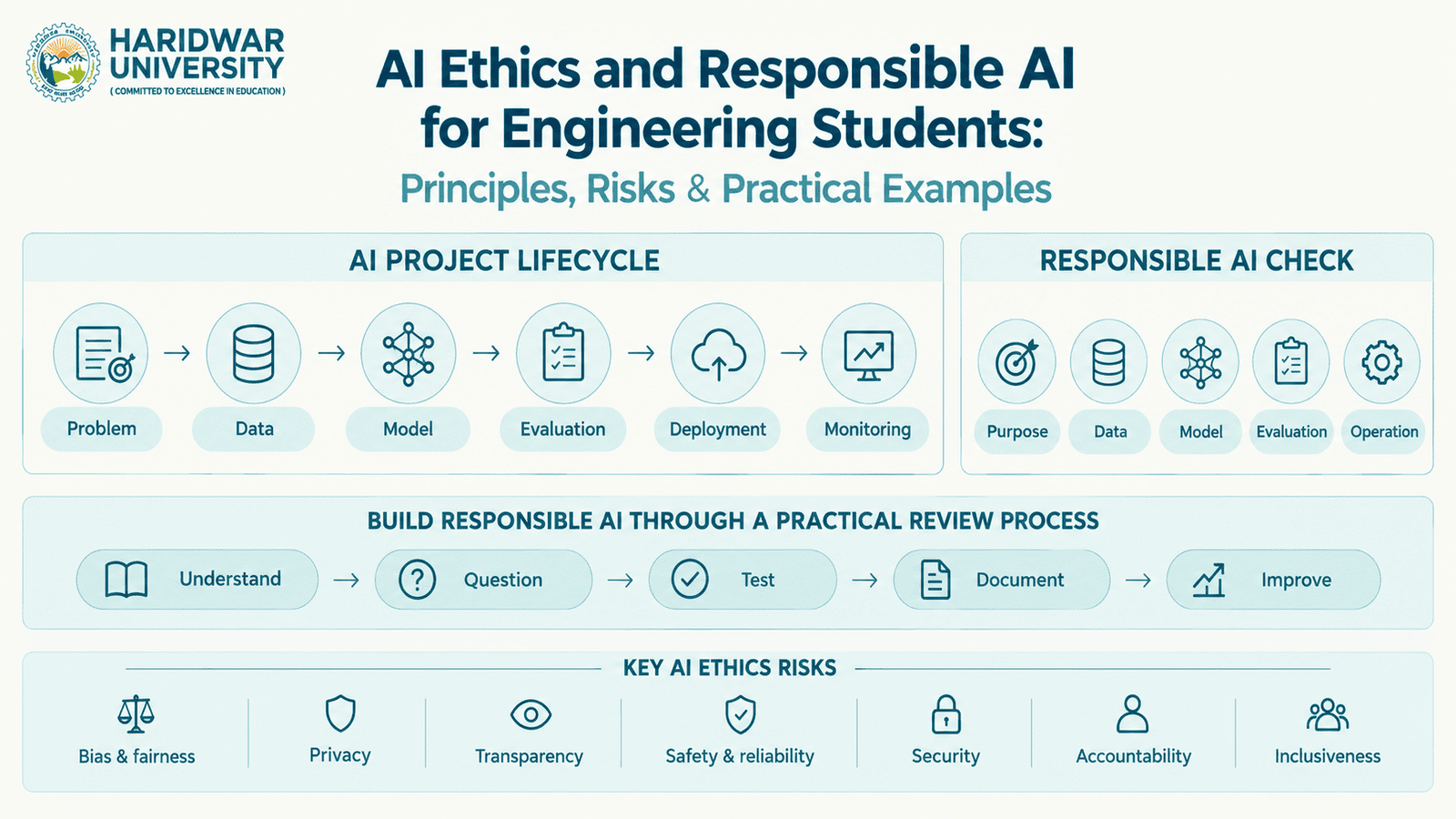
- Apply Responsible AI Principles Across the AI Lifecycle
- Recognise Core AI Ethics Issues in Engineering Projects
- Build Ethics Into Data, Models and Evaluation
- Practical Examples: Resume Screening, Facial Recognition & Campus Bots
- Include Generative AI in Responsible AI Thinking
- Understand the Indian AI Ethics Context (IndiaAI & UNESCO 2026)
- Turn AI Ethics Into a 5-Point Project Review Checklist
- Build Responsible AI Skills Through Engineering Projects
- Frequently Asked Questions (FAQs)
Artificial intelligence is rapidly becoming part of ordinary engineering work. Undergraduate students at Haridwar University are actively building recommendation engines, computer vision detection systems, predictive diagnostic tools, conversational chatbots, Retrieval-Augmented Generation (RAG) pipelines, and autonomous AI agents.
Yet when I review capstone projects, technical performance often receives 95% of the focus, while the human consequences of deployment are relegated to an afterthought. A model can achieve a stellar 94% validation accuracy and still inflict severe real-world harm through biased training data, reckless privacy exposures, hallucinated facts, or missing human oversight.
That is why AI ethics and responsible AI are core engineering disciplines, not peripheral humanities electives. In UNESCO's AI Competency Framework for Students, the Ethics of AI is embedded alongside system design and algorithmic techniques, guiding students from initial conceptual understanding to hands-on ethical creation.
For an engineering student, the critical question is simple: Can I engineer an AI system while understanding who it affects, what failure modes exist, and how I will detect and mitigate those problems?
Why AI Ethics Belongs in Engineering Education
Software engineering decisions dictate how an AI system ingests data, structures representations, calculates inferences, and interfaces with end-users. Ethics enters the engineering lifecycle the moment you write your first database query or define a loss penalty.
Consider an automated resume-screening tool: the engineering questions are never confined to model precision. A student engineer must scrutinise where the training resumes originated, whether historical hiring patterns encoded systemic demographic biases, what happens when an edge-case candidate is misclassified, and how human recruiters can appeal automated scoring.
The exact same rigour applies to biometric face authentication, clinical healthcare predictions, student grading algorithms, and generative language assistants.
Understand AI Ethics Through a Student-Centred Framework
UNESCO's Student Framework translates ethical theory into a three-stage progressive journey:
1. Understand
Recognise algorithmic bias, privacy violations, environmental impacts, and societal ramifications of automated decisions.
2. Apply
Implement concrete tools: fairness audits, differential privacy, explainability APIs (SHAP/LIME), and unit testing.
3. Create
Design systems with ethics baked into the architecture—from human fallback controls to transparent provenance records.
Apply Responsible AI Principles Across the AI Lifecycle
Instead of an ad-hoc checklist reviewed the day before a project viva, map ethical scrutiny across all nine engineering lifecycle phases:
| Project Stage | Responsible AI Diagnostic Question |
|---|---|
| Problem Definition | Who could be harmed or disadvantaged if this system fails or is misapplied? |
| Data Collection | Where did the data originate, what consent was gathered, and what licensing governs its use? |
| Data Preparation | Does the dataset adequately represent marginalized groups or introduce skew in key features? |
| Model Development | What assumptions are baked into the architecture, and is a complex black box truly justified? |
| Evaluation | Are classification errors and false-positive rates distributed unevenly across sub-demographics? |
| Deployment | What is the fallback mechanism when the model encounters an out-of-distribution input? |
| User Interaction | Do users clearly understand that they are interacting with an AI, and what are its confidence limits? |
| Monitoring | How are silent performance degradation, hallucinations, and concept drift tracked in real time? |
| Documentation | Are system cards, data provenance, and explicit out-of-scope boundaries publicly documented? |
Explore Ethical AI Engineering at Haridwar University
Our B.Tech. Hons. AI & Machine Learning under the Roorkee College of Smart Computing incorporates responsible AI governance, ethics-by-design, and algorithmic transparency directly into computing curricula.
Recognise Core AI Ethics Issues in Engineering Projects
Drawing on the NIST AI Risk Management Framework (AI RMF) and Microsoft's Responsible AI standards, student projects must address seven core vulnerabilities:
Historical training data perpetuating systemic discrimination or under-representing specific demographics.
Processing personally identifiable information (PII) without encryption, anonymisation, or explicit user consent.
Black-box models offering zero insight into why a loan was denied, a medical risk flagged, or a resume filtered.
Adversarial vulnerabilities, input perturbation risks, and graceful degradation during unexpected failures.
Clear human ownership when automated predictions cause financial, physical, or reputational damage.
Designing interfaces and systems accessible to diverse physical abilities, languages, and technical literacies.
Build Ethics Into Data, Models and Evaluation
When students select capstone themes—such as those in our guide on 25 Final-Year Project Ideas for CSE & AI/ML Students—they must evaluate four concrete operational scenarios:
Resume Screening AI
Historical hiring datasets embed past gender imbalances. Audit representation and ensure human panel review for all rejections.
Campus Face Recognition
Biometric privacy, explicit consent protocols, encrypted embedding storage, and false-positive consequence mitigation.
Student Performance Predictor
Risk of self-fulfilling negative prophecies. Predictions must trigger academic support, never punitive filtering or gatekeeping.
Campus Knowledge Assistant
RAG systems must enforce factual grounding on official university policy documents and explicitly cite sources.
Include Generative AI in Responsible AI Thinking
Generative AI introduces unique risk vectors beyond classical classification. As students explore Generative AI Project Ideas for Students 2026, they must implement defensive engineering safeguards:
- Hallucination Detection: Validate model assertions against trusted document embeddings using cosine similarity thresholds.
- Data Leaks via Third-Party APIs: Scrub proprietary student identifiers, medical numbers, or API tokens before dispatching prompts to external LLMs.
- Transparent Watermarking & Disclosure: Ensure end-users clearly recognise when prose, images, or synthetic code snippets are generated by an AI model.
- Prompt Injection Defences: Sanitize user-provided text inputs against jailbreaks, system-prompt extraction, and indirect prompt injections.
Understand the Indian AI Ethics Context (IndiaAI & UNESCO 2026)
The 2026 India AI Readiness Assessment Report
In 2026, UNESCO partnered with the national IndiaAI Mission to release the definitive India AI Readiness Assessment Report. Consulting over 600 stakeholders across government, academia, AI startups, and research institutions, the report emphasizes building human-centred AI tailored to India's unique linguistic diversity, digital public infrastructure (DPI), and societal inclusion mandates.
For engineering students in India, responsible AI is no longer a theoretical debate—it is an active corporate governance requirement across major tech hubs from Bengaluru and Hyderabad to Noida and Gurugram.
Turn AI Ethics Into a 5-Point Project Review Checklist
Before submitting an engineering project or demonstrating your prototype during a placement interview, evaluate your system against these five core checkpoints:
What exact problem is solved, and what unintended consequences could affect users?
Where did the data originate, what biases exist, and how was consent preserved?
Under what conditions does the model fail, and what out-of-scope boundaries are set?
Are precision and recall balanced equally across demographic or geographic cohorts?
Who reviews erroneous predictions, and how can end-users appeal automated flags?
Build Responsible AI Skills Through Engineering Projects
The Hallmark of a True Professional
A technically proficient engineer can build an AI model. A truly responsible professional understands when it should be deployed, how it must be tested, who could be disadvantaged, and what architectural safeguards belong around it. By practicing ethics-by-design across your university capstones, you develop the mature technical judgement that enterprise hiring managers actively seek.
Frequently Asked Questions (FAQs)
1. What is AI ethics for engineering students?
AI ethics helps engineering students consider how AI systems affect people, society and the environment, including issues such as fairness, privacy, safety, transparency and accountability.
2. What is responsible AI?
Responsible AI refers to practical approaches for designing, developing, deploying and operating AI systems with attention to issues such as fairness, reliability, privacy, transparency and accountability.
3. What are the main AI ethics issues?
Common issues include bias and discrimination, privacy, transparency, explainability, safety, security, accountability, inclusiveness and the consequences of incorrect AI decisions. NIST groups related concerns within its broader trustworthy-AI framework.
4. Why should engineering students learn AI ethics?
Engineers make decisions about data, models, system architecture, evaluation and deployment. Understanding AI ethics helps them recognise risks before those decisions become system-level problems.
5. How can students apply responsible AI to projects?
Students can examine data provenance, document intended use, evaluate relevant performance measures, identify failure modes, protect sensitive information and explain how human oversight will work.
6. What does UNESCO say about AI ethics for students?
UNESCO's AI Competency Framework for Students includes Ethics of AI as one of four competency dimensions and uses the progression Understand, Apply and Create.
7. How does responsible AI apply to generative AI projects?
Students should consider accuracy, hallucinations, privacy, bias, security, transparency, human oversight and evaluation when developing or using generative AI systems.
Build Ethical, Impactful AI at Haridwar University
Learn modern AI engineering with dedicated faculty mentorship, advanced computing labs, industry-aligned curricula, and comprehensive career support in Roorkee.