

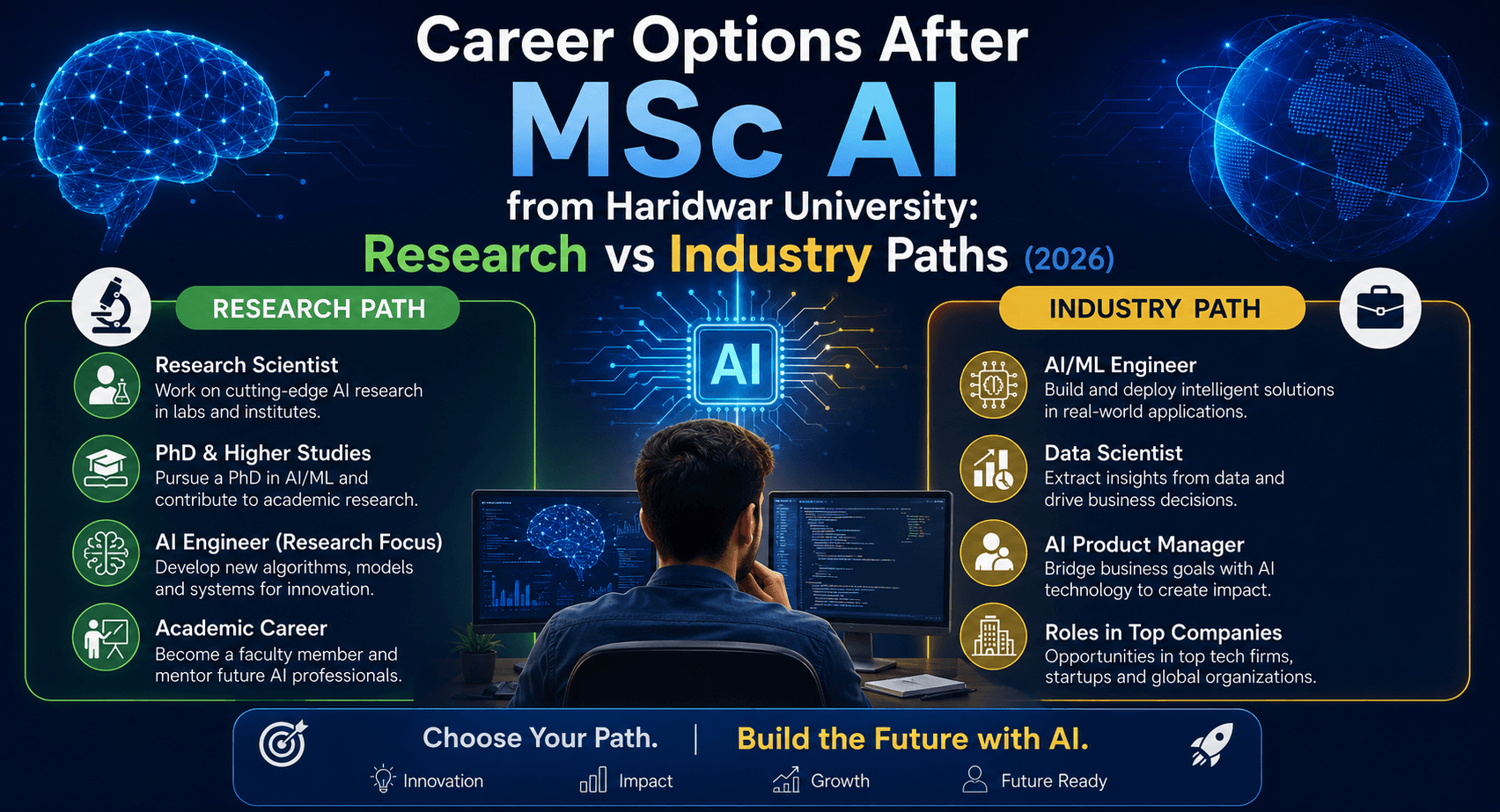
If you've typed career after MSc AI Haridwar University into a search bar, you're probably weighing a decision that feels much bigger than it needs to be. Here's the honest version: what you do after a master's-level AI credential depends less on the exact degree name on your certificate and more on which of two working lives you'd rather live — shipping models into products every quarter, or chasing one hard research question for years at a time. This guide lays out both paths with real 2026 salary numbers and real fellowship figures, and tells you upfront which programmes at Haridwar University actually lead to each one.
Table of Contents
- 1. A Quick Reality Check Before We Start
- 2. Why an AI Master's Still Matters in 2026
- 3. The Industry Track: Six Roles, Six Salary Bands
- 4. The Research Track: PhD, Labs and Fellowships
- 5. Government and PSU AI Roles Are Opening Up
- 6. What Your Portfolio Should Look Like, Per Track
- 7. How Haridwar University Prepares You for Both Tracks
- 8. Frequently Asked Questions
- 9. Next Steps
A Quick Reality Check Before We Start
Here's something most blogs on this topic won't say plainly: Haridwar University does not currently list a standalone M.Sc. in Artificial Intelligence on its official programme pages, verified live in August 2026. If you came looking for that exact degree name, it isn't on offer at HU yet — and dressing up a programme that doesn't exist would do you no favours.
What HU does offer, and what genuinely leads into every career this article covers, are three verified computing routes: B.Tech (Hons.) CSE with AI & ML at undergraduate level, MCA with AI for graduates pivoting into AI, and M.Tech in CS or M.Tech in CSE for those who want a research-adjacent postgraduate credential. We'll map each one to the right programme page in the HU section below.
Why an AI Master's Still Matters in 2026
Machine learning stopped being a niche skill somewhere around 2023. By 2026 it's closer to a baseline expectation across banking, healthcare, e-commerce, and even agri-tech in India. A postgraduate AI credential doesn't guarantee a job — nothing does. What it does is compress the time it takes to become interview-ready for roles that expect you to already know PyTorch and deployment basics, not learn them after you're hired. It's also the credential most PSU and government AI postings quietly filter for, even when the job description doesn't say so out loud.
The Industry Track: Six Roles, Six Salary Bands
Industry pays first and asks philosophical questions later. If you want to ship things people actually use, here's what six of the most in-demand AI job titles pay in India right now, sourced from Glassdoor India and AmbitionBox's 2026 salary reports.
Data Scientist
According to Glassdoor India (2026 salary reports), data scientists average roughly ₹15.6 LPA nationally, with typical pay running ₹10–23 LPA and top earners crossing ₹37 LPA. Freshers with a real portfolio — not just coursework — usually start between ₹6 and ₹14 LPA. The role sits closer to business analysis than pure engineering: you're translating messy data into decisions, not only training models.
ML Engineer
AmbitionBox's 2026 dataset puts the median machine learning engineer salary at around ₹12.8 LPA. PayScale India independently places mid-career (3–6 years) pay around ₹20.4 LPA on average, climbing to ₹18–40 LPA at product companies versus services firms. Unlike data scientists, ML engineers live in deployment — pipelines, model serving, the unglamorous plumbing that keeps a model running in production instead of a notebook.
AI Engineer
Glassdoor India figures show AI engineers averaging close to ₹10–11 LPA, with a realistic band of ₹6–16 LPA depending on specialisation and city. This is often the generalist entry point before someone specialises into NLP, computer vision, or MLOps.
NLP Engineer
Specialised NLP roles — fine-tuning or deploying language models — typically command ₹10–18 LPA at mid-career, occasionally touching ₹25+ LPA for LLM fine-tuning and RAG-pipeline work, now one of the highest-paying niches inside ML engineering.
Computer Vision Engineer
Computer vision work, from medical imaging to autonomous systems, runs a comparable band — roughly ₹12–22 LPA for engineers with two to five years of applied experience, with healthcare-tech, defence, and automotive R&D among the steadier hiring sectors.
MLOps Engineer
MLOps is the newest of the six titles and arguably the safest long-term bet: entry-level sits around ₹6–12.8 LPA, mid-level ₹10–22 LPA, and senior MLOps engineers at product companies clear ₹17–50+ LPA — every company running ML in production eventually needs someone who keeps it from breaking at 2 a.m.
The Research Track: PhD, Labs and Fellowships
Research pays less upfront and more over a career — if you're someone who'd rather spend two years on one hard question than switch projects every quarter.
PhD in India vs Abroad
A PhD in India — through an IIT, IISc, or a NIRF-ranked central university — now comes with genuinely competitive funding, not the token stipend of a decade ago. A fully-funded PhD abroad (common in the US, and increasingly parts of Europe) buys larger compute budgets and wider co-author networks, but also years away from the Indian job market. Neither path is objectively better; it depends whether your five-year goal is an Indian research career or a shot at a global lab.
Research Labs, Fellowships and PMRF
The Prime Minister's Research Fellowship (PMRF official site) is India's flagship funding route for STEM PhDs, including AI and computer science. For the 2026 cycle, fellows receive a monthly stipend starting at ₹70,000 and rising to ₹80,000 by year five, plus a research grant of ₹2 lakh per year. It's available only through IITs, IISc, IISERs, NITs, and other centrally funded institutes on the PMRF list — not a route HU's own PhD (CS) programme feeds into directly, so treat it as an external ladder you climb after strengthening your research profile at the master's stage.
The AI Research Scientist Path
Research scientist roles at labs such as Google DeepMind India, Microsoft Research India, or IBM Research typically expect a PhD, or at minimum a master's with a strong publication record. Compensation here is harder to benchmark publicly than the industry titles above, since self-reported salary aggregators tend to undercount stock and research grants — but total compensation generally exceeds equivalent industry engineering roles once you're five-plus years in.
Government and PSU AI Roles Are Opening Up
This is the track most students overlook. The Government of India's IndiaAI Mission has been actively funding compute access, datasets, and applied-AI projects since 2024, and PSUs — from public-sector banks to energy and engineering PSUs — have started opening AI/ML and data-analytics positions, usually through GATE-based recruitment or direct PSU hiring drives rather than campus placement. It moves slower than the private sector, but it offers job security and pension benefits that private-sector AI roles simply don't — worth a serious look if stability matters as much as salary.
What Your Portfolio Should Look Like, Per Track
For industry: three to five deployed projects beat ten Jupyter notebooks. One end-to-end ML pipeline, one RAG or LLM application, and one MLOps deployment (model serving, monitoring, retraining) on GitHub will do more for your interview conversion than any certificate.
For research: a first-author paper, or even a solid preprint, matters more than five side projects. Admission committees for PMRF and equivalent programmes weigh research potential — shown through a thesis, a conference poster, or a published paper — well above coursework grades.
How Haridwar University Prepares You for Both Tracks
If you're set on Haridwar University specifically, here's how its real programme map lines up with the two tracks above. For the industry track, B.Tech (Hons.) CSE with AI & ML at Roorkee College of Smart Computing is HU's flagship undergraduate route into ML engineering roles, and MCA with AI is built for graduates who want to pivot into AI without redoing an entire undergraduate degree. For a research-adjacent postgraduate credential right now, M.Tech in CS and M.Tech in CSE are the two verified two-year programmes on HU's current academics page — either can be a stepping stone toward HU's own PhD (CS) or toward PMRF-eligible programmes elsewhere.
According to Haridwar University's placement overview page, recruiters have included TCS, IBM, Tech Mahindra, Airtel, and ITC, with placement rates that have run between 86% and 95% depending on the programme and year, and an average package in the ₹6–6.5 LPA range against a reported domestic high of ₹60 LPA. You can also check the official Fees & Scholarships page for complete fee breakdowns. Treat these as directional — always check current-year figures on HU's main homepage before you commit to a programme based on a specific number.
Frequently Asked Questions
1. Does Haridwar University offer an M.Sc. in Artificial Intelligence?
Not currently. HU's live programme pages list MCA with AI, M.Tech CS, and M.Tech CSE as its computing postgraduate options, alongside B.Tech (Hons.) AI & ML at undergraduate level.
2. Which pays more in 2026 — data science or ML engineering?
They're close. Data scientists average around ₹15.6 LPA (Glassdoor India), while ML engineers sit nearer ₹12.8 LPA at the median (AmbitionBox) but climb faster at senior levels because deployment skills are scarcer.
3. Is a PhD necessary for an AI research scientist role?
Usually, yes, at pure research labs like DeepMind or Microsoft Research. A master's with a strong publication record can occasionally substitute, but it's the exception, not the rule.
4. What is PMRF, and can HU students apply directly?
PMRF is a government PhD fellowship (₹70,000–80,000 per month) available only through IITs, IISc, IISERs, and other listed centrally funded institutes — not directly through HU's own PhD programme.
5. Should I check AICTE approval before joining an M.Tech programme?
Yes, for technical and engineering programmes — AICTE governs M.Tech and B.Tech approval. Always verify current approval status directly on its official site before enrolling anywhere.
6. Is MLOps a good specialisation for someone with less coding depth?
Reasonably, yes. MLOps leans more on systems and DevOps thinking than heavy ML theory, and its salary band (₹6–50+ LPA across experience) rewards operational reliability as much as modelling skill.
7. Can I switch from industry to research later?
Yes, though it gets harder after five-plus years without any publications. An M.Tech-to-PhD bridge is a more realistic route than a cold switch straight from an industry role.
8. What's a realistic placement package for HU's computing postgraduate programmes?
HU's placement page cites an average package in the ₹6–6.5 LPA range with a reported domestic high of ₹60 LPA, though outcomes vary by specialisation and internship record — verify current-year numbers on HU's placement page before assuming they apply to your batch.
9. Should I choose research or industry if I'm still unsure?
Default to industry. It's reversible — you can apply for a PhD after two or three working years with savings and a sharper sense of the problem you actually want to research. Starting in research while still unsure risks fellowship funding meant for someone certain.