

Ask any graduate in Roorkee or Haridwar what a “safe” and prestigious career looks like, and the Indian Railways usually comes up within seconds. If you are researching Career Options in the Indian Railways for Graduates, though, you will hit a snag quickly: there isn’t just one railway exam. There are several, conducted by different recruitment bodies, for very different operational and administrative roles.
This comprehensive roadmap maps each gateway so you can see where your degree fits and what the preparation route looks like. For the parent organization itself, the Ministry of Railways operates its official information portal at indianrailways.gov.in.
Essential Advisory: Vacancy counts, age criteria, reservation matrices, and examination dates change with every Centralised Employment Notice (CEN). The official notification is always the final authority. What stays stable is the underlying institutional structure of railway hiring, which this guide details for students of Haridwar University in Roorkee and all graduate aspirants.
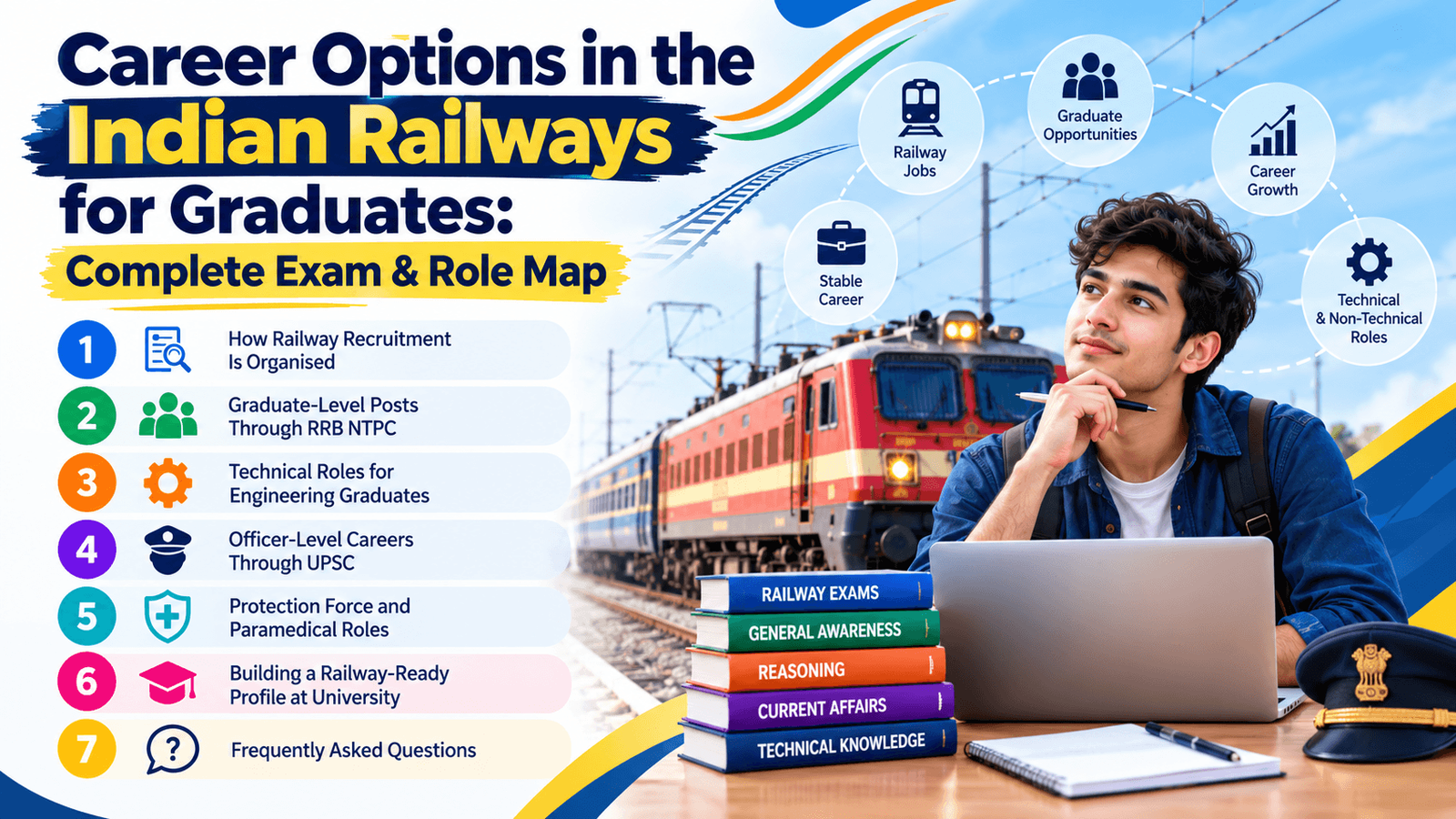
Table of Contents
- • 1. How Railway Recruitment Is Organised
- • 2. Graduate-Level Posts Through RRB NTPC
- • 3. Technical Roles for Engineering Graduates
- • 4. Officer-Level Careers Through UPSC
- • 5. Protection Force and Paramedical Roles
- • 6. Building a Railway-Ready Profile at Haridwar University
- • 7. Frequently Asked Questions (FAQs)
1. How Railway Recruitment Is Organised
Think of Indian Railway hiring as three separate gateways. Most posts below officer level are coordinated through the 21 regional Railway Recruitment Boards (RRBs), which publish Centralised Employment Notices (CEN) for each recruitment cycle. For instance, the RRB Chandigarh portal (rrbcdg.gov.in) publishes separate indicative notifications for CEN 03/2024 (Junior Engineer and Depot Material Superintendent posts), CEN 05/2024 (Non-Technical Popular Categories, graduate level), and CEN 06/2024 (undergraduate NTPC).
The second doorway is the Union Public Service Commission (UPSC), which conducts national examinations to select Group A gazetted officers for the unified Indian Railway Management Service (IRMS).
The third gateway is the Railway Protection Force (RPF), whose Sub-Inspector recruitment runs in coordination with RRBs. Same employer, but three distinctly different exam structures. That is exactly why searching for a single “railway exam” leaves most graduates confused.
Read the Notice, Not the Summary: Every CEN lays out post-wise minimum educational qualifications, medical fitness categories, multi-stage selection procedures, and reservation rosters. While coaching summaries offer quick orientation, they cannot substitute for the original notification.
2. Graduate-Level Posts Through RRB NTPC
For non-engineering graduates, RRB NTPC represents the largest annual intake. Graduate-level NTPC covers core commercial and operating posts including:
- Station Master (7th CPC Pay Level 6)
- Chief Commercial-cum-Ticket Supervisor (CCCT) (Pay Level 6)
- Goods Train Manager (formerly Goods Guard, Pay Level 5)
- Senior Clerk-cum-Typist (Pay Level 5)
- Junior Accounts Assistant-cum-Typist (JAA) (Pay Level 5)
Which Degree Qualifies?
The mandatory baseline is a bachelor’s degree from a recognised university, with no restriction on academic discipline. Commerce and management graduates frequently find accounts-linked roles such as Junior Accounts Assistant a natural fit. Foundational business degrees such as BBA with AI and B.Com with AI offered at Roorkee College of Business Studies cultivate strong numerical and administrative competencies.
How the Selection Process Works
Recruitment progresses across structured stages:
- 1st Stage Computer-Based Test (CBT-1): Common screening test assessing Mathematics, General Intelligence & Reasoning, and General Awareness.
- 2nd Stage CBT (CBT-2): Post-level specific exam with higher difficulty and tighter time constraints.
- Computer-Based Aptitude Test (CBAT) or Typing Skill Test (TST): Station Master candidates take CBAT (psycho test), while clerical posts require English/Hindi typing proficiency.
- Document Verification and Medical Examination: Strict adherence to prescribed medical fitness standards (such as A-2 vision for Station Master and Goods Train Manager).
Because NTPC notices do not operate on a fixed annual calendar, waiting for notification dates wastes valuable college years. Build disciplined exam preparation early: attempt weekly timed sectional mocks, maintain conceptual notes, and ensure all caste/degree certificates are verified well in advance.
3. Technical Roles for Engineering Graduates
Engineering graduates have dedicated technical cadres within Indian Railways. CEN 03/2024 covered Junior Engineer (JE), Depot Material Superintendent (DMS), and Chemical & Metallurgical Assistant (CMA) posts across Pay Level 6.
Eligibility depends directly on your engineering branch:
- Civil Engineering (CE): Track maintenance, bridge construction, permanent way engineering, and railway structural assets.
- Mechanical Engineering (ME): Locomotive maintenance, carriage & wagon workshops, diesel sheds, and rolling stock maintenance.
- Electrical Engineering (EE): Overhead traction power, electric locomotives, train lighting, and substation maintenance.
- Electronics & Telecommunication (ECE): Railway signalling systems, track circuiting, automated train protection, and microwave communications.
At Haridwar University, Roorkee College of Engineering offers AICTE-approved B.Tech. Hons. programmes across Civil, Electrical, Mechanical, and ECE streams, integrating modern AI diagnostic and automated inspection principles. These degrees provide the core technical foundation demanded by RRB JE and public sector engineering recruitment.
4. Officer-Level Careers Through UPSC
The Indian Railway Management Service (IRMS) is the apex officer cadre created by unifying the earlier Group A services (IRTS, IRAS, IRPS, IRSE, IRSME, IRSEE, and IRSSE) into a single streamlined structure.
Under the Ministry of Railways’ notified IRMS (Amendment) Rules, gazetted officer recruitment runs via two national UPSC pathways:
- UPSC Civil Services Examination (CSE): Recruits Group A officers for the Traffic, Accounts, and Personnel non-technical sub-cadres of IRMS, alongside the Indian Railway Protection Force Service (IRPFS). Open to graduates of any discipline.
- UPSC Engineering Services Examination (ESE): Recruits engineering graduates for Civil, Mechanical, Electrical, and Signal & Telecom technical officer sub-cadres.
While UPSC selection represents the most competitive career avenue in Indian Railways, it leads to senior administrative leadership roles, including Divisional Railway Managers (DRM), Principal Heads of Department, and Railway Board appointments.
5. Protection Force and Paramedical Roles
Railway Protection Force (RPF)
The post of RPF Sub-Inspector (Executive) requires a graduate degree from a recognized university. Under the Railway Board’s updated recruitment directives (rpf.indianrailways.gov.in), candidates undergo Computer-Based Testing followed by Physical Efficiency Tests (PET), Physical Measurement Tests (PMT), and Document Verification. Physical endurance and fitness are indispensable components of preparation.
Nursing and Pharmacy Healthcare Cadres
Not every railway position revolves around track engineering or ticket collection. Indian Railways operates a massive nationwide healthcare network of divisional and central hospitals. Historical recruitment (such as RRB CEN 02/2019) has inducted paramedical cadres including Staff Nurse, Pharmacist Grade III, Radiographer, Lab Superintendent, and ECG Technicians.
This demonstrates that graduates with B.Sc. Nursing and B.Pharm degrees also have rewarding public-sector career routes within the railways, with pay levels ranging from Level 5 to Level 7.
6. Building a Railway-Ready Profile at Haridwar University
The degree you choose represents your foundational eligibility credential; your parallel preparation shapes your competitive performance. Below is the verified fee structure for relevant programmes under the Fee Structure 2026-27:
The published fees cover tuition, enrolment, admission, examination, and uniform charges. Transport facility fees vary by route. Details are available on our Fees & Scholarships portal.
Merit Scholarships & Academic Awards
Merit scholarships apply to first-year tuition fees based on qualifying JEE rank, Class 12 aggregate, or CUET percentile:
- Above 90%: 80% tuition scholarship
- Above 80% up to 90%: 50% tuition scholarship
- Above 70% up to 80%: 20% tuition scholarship
- Above 60% up to 70%: 10% tuition scholarship
Additionally, a 25% first-year scholarship supports girls’ education, while students scoring 85% or higher in any semester receive an Academic Excellence award of ₹5,000 (subject to clearing all subjects on the first attempt).
To support students navigating competitive career pressures, HU provides dedicated counselling and welfare assistance throughout their degree. For general admission guidelines and campus placement insights, review our admissions overview and placement overview.
Frequently Asked Questions (FAQs)
1. What are the main career options in the Indian Railways for graduates?
Graduates can target graduate-level RRB NTPC posts, technical engineering posts through RRB JE, RPF Sub-Inspector, paramedical categories, and officer roles through UPSC IRMS. Each route maintains its own specific notice and selection process.
2. Is there one common exam for all railway jobs?
No. Regional RRBs run CEN-based exams for non-officer and technical posts, UPSC administers the IRMS officer cadre examinations, and RPF recruitment operates under separate boards. Applications must only be submitted through the official portal specified in the CEN.
3. Which degree do I need for RRB NTPC graduate posts?
A bachelor’s degree in any discipline from a recognized university satisfies baseline eligibility. Specific posts have vision or typing requirements defined in the notification.
4. Can B.Com or BBA graduates apply for railway jobs?
Yes. Graduate-level NTPC posts include accounts-linked roles such as Junior Accounts Assistant-cum-Typist, and commerce/management graduates can also attempt the UPSC Civil Services Examination for the IRMS accounts sub-cadre.
5. Can B.Tech graduates become railway officers?
Yes. Engineering graduates can appear for UPSC’s Engineering Services Examination (ESE) for IRMS technical sub-cadres or the Civil Services Examination for administrative cadres. At non-officer level, RRB Junior Engineer recruitment is the standard technical entry.
6. How do I avoid fake railway job offers?
Rely solely on official RRB portals (such as rrbcdg.gov.in, rrbbhopal.gov.in) and indianrailways.gov.in. Railway boards routinely warn candidates against touts, fraudulent appointment letters, and unverified notices circulating on social media.
7. Does HU offer coaching for railway exams?
Haridwar University awards the UGC-recognised degree required for eligibility, while students prepare for competitive government exams independently or alongside coursework. HU faculty and placement cells provide general guidance on aptitude and analytical reasoning.
8. What do HU programmes cost, and are scholarships available?
First-year fees under the 2026-27 structure range from ₹67,000 for B.Com with AI to ₹1,90,000 for B.Sc. Nursing. Merit scholarships range from 10% to 80% of first-year tuition, along with a 25% scholarship for female students.
9. How do I apply to Haridwar University?
Review the admission guidelines on our portal, select your program, and submit your application online through the university admissions portal.
Build Your Competitive Foundation at Haridwar University
Whether your goal is a technical railway cadre, civil services, or corporate leadership, Haridwar University delivers UGC-recognised engineering, business, and health science degrees with modern AI integration and career mentorship.