

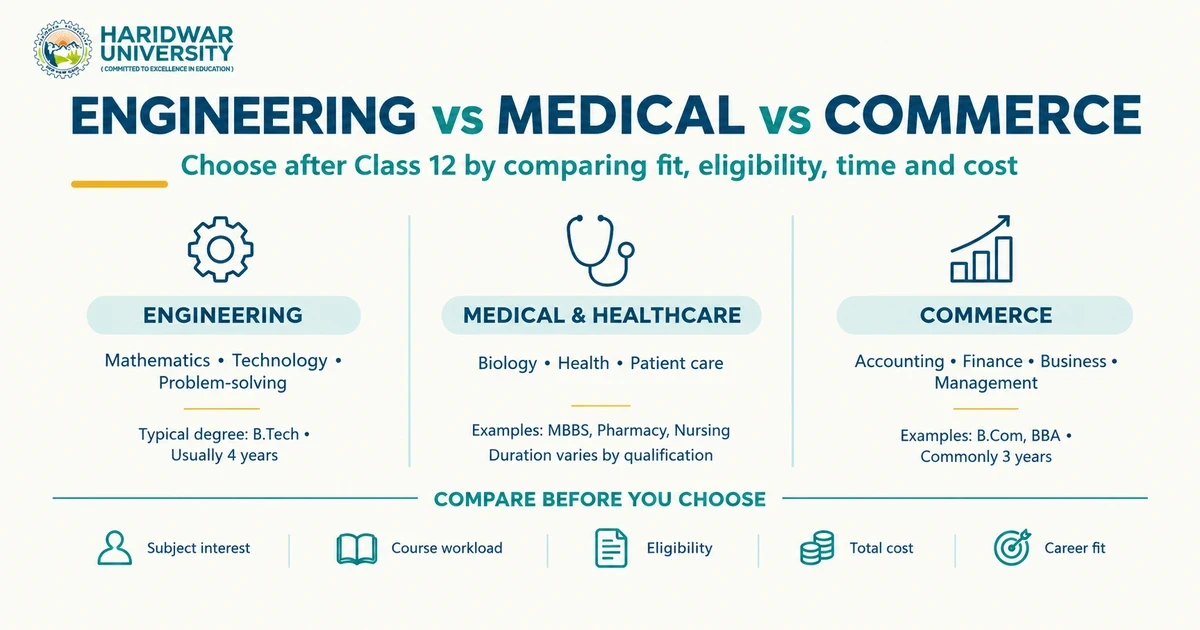
Choosing between engineering, medical and commerce after Class 12 can feel like a decision that will define the rest of your life. Students often compare starting salaries, listen to well-meaning family advice, or follow what their peer group is choosing. There is a far more reliable starting point: understand the actual daily work each pathway involves, the subjects you are prepared to study deeply, and the professional opportunities each route creates.
The comparison between engineering vs medical vs commerce after 12th is not about identifying one universally superior stream. Engineering suits a student who enjoys mathematics, structured systems, and solving complex technical challenges. Medical and healthcare pathways demand an interest in biological sciences, human wellness, and the sustained responsibilities of patient care. Commerce leads towards financial strategy, corporate governance, economics, and business management. By comparing all three streams using transparent criteria—eligibility, course duration, total cost, and skill alignment—your choice becomes clear and grounded in evidence.
Table of Contents
- Understanding the Three Career Pathways
- Engineering vs Medical vs Commerce After 12th: Key Differences
- Eligibility and Entrance Examinations
- Course Duration, Costs and Career Expectations
- Choosing a Stream Based on Your Strengths
- A Practical Decision Framework
- Frequently Asked Questions
- Make a Decision You Can Defend
1. Understanding the Three Career Pathways
Before comparing specific college degrees, it is essential to separate a school academic stream from a lifelong career. Choosing Science in Class 11 and 12 does not automatically mean becoming an engineer or a doctor, and choosing Commerce does not restrict a graduate solely to traditional bookkeeping or auditing.
- Engineering: Focuses on applying mathematics, empirical physics, and computing technology to design, develop, test, and optimize systems, products, and physical infrastructure. Depending on the branch chosen, undergraduates master software algorithms, artificial intelligence, microelectronics, civil construction, or robotics.
- Medical and Healthcare: Encompasses clinical medicine (MBBS/BDS) as well as critical allied health professions including pharmacy (B.Pharm/D.Pharm), nursing (B.Sc Nursing), and medical laboratory sciences. These are not interchangeable qualifications; each carries distinct regulatory frameworks, licensing exams, and patient responsibilities.
- Commerce & Management: Centers on how enterprises allocate financial capital, organize talent, analyze consumer markets, and drive commercial growth. Degrees like B.Com provide deep mastery of accounting, taxation, and corporate law, while programs like BBA focus on organizational strategy and executive decision-making.
Students exploring science opportunities can review Haridwar University’s comprehensive guide to courses after Class 12 Science. For commerce students, our detailed breakdown of courses after Class 12 Commerce maps out high-growth undergraduate pathways.
2. Engineering vs Medical vs Commerce After 12th: Key Differences
The table below provides a structured side-by-side comparison across subject foundations, core academic focus, degrees awarded, undergraduate timelines, and self-assessment questions:
| Factor | Engineering | Medical & Healthcare | Commerce & Management |
|---|---|---|---|
| Common Subject Foundation | Physics, Chemistry & Mathematics (PCM) | Physics, Chemistry & Biology (PCB) | Accountancy, Business Studies, Economics (Maths optional) |
| Main Academic Focus | Applied mathematics, software code, physical design, and systems engineering | Human anatomy, biochemistry, clinical diagnostics, therapeutics & patient care | Financial accounting, corporate taxation, marketing, operations & business analytics |
| Representative Degrees | B.Tech (CSE, AI & ML, Cyber Security, Data Science, ECE, Mechanical, Civil) | MBBS, BDS, B.Pharm, D.Pharm, B.Sc Nursing, Allied Health Sciences | B.Com, B.Com (Hons), BBA with AI, Integrated MBA |
| Undergraduate Duration | Typically 4 years (8 semesters) | 4 to 5.5 years (MBBS: 5.5 yrs with internship; B.Pharm: 4 yrs; D.Pharm: 2 yrs) | Typically 3 to 4 years (under NEP 2020 frameworks) |
| Nature of Practical Training | Computer programming labs, mechanical workshops, CAD design, capstone projects | Hospital clinical postings, pharmacology wet labs, patient care simulations | Financial modeling, market surveys, ERP/spreadsheet simulations, corporate case studies |
| Key Self-Reflection Question | Do I enjoy logical problem-solving, mathematics, and building digital/physical products? | Am I drawn to living sciences, healthcare ethics, and direct human responsibility? | Do I enjoy commercial trends, organizational strategy, and managing financial resources? |
Note: The table is a comparative starting point rather than an exhaustive index. Entry criteria and licensing protocols vary significantly across state and central regulatory authorities.
3. Eligibility and Entrance Examinations
Academic eligibility must always be verified before you commit time to college tours or calculate fee schedules. A program might match your personal ambitions but remain legally closed to you due to specific Class 12 subject combinations or minimum percentage thresholds:
- Engineering Admissions: B.Tech degrees require Physics and Mathematics as mandatory subjects in Class 12, alongside Chemistry, Biotechnology, or Computer Science. The regulatory guidelines issued by the AICTE specify minimum aggregate scores (usually 45%–50%). Admissions take place through national examinations (JEE Main), state counselling, or university-level merit processes.
- Medical and Healthcare Admissions: For MBBS, BDS, and AYUSH courses, qualifying for NEET-UG conducted by the National Testing Agency (NTA) is mandatory. Non-clinical healthcare courses such as B.Pharm and B.Sc Nursing have their own state or institutional eligibility criteria, welcoming both PCB and, in certain pharmacy pathways, PCM students.
- Commerce Admissions: Undergraduate degrees like B.Com and BBA welcome students from Commerce, Science, and Humanities streams. While certain specialized finance and economics honors programs require Class 12 Mathematics, general management programs prioritize overall percentage and aptitude. Professional streams like CA (Chartered Accountancy) or CMA follow independent foundation exams through ICAI and ICMAI.
Essential 5-Point Checklist Before Applying:
- Confirm your specific Class 12 subject combination meets the statutory course criteria.
- Identify whether national entrance tests (JEE/NEET) or direct university merit counselling apply.
- Examine professional registration requirements (e.g., Pharmacy Council of India, Bar Council, or AICTE).
- Calculate total multi-year expenditure including hostel and examination charges against available fees and scholarships.
- Ensure the degree leads directly to your target career or graduate school qualifications.
At Haridwar University, students can review the full range of undergraduate academic programmes across engineering, business, and health sciences before making an application shortlist.
4. Course Duration, Costs and Career Expectations
The Full Cost Equation Beyond First-Year Tuition
Comparing only the first-semester fee brochure provides an incomplete financial picture. A realistic educational budget factors in the complete multi-year investment: tuition over 3 to 5 years, residential accommodation, dining, laboratory fees, books, laptops, and professional certification expenses.
- Engineering (4 Years): Balances a 4-year tuition commitment with direct industry readiness, allowing graduates to enter the technology and industrial workforce at age 21–22.
- Commerce & Management (3 to 4 Years): Represents one of the most cost-effective and rapid routes into corporate operations, financial services, or early MBA preparation.
- Medical Clinical Pathways (5.5+ Years): Demands substantial long-term financial backing and patience; MBBS graduates complete 4.5 years of coursework followed by a 1-year mandatory rotatory internship, often followed by NEET-PG for specialization.
Evaluating Salary Claims with Caution
Promotional advertisements often emphasize outlier salary packages ("₹45 LPA International Offer") that do not represent typical median starting salaries for an entire graduating batch. Real-world compensation depends on technical competency, communication skills, internship achievements, institutional reputation, and economic market cycles. We advise students to select their field based on long-term career resilience and genuine interest, rather than chasing speculative starting package claims.
5. Choosing a Stream Based on Your Strengths
A crucial question every Class 12 student must answer is not just "Which subject did I score highest in on my board exams?", but rather: "Which kind of problem-solving am I eager to engage with, practise, and master over the next 40 years?"
- Engineering Fits You If: You find intellectual satisfaction in quantitative logic, algorithmic thinking, mechanism design, and technological automation. You must feel comfortable with calculus, physics, and computational thinking.
- Healthcare Fits You If: You are fascinated by physiological systems, clinical diagnostics, medicinal chemistry, and public health. You possess high emotional resilience, empathy, and the stamina for rigorous clinical study.
- Commerce Fits You If: You enjoy commercial data, financial statements, market economics, organizational negotiation, and entrepreneurship. You like working with commercial metrics, evaluating risk, and communicating business value.
Remember that contemporary industry values interdisciplinary expertise. Software engineers require sharp communication skills; medical administrators rely heavily on business management; and financial analysts deploy Python and machine learning algorithms.
Deep-Dive Guides for Specific Course Comparisons:
6. A Practical Decision Framework
If you remain undecided between two or three streams, use this self-scoring evaluation framework. Rate each stream from 1 to 5 across the five fundamental decision drivers (1 = Poor Fit / Low Confidence, 5 = Excellent Fit / High Confidence):
| Decision Factor | Engineering (/5) | Medical & Healthcare (/5) | Commerce & Management (/5) |
|---|---|---|---|
| 1. Genuine Interest in Core Subjects | __ / 5 | __ / 5 | __ / 5 |
| 2. Willingness to Handle Course Workload | __ / 5 | __ / 5 | __ / 5 |
| 3. Fit with Desired Professional Work Style | __ / 5 | __ / 5 | __ / 5 |
| 4. Meets Current Statutory Eligibility | __ / 5 | __ / 5 | __ / 5 |
| 5. Fits Family Budget & Financial Plan | __ / 5 | __ / 5 | __ / 5 |
| TOTAL FIT SCORE | __ / 25 | __ / 25 | __ / 25 |
Once you complete your scores, critically evaluate the areas where you scored lowest. If a pathway aligns strongly with your interests but strains your family finances, explore institutional merit scholarships, bank loan partnerships, and government education schemes. If a stream is prestigious but conflicts with your core academic strengths, reconsider before locking yourself into years of stressful coursework.
7. Frequently Asked Questions
1. Which stream is best after Class 12?
There is no single universally "best" stream. Engineering, medical/healthcare, and commerce serve distinctly different intellectual interests, skill sets, and career objectives. The right choice depends on your Class 12 subject eligibility, academic strengths, preferred day-to-day work environment, and family financial plan.
2. Which stream has the highest salary potential?
No stream guarantees the highest salary by default. High earning potential exists across top software engineers, specialized surgeons, corporate investment bankers, and chartered accountants alike. Compensation depends heavily on demonstrable technical skill, problem-solving capability, continuous upskilling, and institutional reputation rather than the degree title alone.
3. Can I pursue a career in technology without choosing B.Tech?
Yes. Programs like the Bachelor of Computer Applications (BCA) and B.Sc in Computer Science provide strong programming, database, and software development foundations. These courses often welcome students from diverse subject backgrounds and can lead to successful IT careers or direct entry into an MCA program.
4. Is medical education limited to becoming a doctor?
No. The healthcare ecosystem encompasses vital non-MBBS professions including pharmacy (B.Pharm/D.Pharm), nursing (B.Sc Nursing), physiotherapy, and medical laboratory sciences. Each route has distinct entrance criteria, shorter training durations, and high global healthcare demand.
5. Can Commerce students pursue careers in technology?
Yes. Many universities admit Commerce students into BCA, Data Science diplomas, and Fintech specializations, especially if they studied Mathematics or Informatics Practices in Class 12. Commerce graduates also excel in ERP consultancy, fintech analysis, and product management.
6. Should I choose a stream based solely on my Class 12 marks?
Class 12 board marks establish minimum statutory eligibility, but they should never be the sole decision driver. A student who scored 95% in Chemistry may find lab research unrewarding as a daily career. Select your stream based on sustained interest in the college curriculum, learning resilience, and long-term career satisfaction.
7. What factors should I compare before selecting a university?
Examine UGC/AICTE/PCI recognitions, industry-aligned curricula, laboratory and computing infrastructure, transparent multi-year fees, hostel accommodation, active corporate placement records, and institutional support services rather than relying on promotional marketing slogans.
8. Make a Decision You Can Defend
The choice between engineering, medical and commerce after 12th becomes clear and manageable when you replace external peer pressure with concrete evidence. Start by auditing the subjects you have studied, identify the degrees you legally qualify for, and compare the realistic academic and financial commitments required.
A sound decision is one you can clearly defend: you understand why the course fits your interests, what daily effort it demands from you, how your family will finance it, and the professional trajectory it enables.
For students exploring undergraduate opportunities at Haridwar University, your next step is to explore our dedicated constituent colleges:
- Explore cutting-edge technical programs at the Roorkee College of Engineering (B.Tech in CSE, AI & ML, Cyber Security, Data Science, and core branches).
- Discover business leadership at the Roorkee College of Business Studies (BBA with AI, B.Com, MBA with AI).
- Review healthcare qualifications at the Roorkee College of Allied Health Sciences.
- Check transparent fee schedules and merit waivers on the Fees and Scholarships portal.
Ready to Take the Next Step Toward Your Ideal Career?
Whether your passion lies in engineering innovation, healthcare excellence, or business leadership, Haridwar University provides UGC-recognised degrees, state-of-the-art laboratories, industry certifications, and generous merit scholarships.