

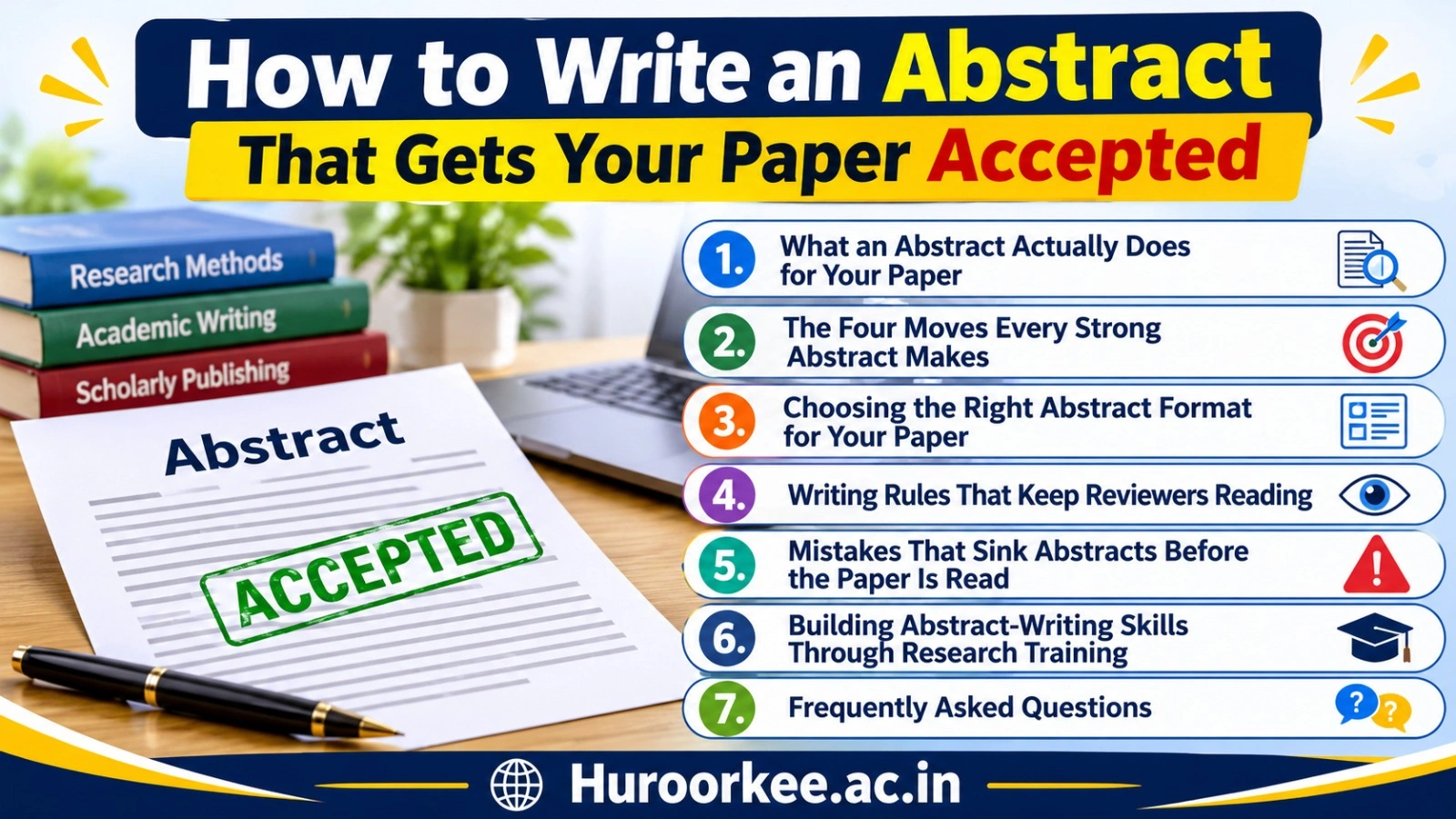
How to Write an Abstract That Gets Your Paper Accepted
Dr. V.K. Saini
Director, Haridwar University
The abstract is usually the first thing an editor or reviewer reads, and it quietly shapes how they read everything after it. Get it right and your methods get a fair hearing. Get it wrong and even strong results can feel like they're hiding. This guide shows how to write an abstract that gets your paper accepted, from deciding what goes in to polishing the final sentence.
It's written for undergraduates, postgraduate scholars and first-time authors, and it works for journal papers, conference submissions and dissertations alike. One note before we start: abstract rules differ from journal to journal, so treat your target venue's author guidelines as the final word.
Abstract formats at a glance
| Format | What it contains | Best suited to |
|---|---|---|
| Structured | Labelled sections such as Background, Methods, Results and Conclusions | Original research with a clear methods-and-results flow |
| Informative | One paragraph covering the problem, method, findings and meaning | Papers that report results but don't require labelled headings |
| Descriptive | A summary of what the paper covers, without the findings | Reviews, position papers and some conference proposals |
Table of Contents
- 1. What an Abstract Actually Does for Your Paper
- 2. The Four Moves Every Strong Abstract Makes
- 3. Choosing the Right Abstract Format for Your Paper
- 4. Writing Rules That Keep Reviewers Reading
- 5. Mistakes That Sink Abstracts Before the Paper Is Read
- 6. Building Abstract-Writing Skills Through Research Training
- 7. Frequently Asked Questions (FAQs)
1. What an Abstract Actually Does for Your Paper
Think of the abstract as a standalone summary that has to work even if nobody opens the full text. Readers meet it in databases, search results and conference programmes, usually before they meet anything else you've written. A good one tells them what you studied, how you studied it, what you found and why it matters. A weak one leaves them guessing.
Who reads it, and why
Editors use it to judge fit with the journal. Reviewers use it to set their expectations. Other researchers use it to decide whether your paper is worth downloading. That's three audiences and one short block of text, so every sentence has to earn its place.
What it isn't
It isn't an introduction, and it isn't a teaser. Telling readers you "will discuss" results without stating them is the quickest way to sound vague. Write the abstract last, once you know exactly what your paper claims.
2. The Four Moves Every Strong Abstract Makes
Whatever the format, strong abstracts follow the same logic. The National Library of Medicine describes a structured abstract as one with distinct, labelled sections, giving Introduction, Methods, Results and Discussion as examples. That same logic works inside an unlabelled paragraph too.
Move one: the problem
Spend one or two sentences on the gap. What's unknown, unsolved or inefficient? Skip the history lesson; the reader needs the problem, not the backstory.
Move two: the method
Say what you did in plain terms: the design, the data, the approach. Reviewers need enough to judge credibility, not enough to replicate your work.
Move three: the result
State your main finding with specifics. If you measured something, report the measurement from your own data. A phrase like "significant improvement" tells nobody anything.
Move four: the meaning
Close with what the result implies. Who should care, and what changes because of it? Don't slip in new claims here; the abstract must match the paper.
3. Choosing the Right Abstract Format for Your Paper
Pick your format by checking the journal, not by personal taste. The same NLM page notes that the International Committee of Medical Journal Editors requires structured abstracts for original research articles, systematic reviews and meta-analyses. Outside medicine there's no single rule, and even inside it, a study of English-language medical journals found that almost two-thirds require a structured abstract, yet 314 different structured formats exist among them.
Structured abstracts
Labelled sections force you to cover everything, which is why they suit empirical work. The downside? You can't hide a missing result behind smooth prose.
Informative and descriptive abstracts
An informative abstract packs the whole argument into one paragraph. A descriptive one maps the paper's scope without revealing findings, which fits reviews and position papers. If you're unsure what your venue wants, read three recent abstracts from the same journal and copy their shape, not their words.
4. Writing Rules That Keep Reviewers Reading
Be specific before you're clever
Replace claims with evidence. "We propose a faster algorithm" becomes a statement of what got faster, on which data, by how much, using the real figure from your results.
Keep sentences short and tense consistent
Past tense usually suits what you did and found, while present tense suits what the results mean. Mixing them mid-sentence is a common slip, and it makes the abstract feel unedited.
Use keywords honestly
Databases index abstracts, so include the terms people would actually search for. Don't stuff them in. One clear mention of each core concept is enough.
Borrow structure, not sentences
If you're drafting the full manuscript alongside, HU's guide on how to write a research paper as an undergraduate pairs well with this one. Follow these habits and you'll have a clear answer to how to write an abstract that gets your paper accepted: lead with substance and cut everything else.
5. Mistakes That Sink Abstracts Before the Paper Is Read
Overpromising
Claiming your method "solves" a field-wide problem when you tested one dataset invites scepticism. Match the size of your claim to the size of your evidence.
Too many citations and unexplained abbreviations
Abstracts get read out of context, so avoid citations and define each acronym where it first appears. The reader may never see your introduction.
Ignoring the word limit and instructions
Journals set their own limits and formatting rules. Breaking them can get a submission sent back before anyone has judged the science, so read the author guidelines first, not last.
Leaving no time to revise
Deadlines pile up and the abstract gets written in ten minutes. It shows. Read yours aloud, cut one sentence, then ask someone outside your field to read it cold. And if submission stress is spilling over, HU's student welfare services exist for the non-academic side of research life.
6. Building Abstract-Writing Skills Through Research Training
Nobody writes a perfect abstract on the first attempt. The skill grows through drafting, feedback and revision on real projects. Postgraduate and doctoral programmes give that practice a natural home, because dissertations and papers demand abstracts again and again. In India, doctoral work runs under the UGC's Ph.D. regulations, 2022, which the Ministry of Education lists on its website.
Research programmes at Haridwar University
Haridwar University offers M.Tech., MCA with AI and Ph.D. programmes in computing. The figures below come from HU's fees and scholarships page, which currently shows the 2027-28 structure, as checked on 24 November 2026.
| Programme | Year 1 | Year 2 | Year 3 |
|---|---|---|---|
| M.Tech. CSE | ₹78,000 | ₹70,000 | — |
| MCA with AI | ₹92,000 | ₹75,000 | — |
| Ph.D. CSE | ₹1,00,000 | ₹90,000 | ₹90,000 |
HU also lists an Academic Excellence Award of ₹5,000 for students who score 85% or more in any semester and clear every subject in the first attempt, plus an AICTE scholarship route for M.Tech. students who have qualified GATE-2027. A student can claim only one scholarship, and fees can change, so confirm everything on the official page before you apply.
Start drafting early, ask for feedback often, and come back to this checklist on how to write an abstract that gets your paper accepted every time you submit.
7. Frequently Asked Questions (FAQs)
1. What's the simplest way to approach an abstract?
Here's the short version of how to write an abstract that gets your paper accepted: state the problem, the method, the main result and what it means, in that order, using your own specifics. Then cut anything that doesn't serve those four points.
2. When should I write the abstract?
Write it after the results and conclusions are settled. Drafting it too early means you'll summarise what you hoped to find, not what you actually found.
3. How long should an abstract be?
The journal or conference sets the limit, so check its author guidelines rather than guessing. Limits differ between venues, and going over can lead to a return before review.
4. Should I include citations in an abstract?
Generally not. An abstract is read on its own, so keep it self-contained. If your target venue's instructions say otherwise, follow them.
5. How is an abstract different from an introduction?
An introduction builds the case slowly and sets context. An abstract compresses the whole paper, including findings, into a short standalone summary.
6. Do I need keywords?
Many journals ask for keywords beside the abstract. Choose terms a reader would actually search for, and follow the venue's instructions on how many to list.
7. Can I use AI tools to write my abstract?
Publishers set their own policies on AI assistance, so read your journal's rules before submitting. Either way, you're responsible for accuracy, and the abstract must reflect your own work.
8. What if my paper is a review with no experiments?
Use a descriptive or informative format. Summarise the scope, the sources you drew on and the conclusions you reached, and keep it just as specific as an experimental abstract.
9. How can I get feedback before submitting?
Ask your supervisor, then a peer from a different subject to read it cold. If they can't tell you what you found and why it matters, revise before you submit.
Take Your Research Career Further at Haridwar University
Ready to take your research further? Explore our M.Tech., MCA with AI, and Ph.D. programmes, review fees and scholarships, and start your application for the 2027-28 academic session.