

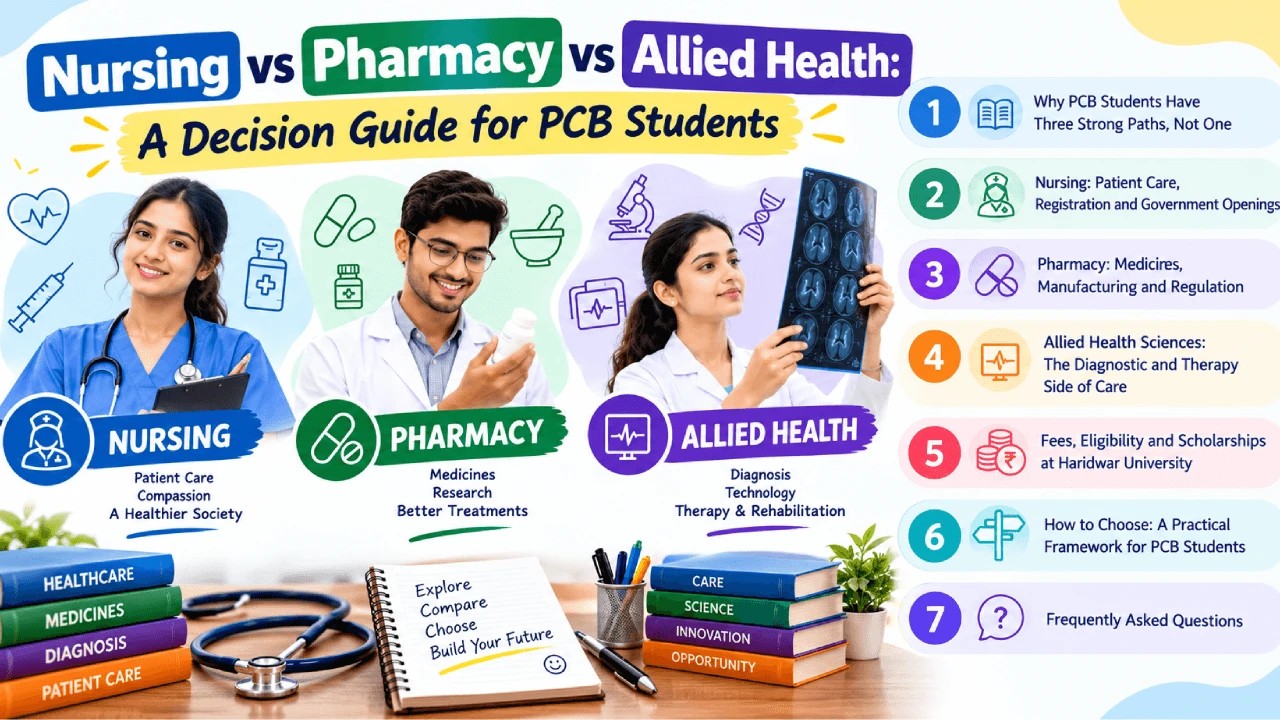
Nursing vs Pharmacy vs Allied Health: A Decision Guide for PCB Students
Ms. Jiya Sajeev
Associate Professor & HOD, Nursing, Haridwar University
Most conversations about careers after Class 12 PCB stop at MBBS. The other health-science routes get far less airtime than they deserve. This guide puts three of them side by side so the choice isn't made in a hurry. Career opportunities after Nursing, Pharmacy and Allied Health are wider than most students expect, but each field asks for a different temperament, a different regulator and a different budget.
Here you'll find what each path involves, how it is regulated, what the programmes cost at Haridwar University for 2026-27, and a short framework for deciding. Fee and scholarship figures come directly from HU's official fee page, and every outside regulatory fact points to a verified government or council source.
Table of Contents
- Why PCB Students Have Three Strong Paths, Not One
- Nursing: Patient Care, Registration and Government Openings
- Pharmacy: Medicines, Manufacturing and Regulation
- Allied Health Sciences: The Diagnostic and Therapy Side of Care
- Fees, Eligibility and Scholarships at Haridwar University
- How to Choose: A Practical Framework for PCB Students
- Frequently Asked Questions
1. Why PCB Students Have Three Strong Paths, Not One
A Physics, Chemistry, and Biology (PCB) background in Class 12 is remarkably flexible, and that is also where the confusion starts. Biology and chemistry branch naturally into three distinct operational domains: patient care, pharmaceutical formulations, and diagnostic technologies. Each runs on completely different working conditions, statutory authorities, and regulatory frameworks:
Nursing Councils
Regulated by the Indian Nursing Council (INC) & State Nursing Councils for clinical bedside care and direct patient recovery.
Pharmacy Council of India
Answers to the PCI under the Pharmacy Act, 1948, governing drug development, synthesis, QA, and registered dispensing.
NCAHP Act, 2021
Regulated under the National Commission for Allied and Healthcare Professions Act, 2021, covering 56 recognized professions across 10 categories.
Mix them up and you may land in a course that doesn't match the day-to-day work you envisioned. So the real question behind career opportunities after Nursing, Pharmacy and Allied Health isn't which field is objectively "best"—it is which one matches how you naturally prefer to work: close to patients through active hospital shifts, in precision laboratories and formulation plants, or operating medical diagnostics behind advanced clinical equipment.
2. Nursing: Patient Care, Registration and Government Openings
Nursing is the most hands-on and patient-facing of the three disciplines. The Indian Nursing Council (INC) regulations structure B.Sc. Nursing as an eight-semester degree completed over four full academic years. The council establishes strict minimum entrance examination percentiles for admission: the 50th percentile for general candidates and the 40th percentile for SC, ST, and OBC candidates.
At Haridwar University, the B.Sc. Nursing (with AI) program requires Class 12 Science with Biology and Chemistry and at least 50% aggregate marks. Accepted admission routes include NEET, recognized state nursing entrance tests, or merit-based evaluation. Always confirm the prevailing state or university quota route for your admission cycle before submitting documents.
Where Nursing Graduates Work
Multispeciality hospitals, community health centres, intensive care units, and collegiate nursing faculties actively hire qualified nurses. In the central government sector, premier institutes such as AIIMS recruit Nursing Officers at Level 07 of the central pay matrix through the National Overseas and Central Eligibility Test (NORCET).
Official recruitment notifications, including the AIIMS NORCET-11 notice (No. 103/2026), mandate a recognized B.Sc. Nursing degree paired with valid State Nursing Council or Indian Nursing Council registration as a Registered Nurse & Registered Midwife (RN/RM). The degree provides qualification; statutory registration enables legal practice.
Haridwar University's nursing curriculum integrates clinical internships in accredited multispeciality teaching hospitals alongside specialized exposure to electronic health records (EHR), telemedicine protocols, and remote patient monitoring. To dive deeper into comparing nursing and pharmacy curriculums, see our detailed analysis on B.Pharm vs B.Sc. Nursing at Haridwar University.
3. Pharmacy: Medicines, Manufacturing and Regulation
Pharmacy appeals to science students who enjoy synthetic chemistry, organic formulations, and analytical biology more than direct bedside patient shifts. The Pharmacy Council of India (PCI) governs all pharmacy education under the Pharmacy Act, 1948. According to the official PCI FAQ portal, only degrees earned from PCI-approved institutions grant legal eligibility for pharmacist state licensing.
The regulatory framework defines structured career ladders: the 2-year Diploma in Pharmacy (D.Pharm) after Class 12, the 4-year Bachelor of Pharmacy (B.Pharm), and the 2-year Master of Pharmacy (M.Pharm) accessible after completing B.Pharm.
What the Professional Work Looks Like
While retail and hospital pharmacy counters are the most visible public faces of the discipline, they represent only a fraction of the career landscape. Haridwar University's flagship B.Pharm (with AI) program prepares graduates for:
- Pharmaceutical Manufacturing & Formulation Tech: Large-scale tablet, injectable, and vaccine synthesis.
- Quality Assurance (QA) & Regulatory Affairs (RA): Auditing clinical trials and drug filings for global regulators (US FDA, EMA, CDSCO).
- Clinical Pharmacy & Pharmacovigilance: Adverse drug reaction monitoring and clinical trials data management.
- Machine Learning in Drug Discovery: AI-powered computational molecular docking and formulation optimization.
Haridwar University provides an interconnected academic ladder within the same campus: a 2-year D.Pharm, a 4-year B.Pharm, a 3-year B.Pharm Lateral Entry (LE) for diploma holders, and a postgraduate M.Pharm in Pharmaceutics. If you are comparing diploma vs degree routes, read our breakdown on B.Pharm vs D.Pharm in India.
4. Allied Health Sciences: The Diagnostic and Therapy Side of Care
Allied health sciences represent the diagnostic, technological, and rehabilitative backbone of the healthcare industry. While nurses deliver direct bedside care and pharmacists manage drug therapies, allied healthcare professionals operate the complex medical instrumentation that isolates diseases, conducts pathological analyses, and provides targeted rehabilitation.
Under the landmark National Commission for Allied and Healthcare Professions Act, 2021, recognized professions include Medical Laboratory Technology (MLT), Medical Radiology & Imaging Technology (MRIT), Physiotherapy, Optometry, and Operation Theatre Technology. Central register enrolment for allied practitioners on the national portal is completely free of charge.
Healthcare Education at Haridwar University
The dedicated constituent institution is the Roorkee College of Allied Health Sciences at Haridwar University. Its official programme structure proudly features Pharmacy Council of India and Indian Nursing Council approvals alongside UGC university recognition.
The college offers premier professional degrees including B.Sc. Nursing, B.Pharm, B.Pharm LE, D.Pharm, and M.Pharm Pharmaceutics. If you are aiming for specialized clinical laboratory or diagnostic diplomas, be sure to consult the admission overview page to verify exact annual intake seat availability.
Because nursing, pharmacy, and allied diagnostic disciplines work synergistically inside modern healthcare networks, completing your qualification within an integrated health-science campus gives you hands-on interdisciplinary clinical exposure from day one.
Explore Allied Health & Pharmacy at Haridwar University
Discover modern laboratories, AI-integrated healthcare curricula, and hospital clinical training.
Explore Roorkee College of Allied Health Sciences →5. Fees, Eligibility and Scholarships at Haridwar University
Financial planning plays a decisive role when choosing between multi-year healthcare degrees. Transparent fee figures from Haridwar University's official fees and scholarships schedule for the 2026-27 academic session (verified 29 October 2026) are detailed below:
| Programme | Duration | Year-Wise Annual Fee | Total Course Tuition |
|---|---|---|---|
| B.Sc. Nursing (with AI) | 4 Years | ₹1,90,000 per year | ₹7,60,000 |
| B.Pharm (with AI) | 4 Years | Yr 1: ₹1,27,000 | Yrs 2-4: ₹1,10,000/yr | ₹4,57,000 |
| B.Pharm LE (with AI) | 3 Years | Yr 1: ₹1,27,000 | Yrs 2-3: ₹1,10,000/yr | ₹3,47,000 |
| D.Pharm (with AI) | 2 Years | Yr 1: ₹80,000 | Yr 2: ₹75,000 | ₹1,55,000 |
| M.Pharm Pharmaceutics | 2 Years | Yr 1: ₹1,57,000 | Yr 2: ₹1,40,000 | ₹2,97,000 |
Over four complete academic years, B.Sc. Nursing comes to ₹7,60,000 versus ₹4,57,000 for B.Pharm—a total tuition gap of ₹3,03,000. Stated figures cover tuition, university enrollment, admission processing, semester examinations, and standard uniforms, with optional transport extra.
Hostel Accommodation & Campus Living
For residential healthcare students, hostel accommodation at Haridwar University is billed annually across three comfortable room formats:
- Standard Room: ₹85,000 per year
- Semi-Deluxe Room: ₹95,000 per year
- AC Deluxe Room: ₹1,05,000 per year
Hostel charges include furnished lodging, four vegetarian meals daily, Wi-Fi connectivity, laundry services, and round-the-clock medical care. Non-vegetarian mess subscriptions add ₹20,000 per academic year.
Institutional Merit & Category Scholarships
Haridwar University offers structured financial concessions on first-year tuition fees based on qualifying Class 12 board examination performance:
- > 90% in Class 12: 80% tuition scholarship
- 80% – 90% in Class 12: 50% tuition scholarship
- 70% – 80% in Class 12: 20% tuition scholarship
- 60% – 70% in Class 12: 10% tuition scholarship
D.Pharm students receive specialized merit slabs of 50%, 30%, 20%, and 10%. Additionally, a 25% first-year tuition concession is granted for girls' education, Uttarakhand state domicile, ward of armed forces personnel, and recognized sports achievers. An academic excellence award pays ₹5,000 cash for students securing 85% or higher in semester exams. Note: Candidates can avail only one scholarship benefit, and private examination candidates are ineligible for merit slabs.
National central and state government scholarship assistance can also be accessed via the central National Scholarships Portal (NSP).
6. How to Choose: A Practical Framework for PCB Students
To make a confident, regret-free choice among nursing, pharmacy, and allied health sciences, run through these three practical evaluation filters:
Check 1: Evaluate the Day-to-Day Work Reality
Look past the degree title. Shadow a healthcare worker or speak to current practitioners. Ward nursing requires emotional stamina, bedside empathy, and rotational night duties. Pharmacy demands meticulous lab accuracy, chemical safety protocols, and regulatory compliance. Diagnostic allied health roles focus on precise equipment operation and specimen reporting. Choose the work routine that resonates with your temperament.
Check 2: Verify Statutory Accreditation & Licensing
Both nursing and pharmacy degrees culminate in mandatory state licensing. Always ensure your chosen university is formally accredited by the relevant statutory body: the Indian Nursing Council (INC) for nursing, or the Pharmacy Council of India (PCI) for pharmacy. For allied health professions, confirm that your target career is scheduled under the NCAHP Act, 2021.
Check 3: Calculate the Total Budget & Campus Support
Calculate the comprehensive cost over the entire study period—tuition, hostel fees, books, clinical lab coats, and transport—with a modest contingency buffer. Then examine institutional support systems. At Haridwar University, comprehensive student welfare services feature dedicated Student Care Centres in each academic block that resolve academic or residential issues within 24 hours, alongside hands-on education loan guidance.
When you evaluate career opportunities after Nursing, Pharmacy and Allied Health, none of these paths is a secondary consolation prize. Each is a vital, noble pillar of the modern medical ecosystem. Pick the discipline you can still feel inspired by on a demanding Thursday, and sustained career success will follow naturally.
7. Frequently Asked Questions
Can I join nursing or pharmacy without NEET?
It depends on the course and the academic year. The Indian Nursing Council mandates minimum entrance percentiles for B.Sc. Nursing, while Haridwar University accepts NEET, state entrance tests, or merit-based evaluation. For B.Pharm and D.Pharm, admission is conducted via pharmacy entrance examinations or qualifying Class 12 PCM/PCB merit.
Which pays more, nursing or pharmacy?
Compensation depends on employer scale, sector, location, and specialization. In government healthcare, official recruiting notices define structured pay bands—such as Level 07 of the central pay matrix for Nursing Officers recruited through AIIMS NORCET. In pharmaceutical industries, research, QA, and regulatory affairs offer dynamic corporate growth ladders.
What do B.Sc. Nursing and B.Pharm cost at Haridwar University?
For the 2026-27 academic session, B.Sc. Nursing tuition is ₹1,90,000 per year, totaling ₹7,60,000 across 4 years. B.Pharm costs ₹1,27,000 in Year 1 and ₹1,10,000 per year for Years 2-4, totaling ₹4,57,000 over 4 years. Residential hostel facilities are available separately from ₹85,000 to ₹1,05,000 annually.
Is D.Pharm or B.Pharm the better start?
Both programs lead to registered pharmacist status upon graduation from a PCI-approved college. D.Pharm takes 2 years and ₹1,55,000 in total tuition, making it the fastest route to retail pharmacy licensing. B.Pharm is a 4-year degree costing ₹4,57,000 that opens industrial manufacturing, regulatory affairs, clinical trials, and postgraduate M.Pharm studies.
Do I need to register after B.Sc. Nursing?
Yes. Graduating with a B.Sc. Nursing degree provides the academic qualification, but clinical employment in hospitals or government bodies (such as AIIMS NORCET) requires formal registration as a Registered Nurse & Registered Midwife (RN/RM) with a State Nursing Council or the Indian Nursing Council.
Is allied health suitable if I dislike ward work?
Yes. Many allied healthcare roles—including pathology laboratory technology, MRI/CT radiography, and clinical optometry—center on diagnostic laboratories and imaging suites rather than continuous bedside ward nursing, providing focused clinical contributions without night bedside care.
Which allied health courses does Haridwar University list?
Under the Roorkee College of Allied Health Sciences, Haridwar University lists B.Sc. Nursing (with AI), B.Pharm (with AI), B.Pharm LE, D.Pharm (with AI), and M.Pharm Pharmaceutics. For questions about individual diagnostic or therapy diplomas, reach out directly to the admissions office.
What scholarships can a PCB student get at Haridwar University?
Merit slabs range from 10% to 80% tuition discount on first-year fees based on Class 12 board marks (with specialized slabs for D.Pharm), alongside a 25% first-year discount for female candidates, state domicile, and sports quota qualifiers. Students can also apply for state and central scholarships through the National Scholarships Portal (NSP).
What if I still can't decide?
Shortlist two preferred programmes, review the official curriculum syllabi, and arrange an informal discussion with a working nurse and a practicing pharmacist. Experiencing their day-to-day work perspective ensures a thoughtful, well-informed career decision.
Launch Your Healthcare Career at Haridwar University
Choose from PCI and INC-approved nursing and pharmacy programs equipped with state-of-the-art simulation laboratories, hospital clinical rotations, and comprehensive merit scholarships for PCB students.