

Fintech Jobs in India for Commerce Graduates: 10 Roles, Salaries & How to Start
Mr. Javed Ali
Head, Business Studies, Haridwar University
A commerce degree can lead to more than conventional accounting, banking or taxation roles. As financial services move towards app-based payments, digital lending, automated compliance and data-led decision-making, fintech companies need people who understand both money and the systems through which it moves. This creates opportunities for B.Com, BBA and finance graduates, including roles that do not require software development skills.
The scale of this change is visible in India’s payment data. Retail digital payments reached 22,167.90 crore transactions in FY 2024–25, with UPI accounting for 81% of the volume. Behind these transactions are processes involving payment operations, reconciliation, fraud checks, customer support and regulatory compliance. These are areas where commerce graduates can build relevant careers. The Ministry of Finance’s digital payments figures offer a useful indication of the ecosystem’s scale.
In this guide, I look at ten fintech jobs in India for commerce graduates, the work involved, the skills employers may expect and practical ways for freshers to prepare.
Table of Contents
- 1. What Fintech Means for Commerce Graduates
- 2. 10 Fintech Jobs for Commerce Graduates
- 3. Fintech Jobs That Do Not Require Coding
- 4. Choosing Between B.Com, BBA and MBA Finance
- 5. Skills Required for Fintech Jobs
- 6. How Freshers Can Enter the Fintech Industry
- 7. Fintech Salaries in India
- 8. Building a Long-Term Fintech Career
- 9. Frequently Asked Questions (FAQs)
- 10. A Fintech Career Is Not One Fixed Profession
1. What Fintech Means for Commerce Graduates
Fintech, short for financial technology, refers to the use of technology to deliver or improve financial services. It includes UPI payments, digital wallets, online lending, investment platforms, insurance technology, payment gateways and financial software used by businesses.
It is not simply another name for the IT industry. A fintech business may employ developers and data scientists, but it also needs people who understand transactions, customer onboarding, credit assessment, accounting, risk and compliance.
The growth of digital payments has increased the importance of processes such as transaction monitoring, payment reconciliation, customer verification and risk management across India’s financial services ecosystem.
For commerce graduates, the opportunity lies in connecting financial knowledge with digital processes. A B.Com graduate who understands reconciliation, for example, may be suited to payment operations. A BBA graduate with analytical and communication skills may find a route into business analysis or customer success.
2. 10 Fintech Jobs for Commerce Graduates
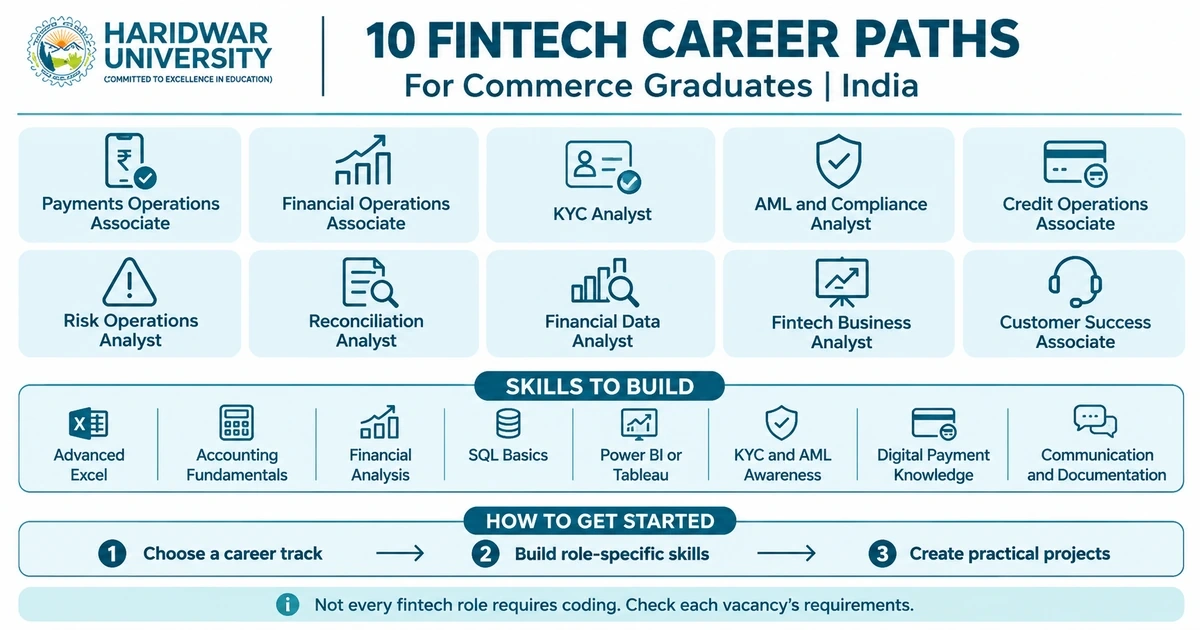
These roles represent potential career paths, not guaranteed fresher vacancies. Employers differ in their degree, experience and technical requirements.
1. Payments Operations Associate
Monitors digital payment transactions, investigates failed payments, follows up on settlement issues and helps resolve transaction disputes. Knowledge of payment cycles and reconciliation is useful.
2. Financial Operations Associate
Supports transaction processing, account records, reporting, invoice checks and operational controls. Accounting fundamentals and advanced Excel can provide a starting point.
3. KYC Analyst
Reviews customer identity documents and onboarding information to help financial institutions meet Know Your Customer requirements. Accuracy, documentation and awareness of verification procedures are important.
4. AML and Compliance Analyst
Supports checks designed to identify suspicious financial activity and reduce money-laundering risks. Graduates need an understanding of compliance processes; specialist roles may require relevant experience or additional training.
5. Credit Operations Associate
Assists with loan application documentation, customer information checks and coordination of credit-processing workflows. Banking and financial management concepts are relevant.
6. Risk Operations Analyst
Helps monitor transactions, flag unusual activity and support risk-control processes. Analytical thinking, spreadsheet skills and attention to detail matter.
7. Reconciliation Analyst
Compares transaction records across banks, payment platforms and internal systems to identify mismatches. Accounting knowledge and Excel are particularly useful.
8. Financial Data Analyst
Works with financial or transaction data to identify patterns, prepare reports and support business decisions. Excel is a starting point; SQL and Power BI can strengthen a candidate’s profile.
9. Fintech Business Analyst
Helps translate business requirements into process improvements, documents workflows and coordinates between business and technology teams. Employers may expect analytical ability, communication skills and familiarity with tools such as Excel, SQL or process-mapping software.
10. Customer Success Associate, Financial Products
Helps customers use digital banking, payment, lending or investment products. The role involves resolving queries, explaining product processes and communicating recurring customer issues to internal teams.
A useful distinction: job titles are not standardised across the industry. A “risk analyst” vacancy at one employer may focus on transaction monitoring, while another may require statistical modelling or programming. Read the responsibilities and eligibility criteria rather than applying on title alone.
3. Fintech Jobs That Do Not Require Coding
Many fintech jobs are built around financial processes rather than software development. Payments operations, KYC review, reconciliation, customer success and some credit operations roles may be accessible without programming, depending on the employer’s requirements.
That does not mean technology knowledge is irrelevant. A candidate should understand how digital transactions work, how customer data is handled and how operational systems support financial services. Excel is often useful; SQL or Power BI may be requested for analytical roles.
If a vacancy lists Python, advanced SQL, APIs or software development as essential requirements, it is probably a technical or data-heavy position. A commerce graduate should not assume that every fintech role has the same entry requirements.
4. Choosing Between B.Com, BBA and MBA Finance
There is no single degree that guarantees entry into fintech. The better choice depends on the kind of work a student wants to pursue.
- B.Com: A useful foundation for accounting, taxation, financial reporting and reconciliation-related roles.
- BBA: Can help develop an understanding of business operations, management, marketing and customer-facing work. Read our full overview on career options after BBA.
- B.Com or BBA with a Finance Specialisation: Offers a more focused route into financial services, subject to the programme’s actual curriculum.
- MBA Finance: May support progression towards financial analysis, business development, product, credit or managerial roles. It is not a universal requirement for entry-level fintech jobs. Explore our guide on careers after MBA.
Students can review Haridwar University’s academic programmes and Roorkee College of Business Studies to compare relevant course options and their curricula. They may also find it useful to read HU’s guide to career options after B.Com, including banking and analytics and its article on AI in finance and accounting for B.Com and MBA students.
A degree should be selected for its subject foundation and learning opportunities, not simply because the word “fintech” appears in a programme title.
5. Skills Required for Fintech Jobs
A commerce graduate does not need to master every tool in the fintech sector. The sensible approach is to build a core skill set and then add role-specific capabilities.
| Skill | Where It Is Useful |
|---|---|
| Advanced Excel | Reconciliation, operations and reporting |
| Accounting Fundamentals | Financial operations and settlements |
| Financial Analysis | Credit, risk and analyst roles |
| SQL Basics | Data analysis and business reporting |
| Power BI or Tableau | Dashboards and visual reporting |
| KYC and AML Awareness | Customer onboarding and compliance |
| Digital Payment Knowledge | Payments operations |
| Communication and Documentation | Customer success and coordination |
Students should also understand basic concepts such as UPI, payment gateways, digital lending, credit scores, transaction disputes and data privacy. The NPCI UPI statistics portal is a useful primary source for understanding India’s UPI ecosystem.
6. How Freshers Can Enter the Fintech Industry
A practical entry plan is more valuable than collecting certificates without a clear job target.
- Choose One Career Track: Start with payments, compliance, credit, reconciliation, customer success or financial analysis.
- Study Job Descriptions: Review 10–15 relevant vacancies and note recurring qualifications, tools and experience requirements.
- Build the Necessary Skills: Practise Excel and financial reporting first. Add SQL, Power BI or compliance knowledge if your chosen track requires them.
- Create Two Practical Projects: For example, prepare a sample transaction-reconciliation sheet using fictional data, or build a dashboard showing monthly payment trends. Never use real customer or banking information.
- Look for Internships and Trainee Roles: Search for titles such as payments operations trainee, KYC associate, reconciliation executive, credit operations associate and customer support associate.
- Prepare Examples for Interviews: Be ready to explain how you would investigate a failed transaction, identify a mismatch in records or handle an incomplete customer document.
Job portals can help identify vacancies, but listings must be checked carefully. Some roles labelled “fresher” still ask for technical skills, specialised qualifications or prior internships.
7. Fintech Salaries in India
Fintech salaries vary by role, city, employer, qualification and experience. A customer support position, a KYC operations role and a financial data analyst position should not be treated as one salary category.
Some published figures help establish a broad reference point. Adecco’s India Salary Guide 2025 lists ₹4 lakh–₹8 lakh per year for Compliance Analyst roles at the 0–3 years experience level. This is a broad compliance-sector benchmark, not a guaranteed fintech fresher salary.
Actual vacancy examples can be lower or higher. A recently advertised cross-border payments operations role in Bengaluru listed ₹3 lakh per annum and welcomed freshers, while a job-listing snapshot for fresher KYC roles showed advertised ranges from approximately ₹3.5 lakh to ₹9 lakh. These are individual listings and platform snapshots, not a national salary average.
For a realistic estimate, compare current vacancies for the exact job title and location. Check whether the advertised figure is fixed pay, total annual compensation or a range that includes incentives. Salary websites can offer broad indications, but their estimates may combine different experience levels and responsibilities.
As a fresher, focus on the quality of the role, the training provided and the skills you will gain. A first job in payment operations or compliance can provide a foundation for later movement into risk, process management, analytics or product operations.
8. Building a Long-Term Fintech Career
The strongest fintech candidates are not necessarily those who know the most software. They are the ones who can understand a financial problem, work accurately with information and communicate what needs to happen next.
For commerce graduates, that means building on familiar subjects such as accounting, banking and finance while becoming comfortable with digital systems and data. Start with one role, study its requirements and develop evidence of your ability through practical projects or internships. That is a more credible route into fintech than trying to learn every tool in the industry at once.
9. Frequently Asked Questions (FAQs)
1. Can a commerce student get a job in fintech?
Yes. Commerce graduates may qualify for roles in payments operations, reconciliation, KYC, credit operations, customer success and some analyst positions. Eligibility depends on the employer and the specific job description.
2. Is fintech a good career option after B.Com?
It can be suitable for B.Com graduates interested in financial services and technology-enabled processes. Accounting, financial reporting and analytical skills can be relevant to several non-development roles.
3. Do fintech jobs require coding?
No. Many operations, compliance, customer support and reconciliation roles do not require coding. Data and technical roles may require SQL, Python or other programming skills.
4. Which degree is best for a career in fintech?
B.Com, BBA and finance-related degrees can all provide relevant foundations. The right choice depends on whether a student is interested in accounting, business operations, financial analysis, compliance or technology.
5. What skills should a fresher learn for fintech jobs?
Start with Excel, accounting fundamentals, communication and digital payment concepts. Add SQL, Power BI, KYC or AML knowledge according to the role you are targeting.
6. Can I enter fintech without an MBA?
Yes. Many entry-level roles consider graduates with a relevant bachelor’s degree. An MBA may be useful for certain specialist or managerial career paths, but it is not a general entry requirement.
7. How can I find fintech jobs for freshers in India?
Search job portals and company career pages using specific titles such as KYC analyst, payments operations associate, credit operations trainee and reconciliation analyst. Check the experience requirement, degree eligibility and required tools before applying.
10. A Fintech Career Is Not One Fixed Profession
A fintech career is not one fixed profession. It is a collection of roles across payments, lending, compliance, operations, analytics and customer experience. Commerce graduates who understand their strengths and add the right digital skills can make a considered start in this expanding financial ecosystem.
Ready to Build Your Career in Commerce & Management?
Prepare for leadership roles in digital banking, fintech, corporate finance, and business analytics. Explore our industry-aligned B.Com, BBA, and MBA degree programmes at Haridwar University with practical training, dedicated placement support, and generous merit scholarships. Applications are open for the 2027-28 session.