

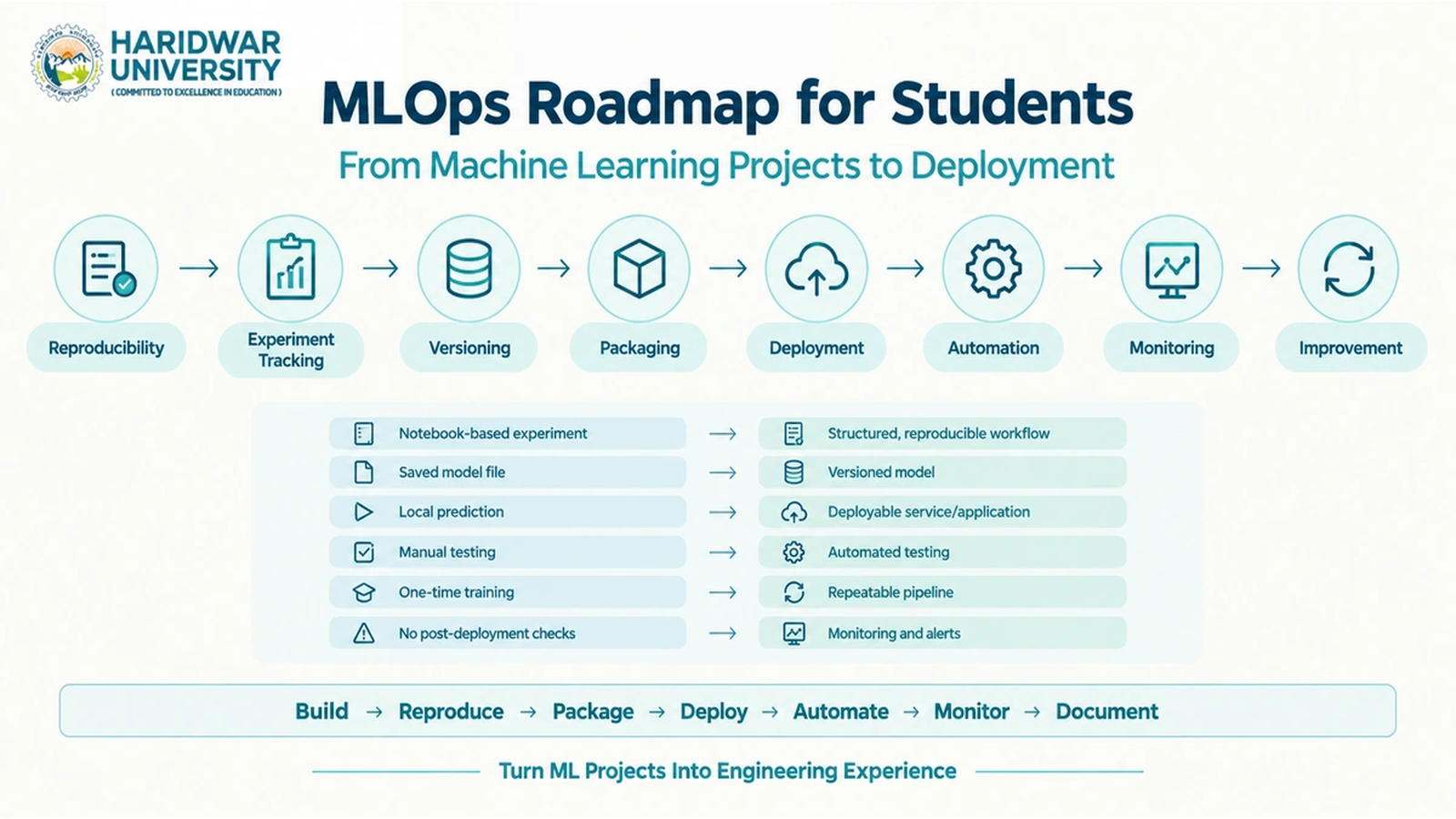
MLOps Roadmap for Students: From Machine Learning Projects to Deployment
Dr. Himanshu Verma
Head of Department, Computer Science & Engineering, Haridwar University
Roadmap Table of Contents
- What MLOps Adds to a Student's Machine Learning Project
- Learn the Foundations Before Starting MLOps
- Follow an MLOps Roadmap From Model Training to Production
- Turn a Machine Learning Model Into a Deployable Application
- Add Reproducibility, Versioning and Experiment Tracking
- Use Automation and CI/CD to Make ML Workflows Repeatable
- Understand Monitoring Because Deployment Is Not the End
- Learn MLOps Tools According to the Problem You Are Solving
- Build an MLOps Project That Demonstrates Engineering Capability
- Show MLOps Skills Through a Technical Portfolio
- Avoid Common MLOps Learning Mistakes
- Frequently Asked Questions (FAQs)
When I review student machine-learning projects in our department, I often see the exact same pattern: the model works inside a Jupyter notebook, a high accuracy score is reported, a few confusion matrix screenshots are copied into slides, and the project abruptly concludes there.
That is a reasonable starting point, but it leaves critical engineering questions unanswered: What happens when someone else needs to reproduce your results? How do you deploy this model for external users? How do you know when incoming data drifts and model accuracy deteriorates?
This is precisely where MLOps (Machine Learning Operations) becomes indispensable.
MLOps adapts proven DevOps principles to machine learning workflows, bridging the gap between isolated experimentation and production-ready, automated, and maintainable systems. For engineering students at Haridwar University and technical universities nationwide, MLOps should not be treated as a daunting catalogue of enterprise tools to memorise. Rather, it represents the vital engineering discipline that converts a theoretical model into a complete, defensible software product.
What MLOps Adds to a Student's Machine Learning Project
The clearest way to grasp the value of MLOps is to contrast a standard college assignment with a production-oriented machine learning system:
| Typical Student ML Project | MLOps-Oriented Engineering System |
|---|---|
| Isolated notebook-based experiment | Structured, modular, and reproducible repository |
| Implicit, unpinned local dependencies | Explicit environment definitions (Docker, venv, requirements) |
Single static file (e.g. final_model.pkl) |
Versioned model artifacts registered with metadata & lineage |
| Manual comparison of print statements | Automated experiment tracking (MLflow parameters & metrics) |
| Local manual predictions in cell outputs | Deployable RESTful API service (FastAPI) handling live payloads |
| Manual sanity checks or no testing | Automated unit and integration testing via CI/CD pipelines |
| One-off training script on a single machine | Automated, repeatable training pipelines |
| No post-deployment observability | Inference logging, latency monitoring, and data drift detection |
The difference is not that one project uses a more exotic mathematical algorithm. It is that MLOps manages the entire engineering lifecycle surrounding the model.
Learn the Foundations Before Starting MLOps
Students should never begin MLOps by blindly setting up distributed Kubernetes clusters or complex cloud architectures. I recommend establishing four non-negotiable prerequisites:
1. Python & Software Design
Modular code organisation, OOP principles, type hints, exception handling, and virtual environment isolation.
2. Git & Version Control
Atomic commits, branch management, pull requests, semantic version tags, and proper .gitignore hygiene.
3. ML Fundamentals
Data pre-processing, feature scaling, train/val/test splits, loss functions, and domain-appropriate evaluation metrics.
4. APIs & CLI Tooling
Basic terminal navigation, bash scripting, curl requests, and understanding HTTP request/response methods.
For strong preparatory groundwork, students can refer to our guides on Python Libraries for Machine Learning and 20 Machine Learning Projects for Beginners.
Follow an MLOps Roadmap From Model Training to Production
Teach MLOps as an orderly sequence where each milestone solves a concrete engineering problem:
| Stage | What to Learn | Evidence to Produce |
|---|---|---|
| 1. Reproducibility | Git, pinned environments, clean directory layout | Re-runnable project on any peer's computer |
| 2. Experiment Tracking | Logging hyperparams, loss curves, evaluation metrics (MLflow) | Comparable runs dashboard with logged parameters |
| 3. Versioning | Data versioning concepts (DVC) and model registries | Traceable model linked to exact dataset version |
| 4. Packaging | Docker containerisation, multi-stage builds | Portable, self-contained Docker image |
| 5. Deployment | FastAPI REST endpoints, JSON payload validation | Live inference API endpoint with Swagger docs |
| 6. Automation | Pytest, GitHub Actions, CI/CD automated test runs | Automated build & test workflow on git push |
| 7. Monitoring | Inference logs, latency percentiles, data/concept drift | Logging setup tracking input anomalies & drift |
| 8. Retraining Loop | Automated retraining triggers and model registry promotion | Documented lifecycle from staging to production |
Build Production AI Systems at Haridwar University
Our B.Tech. Hons. AI & Machine Learning under the Roorkee College of Smart Computing integrates hands-on MLOps, containerisation, and cloud deployment directly into laboratory coursework.
Turn a Machine Learning Model Into a Deployable Application
A trained model serialised inside a notebook is merely an artifact—not an operational application. The practical engineering transition follows this four-stage pipeline:
At this stage, students learn how external client applications transmit JSON payloads to an endpoint, how the schema is validated with Pydantic, how pre-processing transforms raw features, and how the inference response is returned with millisecond latency.
Add Reproducibility, Versioning and Experiment Tracking
A single diagnostic question distinguishes a casual student script from a professional machine learning project: Can an independent reviewer reproduce the exact test metrics you published?
Disciplined engineering requires recording five elements during every training run:
- Git Commit Hash: The precise state of training code.
- Dataset Hash / Version: The specific snapshot of input records.
- Hyperparameters: Learning rates, regularisation penalties, tree depths, and random seeds.
- Validation Metrics: Confusion matrices, ROC-AUC, precision, recall, and F1 scores.
- Model Artifacts: Serialised binaries registered with version tags.
Experiment-tracking frameworks like MLflow log these parameters automatically through clean Python decorators. Avoid saving ad-hoc files like final_model_v2_final.pkl; maintain traceable lineage so every deployed model can be mapped back to its training run.
Use Automation and CI/CD to Make ML Workflows Repeatable
Continuous Integration and Continuous Deployment (CI/CD) are not corporate buzzwords—they are essential safeguards against silent regressions in machine learning systems.
↓ [Trigger GitHub Actions Runner]
✓ lint: flake8 & black formatting check passed
✓ test: pytest schema validation & input sanitisation tests passed
✓ benchmark: model inference latency < 45ms verified
✓ build: multi-stage Docker image compiled & tagged
✓ deploy: container updated to staging environment
Automating build and test cycles ensures that breaking schema updates or syntax errors are halted before reaching production endpoints.
Understand Monitoring Because Deployment Is Not the End
The Post-Deployment Reality: Models Decay Over Time
A machine learning model can achieve 96% accuracy upon initial launch and still become useless within three months. Real-world consumer preferences shift, economic conditions fluctuate, and incoming sensor distributions diverge. This degradation—known as data drift and concept drift—must be continuously detected through telemetry.
Student MLOps architectures should incorporate the continuous operational loop:
Learn MLOps Tools According to the Problem You Are Solving
Rather than hoarding tools, select libraries when a specific technical challenge demands them:
| Operational Problem | Recommended Tool / Technology |
|---|---|
| Source Code Versioning | Git, GitHub / GitLab |
| Experiment Tracking & Logging | MLflow Tracking, Weights & Biases |
| Model Registry & Lineage | MLflow Model Registry |
| Containerisation & Environments | Docker, Docker Compose |
| REST API Serving | FastAPI, Pydantic, Uvicorn |
| Automated Testing & CI/CD | Pytest, GitHub Actions |
| Inference Monitoring & Drift | Evidently AI, Prometheus, structured JSON logging |
Build an MLOps Project That Demonstrates Engineering Capability
Instead of architecting an unwieldy distributed system from scratch, upgrade an existing machine learning model in four manageable iterations:
Project 1: API Serving
Train a classifier and wrap it in a lightweight FastAPI application with Swagger documentation.
Project 2: Tracking & DVC
Integrate MLflow tracking and pin dataset versions using DVC or explicit remote storage.
Project 3: CI/CD Pipelines
Add automated pytest unit tests and compile a Docker image via GitHub Actions workflows.
Capstone: Production Loop
Deploy the container, log incoming inferences, and automate data drift alerts.
For advanced capstone ideas, explore our faculty guides on Deep Learning Project Ideas and How to Build an AI Portfolio for Job Applications.
Show MLOps Skills Through a Technical Portfolio
Recruiters and engineering directors do not give points for buzzwords listed on a CV. In your GitHub repository, provide visible proof across 10 structured sections:
Avoid Common MLOps Learning Mistakes
- Over-engineering with Kubernetes: Do not set up distributed clusters before you can build a reliable Docker container running locally.
- Tool Collector Syndrome: Memorising marketing taglines for ten MLOps frameworks is not the same as debugging a deployment regression.
- Ignoring Reproducibility: If your script only works on your specific machine with local path dependencies, it fails basic engineering scrutiny.
- Stopping at the API: Deploying the endpoint is half the battle; real-world engineering requires observing inference latency and monitoring drift.
Turn ML Projects Into Engineering Experience
The hallmark of a high-calibre engineering graduate is disciplined execution: Build → Reproduce → Package → Deploy → Automate → Monitor → Document. When you master these practices, your machine learning projects cease to be classroom exercises—they become production-ready systems that win technical interviews.
Frequently Asked Questions (FAQs)
1. What is MLOps for students?
MLOps is the set of practices that helps students move machine-learning work from experimentation towards reproducible, deployable and maintainable systems.
2. How long does it take to learn MLOps?
The timeline depends on your existing Python, ML and software-development knowledge. It is better to progress through practical projects than to follow an arbitrary number of study days.
3. Do I need to know DevOps before learning MLOps?
No. Basic knowledge of source control, environments, testing and deployment is useful, but you can learn the relevant DevOps practices alongside MLOps.
4. Can students learn MLOps without cloud experience?
Yes. Start with local reproducibility, versioning, experiment tracking, packaging and a small deployment. Cloud services can be introduced when the project requires them.
5. Which MLOps tools should beginners learn first?
Start with tools that solve immediate project problems. Git and environment management are useful foundations, followed by experiment tracking and deployment-related tools as your projects become more complex.
6. Is MLOps difficult for machine-learning beginners?
It can feel difficult if you approach it as a large collection of technologies. It becomes more manageable when learned as a sequence of practical improvements to an existing ML project.
7. What MLOps project should a student build first?
Start by taking a small machine-learning model and making it reproducible and deployable. Then add experiment tracking, automated testing and monitoring progressively.
Master Applied Machine Learning & Systems at Haridwar University
Learn cutting-edge artificial intelligence, software deployment, and cloud infrastructure with hands-on lab access, expert faculty mentorship, and comprehensive placement training in Roorkee.