

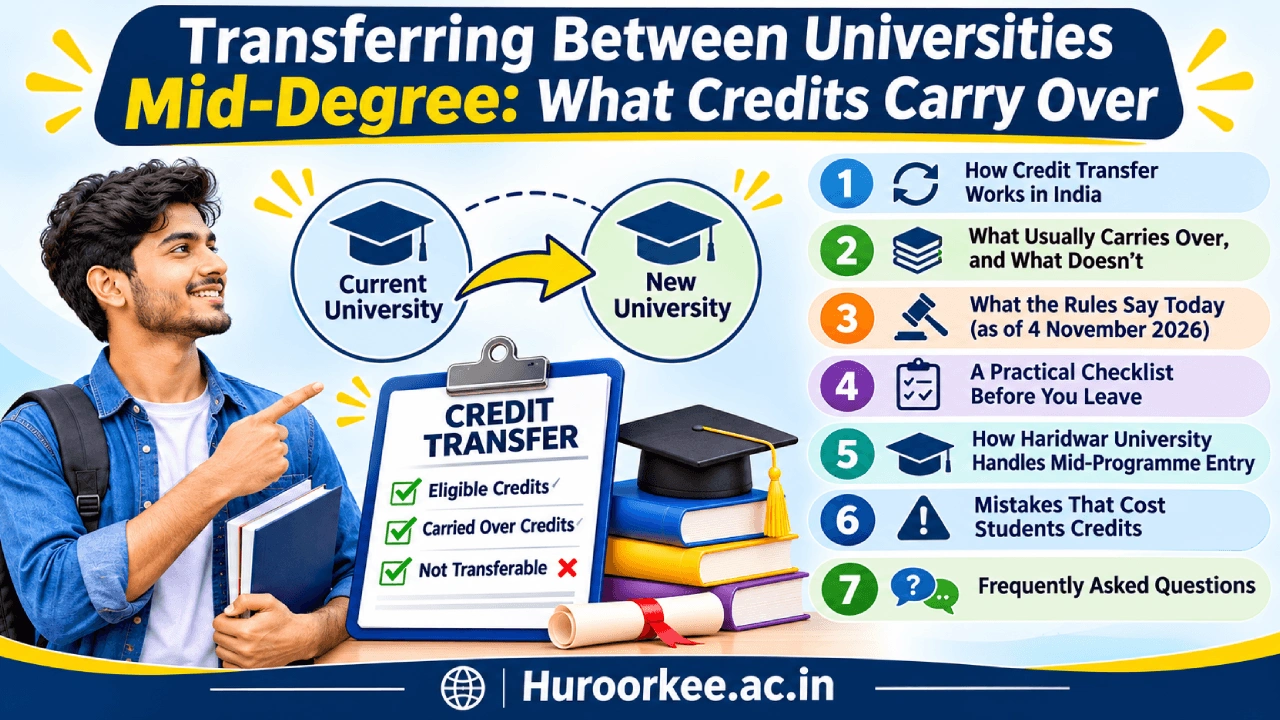
Transferring Between Universities Mid-Degree: What Credits Carry Over
Mr. Jitendra Chaudhary
Admissions Manager, Haridwar University
Transferring between universities mid-degree sounds straightforward until you face the question that really matters: what happens to the semesters you have already finished? Some students lose an entire academic year because subjects fail equivalence checks. Others walk into their new campus with almost all completed coursework recognised and credited. That gap rarely comes down to luck. It comes down to regulatory rules, meticulous paperwork, and precise timing—nearly all of which can be resolved before withdrawing from your existing institution.
This comprehensive guide adheres strictly to published standards: University Grants Commission (UGC) and Ministry of Education regulations governing the national credit system, and Haridwar University's official provisions for lateral entry and mid-programme admissions. Every policy, credit threshold, and figure detailed below has been verified as of November 2026.
Quick View: Which Credits Carry Over and Which Do Not
| Credit Situation | Can It Carry Over? | What the Regulations State |
|---|---|---|
| Courses credited and uploaded to ABC | Yes, subject to acceptance | The receiving university evaluates syllabus equivalence; ABC only holds data uploaded by the awarding university. |
| Credits earned before academic year 2021-22 | Not via ABC platform | ABC regulations cover learning earned from the 2021-22 academic session onwards. |
| Credits older than seven years | No | Maximum validity period under UGC credit framework is seven years from date of completion. |
| Credits already redeemed for a degree/award | No | Redeemed credits are locked permanently and cannot be re-applied to another qualification. |
| SWAYAM / NPTEL online course credits | Yes, within regulatory cap | Up to 40% of total programme credits may be earned through SWAYAM where approved by the institution. |
| More than 50% of the programme's credits | Not permitted | At least 50% of the total degree credits must be earned directly at the degree-awarding institution. |
Table of Contents
- How Credit Transfer Works in India
- What Usually Carries Over, and What Doesn't
- What the Rules Say Today (as of November 2026)
- A Practical Checklist Before You Leave Your Current College
- How Haridwar University Handles Mid-Programme & Lateral Entry
- Mistakes That Cost Students Credits and Semesters
- Frequently Asked Questions (FAQs)
- Securing a Clean, Worry-Free Transfer
1. How Credit Transfer Works in India
In Indian higher education, an academic credit represents an objective unit of learning workload. According to the Academic Bank of Credits (ABC) regulations as established by the University Grants Commission, credit values are calculated methodically:
- Theory & Tutorials: One hour of classroom lecture or tutorial per week over a 15-week semester equals 1 academic credit (15 contact hours).
- Practical & Laboratory Work: Two hours of laboratory or workshop practicals per week across a semester equals 1 academic credit (30 practical hours).
- Internships & Field Work: One full week of structured internship or industrial training earns 1 credit, with a cumulative cap of up to 6 credits.
Crucially, academic credits are awarded strictly by the registered higher education institution where you completed the coursework—not by the student or third-party agencies.
The Academic Bank of Credits in Plain Words
The Academic Bank of Credits (ABC) is a national digital platform set up by the Ministry of Education and governed by the UGC under the National Education Policy (NEP) 2020. As explained in the official Press Information Bureau (PIB) backgrounder, the ABC acts as a virtual storehouse: it securely deposits, accumulates, transfers, and redeems academic credits earned by students.
Your college exam branch registers these credits electronically against your unique 12-digit ABC ID (linked to DigiLocker and Aadhaar). Individual students cannot manually upload marks sheets or self-certify grades onto the portal.
Why the Receiving University Has the Final Say
A widespread misconception among undergraduates is believing that because credits sit safely in their ABC account, any university must accept them automatically. This is incorrect. The ABC is an administrative record-keeper and ledger, not an autonomous degree-awarding authority.
The university you are transferring to retains full academic autonomy. Its Board of Studies and Academic Council examine your previous course syllabi, contact hours, curriculum weightage, and evaluation methods against their own course requirements. Therefore, transferring mid-degree operates like an academic handshake: your previous institution must officially release and upload the earned credits, and the new institution must formally accept their syllabus equivalence.
Detailed Platform Guide: To understand how the portal interface works and how digital transfer requests are submitted, read our comprehensive guide on Credit Transfer and the Academic Bank of Credits.
2. What Usually Carries Over, and What Doesn't
To know whether your previously earned courses will transfer successfully, evaluate them against four critical regulatory filters. Credits must successfully satisfy every filter.
Filter 1: Course and Syllabus Equivalence
Courses matching the receiving programme in core content, learning objectives, and depth have the highest likelihood of seamless credit transfer. For instance, standard introductory courses like Engineering Mathematics, Basic Electrical Engineering, or Object-Oriented Programming often match closely. Conversely, if your prior college offered unique non-standard electives that have no curriculum counterpart at the new university, the receiving institution may either count them as open electives or reject transfer credit entirely.
Filter 2: The Mandatory 50% Institutional Credit Ceiling
Under UGC ABC regulations, at least 50% of the total credits required for any academic award or degree must be earned at the university conferring the degree. For example, if a bachelor's degree curriculum mandates 160 total credits, you must complete at least 80 credits in residency at the new university.
Even if you possess 100 perfectly matched credits from your previous college, the new institution cannot accept more than 80 credits. For this reason, attempting a mid-degree transfer during your final academic year often runs directly into this statutory ceiling, preventing students from obtaining the final degree on an accelerated timeline.
Filter 3: Credit Shelf-Life and One-Time Redemption
Academic credits do not last forever. Under the national credit framework, credits have a maximum shelf-life of seven years from the date of completion, or the specific discipline validity limit set by university regulations. Furthermore, credits accumulated prior to the 2021-22 academic session cannot be migrated via the ABC system. Crucially, once credits have been redeemed towards the award of a qualification (such as an undergraduate diploma or bachelor's degree), they are marked as redeemed and cannot be reused towards another qualification.
Filter 4: Online and MOOCs Course Limits
Credits completed on approved digital portals such as SWAYAM and NPTEL can carry over, up to a regulatory limit of 40% of the total programme credits. However, the receiving university must have formally adopted the UGC Online Credit Transfer regulations for that specific degree. To date, approximately 388 universities across India have formally adopted this regulation.
3. What the Rules Say Today (as of November 2026)
The operational benchmark for mid-degree mobility continues to rest upon the UGC (Establishment and Operation of Academic Bank of Credits in Higher Education) Regulations. Key regulatory directives to keep in mind include:
- Mandatory Digital Onboarding: UGC mandated that all recognised Higher Education Institutions (HEIs) must onboard their students and upload completed semester transcripts directly to the ABC portal.
- National Credit Framework (NCrF) Adoption: While higher education bodies are rapidly aligning with the NCrF, adoption remains phased across various state and central universities. Always confirm your prior institution's current compliance status.
- Status of Higher Education Regulatory Bills: Proposals such as the Viksit Bharat Shiksha Adhishthan Bill, 2025 (introduced to unify UGC, AICTE, and NCTE under an apex national commission) remain under review before the Joint Parliamentary Committee as of November 2026. A legislative bill is not enacted law; therefore, all established UGC and statutory council regulations govern credit recognition today.
Regulatory Tip: Academic guidelines undergo periodic updates. Always verify statutory notifications directly on the official UGC portal in the week you submit your formal transfer documentation.
4. A Practical Checklist Before You Leave Your Current College
Avoid taking impulsive steps that might jeopardize your academic standing. Follow this sequential, 4-step checklist before handing in your withdrawal paperwork:
-
Generate and Verify Your ABC ID:
Register on the ABC platform through your Aadhaar-linked DigiLocker account. Verify that your legal name, date of birth, and identity credentials match your university enrolment records identically. -
Ensure All Completed Semesters Are Uploaded by Your Current Institution:
Contact your current college's examination branch or registrar office. Verify that marks and earned credits for every completed semester have been uploaded and approved on the ABC database. If marks are missing, only your existing university can upload them. -
Obtain Written Course Mapping and Credit Evaluation:
Submit certified copies of your semester marksheets, detailed syllabus brochures, and course outcomes to the target university's admissions authority. Request an official written credit evaluation statement specifying which subjects are accepted, which require bridge courses, and the exact credits needed to graduate. Never withdraw from your college based on informal or verbal assurances. -
Time Your Migration Around Official Semester Results:
Do not attempt to migrate mid-way through an active, unexamined term. A semester with pending examinations or unpublished results carries zero official credits to transfer. Finalise your transfer between the publication of semester results and the start of the subsequent term.
For more details on securing official documentation from your previous institution, review our resource on how to obtain transcripts, migration, and bonafide certificates.
5. How Haridwar University Handles Mid-Programme & Lateral Entry
At Haridwar University (HU), admissions adhere strictly to merit-based principles and criteria formulated by the Academic Council. Under Haridwar University's academic regulations, lateral entry and mid-programme admissions are facilitated subject to seat availability and academic screening.
- Academic Screening: Candidates undergo evaluation by the respective departmental admission committee to verify subject prerequisites, practical competencies, and syllabus alignment.
- Mandatory Bridge Courses: Where curriculum variations exist between the student's prior syllabus and HU's coursework, the university may prescribe specific bridge subjects. As per university regulations, candidates must clear all prescribed bridge courses within one academic year, failing which admission stands cancelled.
- Institutional Evaluation: Because Haridwar University does not publish a one-size-fits-all credit transfer percentage table, every transfer application is assessed on its individual academic merits. Written admission approvals must always be secured from the Admissions Office.
To review program criteria, visit the official Haridwar University Eligibility Criteria page.
Haridwar University Lateral Entry Fee Structure
Haridwar University maintains a transparent fee structure for lateral entry admissions across professional programmes. Below are the published lateral-entry lines from the official HU Fees & Scholarships schedule:
| Programme (Lateral Entry) | First Listed Year | Second Year | Third Year | Sum of Listed Years |
|---|---|---|---|---|
| B.Tech. Hons. LE – Computer Science & Engineering (CSE) | ₹1,32,000 | ₹1,15,000 | ₹1,15,000 | ₹3,62,000 |
| B.Tech. Hons. LE – Artificial Intelligence & Machine Learning (AI & ML) | ₹1,62,000 | ₹1,45,000 | ₹1,45,000 | ₹4,52,000 |
| B.Tech. Hons. LE – Electronics & Communication Engineering (ECE) | ₹1,32,000 | ₹1,15,000 | ₹1,15,000 | ₹3,62,000 |
| Bachelor of Pharmacy (B.Pharm LE with AI) | ₹1,27,000 | ₹1,10,000 | ₹1,10,000 | ₹3,47,000 |
Note: Fee schedules apply to approved lateral entry streams. Always consult admissions to verify program applicability and semester placement for your specific transfer circumstances. For technical comparisons between 4-year standard degrees and lateral entry, check our guide on Regular vs Lateral Entry B.Tech.
Scholarships and Financial Support Considerations
Haridwar University provides substantial merit scholarships based on qualifying competitive examination ranks (JEE Main, CUET) or Class 12 percentages. However, published scholarship slabs primarily designate first-year admission intakes, and students may avail only one primary institutional scholarship.
Mid-programme applicants should clarify scholarship eligibility with the admissions dean during evaluation. Notably, Haridwar University also offers an Academic Excellence Award of ₹5,000 for students securing 85% or higher in semester examinations, which remains open to continuing and lateral-entry scholars alike.
6. Mistakes That Cost Students Credits and Semesters
Transferring between universities mid-degree does not have to cost you time or momentum. Avoiding these three critical mistakes will safeguard your academic progression:
Mistake 1: Withdrawing Before Securing Written Acceptance
Never request a formal College Leaving Certificate (CLC) or cancel your registration until the receiving university has issued a formal provisional offer and written credit mapping. If credits fall short, reverting a cancelled seat at your original college is often impossible.
Mistake 2: Letting the Credit Clock Run Down
Remember that banked credits expire after seven years. If personal or professional reasons require pausing your studies, take advantage of the NEP 2020 Multiple Entry and Exit Scheme (MEES). According to official PIB records, 153 universities now offer modular exit awards: exit after year one with an Undergraduate Certificate, after year two with an Undergraduate Diploma, or complete year three/four for a full Bachelor's degree.
Mistake 3: Navigating Administrative Hurdles Alone
Academic records can be held up by mismatched spelling, delayed portal synchronization, or pending library dues. Once at Haridwar University, students can access dedicated administrative guidance through the Student Welfare & Student Care Centre located in each academic block, which provides rapid 24-hour query resolution.
7. Frequently Asked Questions (FAQs)
1. Can I transfer between universities in the middle of a semester?
Transferring mid-semester is extremely risky and generally discouraged. The ABC system and universities only recognise coursework that has undergone formal examination and has official credits uploaded. An incomplete, ongoing term has zero verifiable credits to transfer. You should always complete your examinations and migrate between academic terms.
2. How many credits can I transfer from my previous college to a new university?
Under UGC ABC regulations, at least 50% of the total programme credits must be completed at the university awarding your final degree. Consequently, a maximum of 50% of your total required degree credits may carry over. The receiving institution may accept fewer credits depending on syllabus compatibility.
3. Do my accumulated university credits expire?
Yes. Under the national credit framework, credits remain valid for a maximum shelf-life of seven years from the date of completion, or as specified by the academic discipline. In addition, once credits are redeemed towards an awarded qualification, they cannot be reused.
4. What is an ABC ID and how do I create one?
An ABC ID is a unique 12-digit virtual identification number issued on the Academic Bank of Credits platform. You can generate your ABC ID via DigiLocker or the official portal (abc.gov.in) using your Aadhaar details. Your university deposits all verified course credits directly against this ID.
5. Will my SWAYAM and NPTEL online course credits transfer with me?
Yes, SWAYAM credits can carry over up to 40% of the degree's curriculum, provided the receiving university has formally implemented the UGC online credit regulations and approves the specific courses for your curriculum.
6. Will Haridwar University accept credits from my current institution?
Haridwar University permits mid-programme lateral entry and credit transfer subject to seat availability and departmental screening. Because each case requires syllabus mapping, applicants must submit their previous marksheets and syllabi to the admissions team for an official written credit evaluation.
7. What are the tuition fees after transferring into Haridwar University?
Haridwar University maintains published lateral entry fee structures (e.g., ₹1,32,000 for the first listed year of B.Tech. CSE lateral entry; ₹1,27,000 for B.Pharm LE). Final fee schedules depend on the assigned semester and stream, which is confirmed in writing by the admissions department.
8. Which essential documents should I collect from my previous university?
You should collect certified semester marksheets, your official syllabus copy signed by the department, a Transfer Certificate (TC) or College Leaving Certificate (CLC), a Migration Certificate, and proof of your ABC ID credit ledger.
9. Can a lateral entry or transfer student qualify for scholarships at HU?
While major merit scholarships are primarily tied to first-year entrance ranks, mid-programme applicants can discuss financial assistance options with admissions. Furthermore, the ₹5,000 Academic Excellence Award for achieving 85%+ in semester exams is open to all enrolled students regardless of entry year.
Securing a Clean, Worry-Free Transfer
Transferring between universities mid-degree is a significant academic pivot, but it does not need to result in lost credits or delayed graduation. By taking proactive ownership of your academic records—verifying your ABC ledger, comparing curriculum outcomes, timing your departure correctly, and obtaining written credit evaluations from admissions—you can ensure your hard-earned coursework moves with you smoothly.
For aspiring students exploring opportunities to resume or advance their education, Haridwar University offers industry-aligned degrees across computing, engineering, management, health sciences, and pharmacy. Explore our complete directory of undergraduate and postgraduate programmes or connect directly with our admissions counsellors to discuss your lateral transfer plan.
Ready to Advance Your Education at Haridwar University?
Whether you are seeking lateral entry or transferring credits, Haridwar University provides career-focused, NEP-aligned education designed for real-world impact. Admissions are open for the 2026-27 academic session.