

Data Analyst vs Data Scientist vs ML Engineer: Roles, Skills, Salaries & Career Paths in India
Dr. Himanshu Verma
Associate Professor & HOD, Computer Science & Engineering, Haridwar University
When students ask me about Data Analyst vs Data Scientist vs Machine Learning Engineer, I find that the hardest part is rarely learning the definitions. The harder question is deciding what kind of work they actually want to do day in and day out.
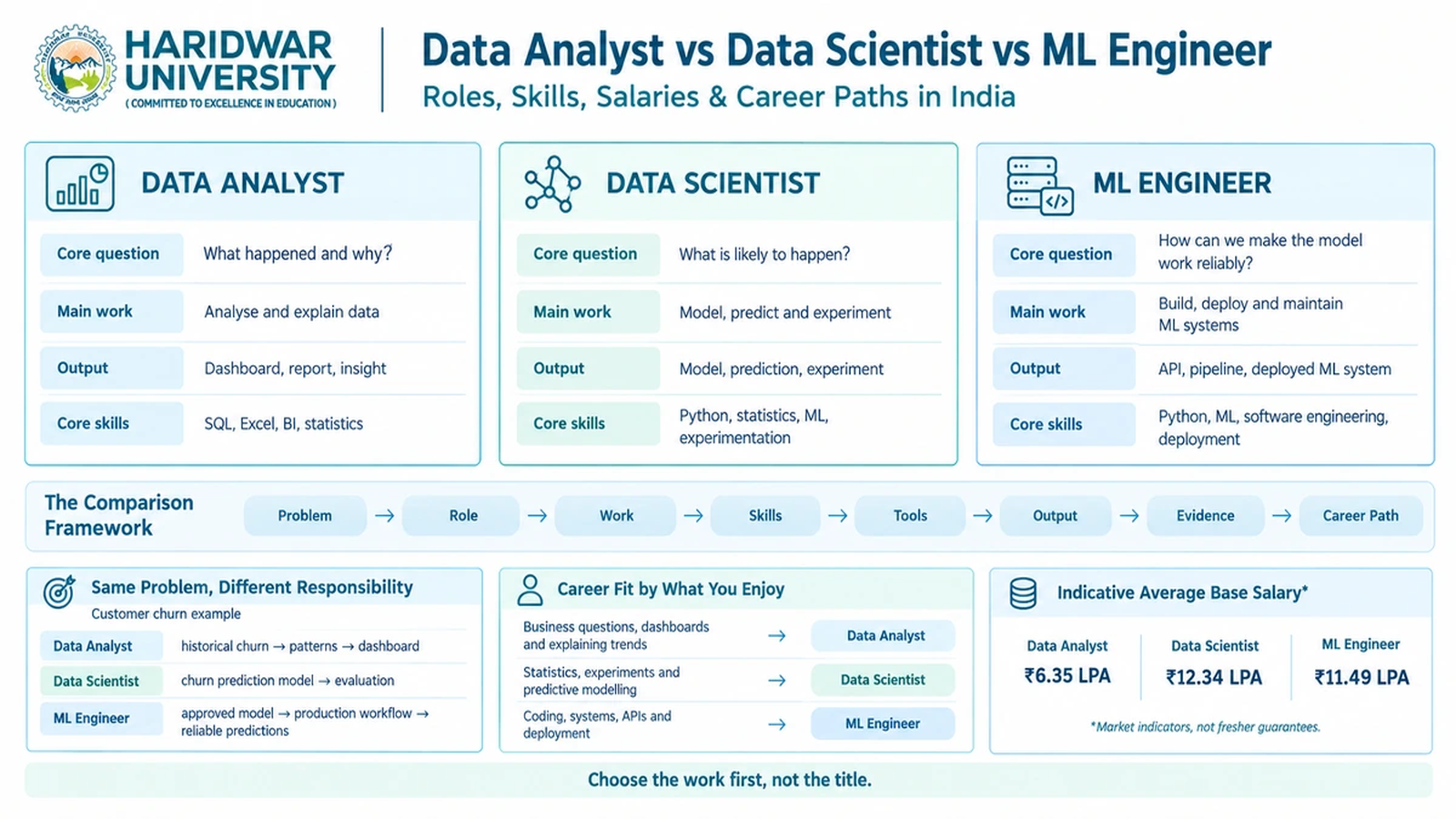
A Data Analyst turns data into business insight. A Data Scientist uses statistics, experimentation and machine learning to answer predictive questions. A Machine Learning Engineer takes models and helps turn them into reliable, production-grade software systems. The boundaries overlap, but the work, skills and evidence expected from each role are not identical.
That distinction matters more than a salary headline. Current Indian salary data, for example, puts average base pay at about ₹6.35 lakh for Data Analysts, ₹12.34 lakh for Data Scientists and ₹11.49 lakh for Machine Learning Engineers. However, these figures come from different sample sizes and experience mixes, so they should not be treated as guaranteed fresher salaries.
My preferred framework to compare the three is simple: Problem → Role → Work → Skills → Tools → Output → Evidence → Career Path
Table of Contents
- 1. How Data Analyst, Data Scientist and ML Engineer Roles Differ
- 2. What a Data Analyst Actually Does
- 3. What a Data Scientist Actually Does
- 4. Where a Machine Learning Engineer Fits
- 5. How the Three Roles Solve the Same Problem Differently
- 6. How the Skills Differ Across the Three Roles
- 7. How the Tools Differ From Role to Role
- 8. What Students Should Build for Each Career Path
- 9. How the Entry Difficulty Differs Across the Three Roles
- 10. How to Move From Data Analyst to Data Scientist or ML Engineer
- 11. How Salaries Compare in India in 2026
- 12. Which Data Career Fits Different Student Strengths
- 13. Frequently Asked Questions (FAQs)
- 14. Choose the Data Role by the Work You Want to Do
1. How Data Analyst, Data Scientist and ML Engineer Roles Differ
The clearest distinction is not the software each person uses. It is the responsibility attached to the work. The boundaries change by company—a early-stage startup may expect one person to perform all three functions. That is why I advise students to read the job description rather than just the job title.
| Area | Data Analyst | Data Scientist | ML Engineer |
|---|---|---|---|
| Core Question | What happened and why? | What is likely to happen? | How can we make the model work reliably? |
| Main Work | Analyse and explain data | Model, predict and experiment | Build, deploy and maintain ML systems |
| Typical Output | Dashboard, report, business insight | Model, prediction, experiment results | API, data pipeline, deployed ML service |
| Core Skills | SQL, Excel, BI tools, statistics | Python, statistics, ML, experimentation | Python, ML, software engineering, deployment |
| Engineering Depth | Moderate | Moderate to high | High |
| Deployment Scope | Usually limited | Sometimes | Central / Production |
| Primary Communication | Business-facing | Technical + business | Technical + product / engineering teams |
2. What a Data Analyst Actually Does
A Data Analyst generally starts with a business or operational question: Why did sales fall in Q3? Which customer segment is growing? Where are operational costs increasing? Which product is underperforming?
The analyst extracts, cleans and examines relevant data using SQL, spreadsheets, business intelligence platforms (Power BI, Tableau) and descriptive statistical techniques. The final product is not simply a chart—it is an actionable explanation that a manager can use.
A structured student analytical workflow: Business Question → Data Extraction → Cleaning → Analysis → Visualisation → Insight → Recommendation
That last step matters immensely: a dashboard full of colorful graphs is not automatically analysis. For students building this quantitative foundation, Haridwar University's B.Sc. Computer Science (Data Science) programme includes programming, DBMS, AI/ML, data mining, Big Data Analytics, Machine Learning with Python and NLP.
3. What a Data Scientist Actually Does
Data Science moves further into statistical modelling, prediction and experimentation. A Data Scientist asks whether customers are likely to churn, whether a credit transaction looks fraudulent, which features drive an outcome, or whether a predictive algorithm outperforms an established baseline.
The Data Science workflow becomes: Problem Framing → Data Pipeline → Hypothesis → Feature Engineering → Model Training → Evaluation → Interpretation
This requires far more than knowing how to import an Scikit-learn library. Statistics, probability distributions, bias-variance tradeoffs, model evaluation metrics (ROC-AUC, F1-score) and experimental design are core. I caution students against treating every predictive script as "Data Science"—a model is only useful when the problem is framed properly and the validation supports real-world decisions. Haridwar University's comprehensive B.Tech AI & ML guide outlines how mathematics, machine learning, deep learning, NLP, computer vision and MLOps build a progressive career pathway.
4. Where a Machine Learning Engineer Fits
The Machine Learning Engineer sits closer to software engineering, backend architecture and production systems. Suppose a Data Scientist has trained an accurate churn model in a Jupyter Notebook. Someone still needs to make that model usable inside an enterprise application serving thousands of live requests.
That engineering lifecycle involves:
- Packaging and serializing the model artifact
- Building high-performance REST / gRPC API endpoints
- Connecting model inference to real-time application pipelines
- Writing automated unit, regression and integration test suites
- Managing model artifacts and dataset versioning
- Automating continuous retraining pipelines (CI/CD for ML)
- Deploying services to containerised cloud environments
- Monitoring live telemetry for data drift and concept drift
This is why I do not define an ML Engineer simply as "a Data Scientist who knows Docker". The responsibility is fundamentally broader: make machine learning function dependably as part of a mission-critical software system. To understand this lifecycle, read Haridwar University's detailed MLOps Roadmap for Students, which explores the step-by-step transition from offline experiments to production-grade deployment.
5. How the Three Roles Solve the Same Problem Differently
Consider a concrete business scenario: Customer Churn in a Subscription SaaS Platform.
- The Data Analyst examines historical churn records, identifies behavioral segments (e.g., users who log in less than twice a week), and creates an executive dashboard pinpointing exactly where revenue leakage occurs.
- The Data Scientist develops a churn prediction model, tests multiple classification algorithms, conducts feature importance analysis, and evaluates model sensitivity to flag at-risk subscribers 30 days before contract expiry.
- The ML Engineer takes the approved churn model, packages it into a microservice, configures batch and real-time inference pipelines, integrates it with the CRM, and monitors inference latencies and prediction drift in production.
Same business challenge—three completely distinct responsibilities and deliverables. This is the exact distinction every student should recognize before committing to a learning roadmap.
6. How the Skills Differ Across the Three Roles
Skills overlap across data roles, but their required depth, mastery, and day-to-day purpose vary significantly:
| Skill Domain | Data Analyst | Data Scientist | ML Engineer |
|---|---|---|---|
| SQL | Essential | Important | Useful |
| Excel / Business Intelligence | Strong | Useful | Limited |
| Statistics & Probability | Basic – Moderate | Strong / Core | Moderate |
| Python Programming | Useful – Important | Essential | Essential |
| Machine Learning | Basic Awareness | Core | Core |
| Software Engineering Practices | Useful | Important | Essential |
| APIs & Microservices | Limited | Useful | Important |
| Cloud Computing | Useful | Useful | Important |
| MLOps & Automation | Limited | Useful | Core |
| Communication & Storytelling | Essential | Essential | Essential |
The pattern is more important than any arbitrary checklist: Data Analyst skills centre on analysis; Data Scientist skills centre on modelling and statistical inference; ML Engineer skills add substantial software architecture and systems engineering responsibility.
7. How the Tools Differ From Role to Role
Tools evolve quickly, so do not build your entire four-year university plan around memorising temporary software brand names. An analyst may work with SQL dialect, Excel, Power BI or Tableau. A Data Scientist may live in Python, Pandas, NumPy, Scikit-learn, Jupyter Notebooks, PyTorch and MLflow. An ML Engineer layers on FastAPI/Flask, Docker containers, Kubernetes, AWS/Azure pipelines, CI/CD runners, and MLOps monitoring suites.
The durable skill is knowing why a tool is being selected for the problem. This is also why students should avoid collecting superficial certificates without building functional projects. Haridwar University's guide to 25 Final-Year Project Ideas for CSE & AI/ML Students champions a project-first mindset connecting real industry challenges with practical technical stacks.
8. What Students Should Build for Each Career Path
A portfolio should demonstrate the exact proof-of-work associated with your target role, rather than generic textbook clones:
| Target Role | Demonstration Project | Evidence to Showcase |
|---|---|---|
| Data Analyst | Sales Performance & Margin Analysis | Complex SQL scripts, data cleaning documentation, KPI definitions, interactive dashboard, executive business presentation |
| Data Scientist | Customer Churn Prediction & Scoring | Exploratory Data Analysis (EDA), feature engineering rationale, cross-validation, hyperparameter tuning, model limitations analysis |
| ML Engineer | Production Churn Scoring Service | Dockerized inference API, automated PyTest suite, GitHub Actions CI/CD pipeline, DVC data versioning, Prometheus latency monitoring |
This focused portfolio approach is far more compelling to hiring managers than three disconnected tutorial repos. In my guide on How to Build an AI Portfolio for Job Applications, I outline how choosing, executing, documenting, and deploying practical systems creates demonstrable hiring evidence.
9. How the Entry Difficulty Differs Across the Three Roles
I avoid saying that Data Analysis is "easy" and ML Engineering is "hard". They are demanding in distinctly different ways:
- Data Analysis demands comfort with large tabular databases, SQL logic, business acumen, and verbal clarity when presenting to non-technical stakeholders.
- Data Science adds rigorous mathematical intuition, inferential statistics, experimental design, and algorithmic problem formulation.
- ML Engineering adds deep software engineering discipline, systems architecture, distributed computing, and containerised deployment reliability.
A student who dislikes advanced calculus and statistical probability may find Data Science deeply frustrating. Another who enjoys mathematical modelling but dislikes Docker, Linux sysadmin work and CI/CD pipelines will strongly prefer Data Science over ML Engineering. Difficulty is largely a matter of cognitive fit rather than simple hierarchy.
10. How to Move From Data Analyst to Data Scientist or ML Engineer
Career transitions in data science rarely require starting your education from scratch. They involve systematically layering new capabilities on top of existing foundations:
From Data Analyst → Data Scientist
Path: SQL & Descriptive Analytics → Python → Inferential Statistics → Machine Learning Algorithms → A/B Experimentation → Model Validation
From Data Scientist → ML Engineer
Path: Notebook Modelling → Object-Oriented Software Engineering → REST APIs (FastAPI) → Unit Testing → Docker → Cloud Pipelines → MLOps
From Software Engineer → ML Engineer
Path: Backend Programming → Applied ML Mathematics → Model Training → Feature Stores → Data Pipelines → Distributed Inference Architecture
11. How Salaries Compare in India in 2026
Salary figures cited across social media need much more analytical scrutiny than most career blogs suggest. Indeed's verified India career benchmarks report the following average base compensation:
| Role | Indicative Average Base Salary* | Verified Source Sample |
|---|---|---|
| Data Analyst | ₹6.35 LPA | Indeed India (636 salaries reported) |
| Data Scientist | ₹12.34 LPA | Indeed India (374 salaries reported) |
| Machine Learning Engineer | ₹11.49 LPA | Indeed India (51 salaries reported) |
*Note: These figures represent indicative market benchmarks across all experience levels, not guaranteed campus starting offers. Compensation fluctuates substantially based on technical skill, city tier, employer scale, specialization, and interview problem-solving rigor.
The figures also show why I would not choose a career solely because one table says it “pays the most”. A Data Scientist average, for example, includes experienced professionals and cannot be interpreted as a graduate's expected starting salary.
For students, skills, internships, demonstrable projects and role fit are more useful decision variables than a single salary number.
12. Which Data Career Fits Different Student Strengths
When guiding students through career decisions, I find this self-assessment matrix very helpful:
| If You Naturally Enjoy... | Strongest Starting Career Fit |
|---|---|
| Business operations, dashboards, financial metrics and communicating trends | Data Analyst |
| Mathematical curiosity, probability, hypothesis testing and predictive algorithms | Data Scientist |
| Software architecture, APIs, Linux environments, containers and cloud deployment | Machine Learning Engineer |
Remember: there is no single "winner". An analyst can gradually expand into predictive modelling and transition into Data Science. A software developer can learn model fine-tuning and transition into ML Engineering.
13. Frequently Asked Questions (FAQs)
Which is better, a Data Analyst or an ML Engineer?
Neither is universally better. Data Analysis suits students who prefer analytical and business-facing work, while ML Engineering suits those who enjoy software systems, deployment and machine learning.
Who gets paid more, a Data Scientist or an ML Engineer?
Current Indeed India averages are relatively close, with Data Scientists at about ₹12.34 lakh and ML Engineers at about ₹11.49 lakh in the cited 2026 data. Experience and employer can change the comparison considerably.
Which is easier, Data Analysis or Data Science?
Data Analysis is often the more accessible starting point because it generally requires less advanced modelling. However, the difficulty depends on the student's strengths in statistics, programming and business analysis.
Are ML Engineers in high demand in India?
ML engineering remains an active technical hiring area, with current Indian listings spanning product companies, technology firms and specialised AI/ML teams. Demand should be assessed role by role rather than treated as a guarantee of employment.
Is machine learning required for Data Science?
Machine learning is an important part of many Data Scientist roles, but Data Science also depends on statistics, data preparation, experimentation, communication and problem formulation.
Can a Data Analyst become a Data Scientist or ML Engineer?
Yes. The transition requires deliberate skill expansion. Analysts moving towards Data Science usually add Python, statistics and machine learning, while those moving towards ML Engineering need substantially stronger software engineering and deployment skills.
Can AI replace Data Analysts, Data Scientists or ML Engineers?
AI is changing the tools used across all three roles, but the work still requires problem definition, data judgement, evaluation, communication and responsibility for technical decisions. The more useful question for students is how to work effectively with AI rather than assuming a job title will remain unchanged.
14. Choose the Data Role by the Work You Want to Do
When I compare these three careers with students, I return to one foundational rule: do not choose the job title first; choose the nature of the work you want to master.
If you enjoy turning messy corporate information into clear strategic answers, Data Analysis is a solid foundation. If you want to investigate patterns, build predictive models and test hypotheses, Data Science takes you deeper into statistical inference. If you want to make those models function inside dependable, fault-tolerant software systems, ML Engineering provides that engineering layer.
For students at Haridwar University, the wider computing ecosystem offers industry-aligned degrees including B.Tech (Hons.) Computer Science with AI & ML, B.Tech (Hons.) Data Science, BCA with Data Science, and B.Sc. Computer Science (Data Science) through the Roorkee College of Smart Computing. The career choice becomes clear when you stop asking "Which role pays more?" and begin asking "Which kind of problems do I want to become exceptional at solving?"
Launch Your Career in Data Science, AI & Machine Learning
Build industry-ready capability in Artificial Intelligence, Big Data Analytics, and Machine Learning Systems at Haridwar University's Roorkee College of Smart Computing. Work in cutting-edge labs, complete real-world projects, and secure top technology placements.