

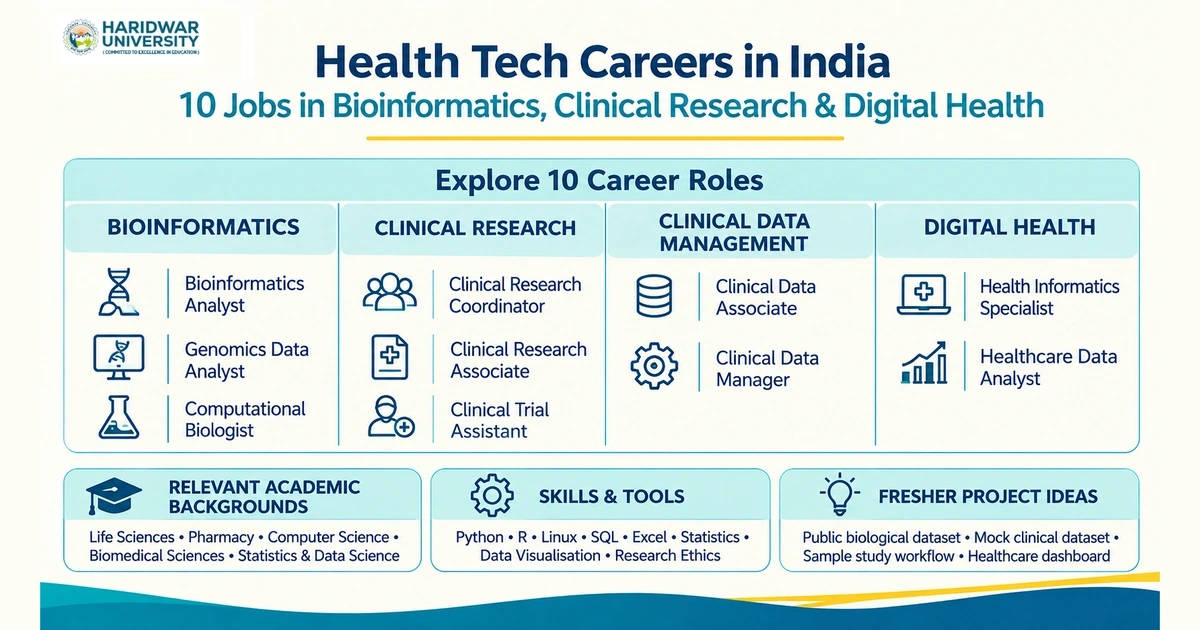
Health Tech Careers in India: 10 Jobs in Bioinformatics, Clinical Research & Digital Health
Dr. Deovrat Kumar
Head of Pharmacy, Haridwar University
Healthcare increasingly depends on people who can work with biological data, clinical trials, patient information and digital systems. Behind a genomic study, a clinical trial or an electronic health record platform are professionals combining scientific knowledge with data analysis, research procedures and technology. These developments are creating varied health tech careers in India.
For students, the field offers more than one route. A life sciences graduate may explore bioinformatics or clinical research, while someone with a computing background may work in healthcare analytics or health informatics. Pharmacy and allied health graduates can also explore clinical data and research-related roles, depending on the employer’s eligibility requirements.
I would encourage students to look beyond job titles. The more useful starting point is understanding what each professional actually does, which academic background is relevant and what practical skills employers expect.
Table of Contents
- 1. What Health Technology Means for Career Opportunities
- 2. Four Major Areas of Health Tech Careers
- 3. 10 Health Tech Jobs in India
- 4. Degrees and Qualifications for Health Tech Careers
- 5. Skills and Tools Required for Health Tech Jobs
- 6. How Freshers Can Start a Career in Health Technology
- 7. Health Tech Salaries and Career Progression
- 8. Where Health Tech Professionals Work
- 9. Frequently Asked Questions (FAQs)
- 10. Choosing the Right Health Tech Career Path
1. What Health Technology Means for Career Opportunities
Health technology, or health tech, covers the use of science, data and digital tools to support healthcare, medical research and health services. The World Health Organization includes artificial intelligence, big data, health information systems, telemedicine and interoperability within the wider digital health landscape.
India’s digital health initiatives also make this area relevant. The Ayushman Bharat Digital Mission is working towards a connected digital health ecosystem. This involves technology, health information exchange and systems that support access to digital health services.
The career implications extend beyond software development. Healthcare organisations need professionals who understand biological information, clinical research processes, data quality and the systems through which health information is recorded and used.
2. Four Major Areas of Health Tech Careers
These career areas overlap, but their everyday responsibilities are different.
| Area | Main Focus | Typical Work |
|---|---|---|
| Bioinformatics | Biological and genomic data | Analysing DNA, RNA and other biological datasets |
| Clinical Research | Medical studies and clinical trials | Study coordination, documentation and monitoring |
| Clinical Data Management | Clinical trial information | Data entry, validation, query resolution and database management |
| Digital Health | Technology-enabled healthcare | Health information systems, analytics and digital applications |
Bioinformatics is generally more computational and research-oriented. Clinical research involves people, protocols and study documentation. Clinical data management focuses on the accuracy and integrity of trial information. Digital health connects healthcare knowledge with information systems and technology.
3. 10 Health Tech Jobs in India
The following roles illustrate different entry points. Actual responsibilities and eligibility vary by employer, project and experience.
1. Bioinformatics Analyst
Works with biological datasets, including genomic and sequencing information. Responsibilities can include processing data, running analysis workflows and interpreting results with researchers. Python, R, Linux and biological databases are useful skills.
2. Genomics Data Analyst
Analyses genetic and sequencing datasets to identify patterns or variations relevant to research. The role requires an understanding of molecular biology, statistics and data interpretation.
3. Computational Biologist
Uses computational methods and mathematical models to investigate biological questions. This role often involves research experience and stronger foundations in programming, statistics and biological sciences.
4. Clinical Research Coordinator
Supports the day-to-day organisation of clinical studies. Responsibilities may include coordinating study visits, maintaining records, communicating with research teams and ensuring that activities follow approved study procedures.
5. Clinical Research Associate (CRA)
Monitors clinical trial activities at research sites on behalf of a sponsor or contract research organisation. The work can include reviewing study documentation, checking protocol compliance and reporting findings. Some CRA positions require prior clinical research experience.
6. Clinical Trial Assistant
Provides administrative and documentation support to clinical research teams. Work may involve maintaining trial files, tracking documents, organising study records and supporting regulatory submissions.
7. Clinical Data Associate
Helps maintain the accuracy and completeness of clinical trial data. Typical tasks include reviewing electronic case report forms, identifying inconsistencies and raising data queries for resolution.
8. Clinical Data Manager
Oversees processes used to collect, validate and organise clinical study data. The role may involve database design, data review, query management and coordination with clinical and statistical teams. It is generally a progression role rather than an automatic fresher position.
9. Health Informatics Specialist
Works with healthcare information systems and the way clinical information is collected, stored, accessed and used. Understanding healthcare workflows, data standards and information systems is important.
10. Healthcare Data Analyst
Analyses healthcare information to identify patterns and prepare reports for operational, research or service-related decisions. Excel, SQL, statistics and data visualisation can be relevant, depending on the organisation.
4. Degrees and Qualifications for Health Tech Careers
There is no single degree that qualifies someone for every health tech job. The right academic route depends on the work involved.
| Academic Background | Relevant Career Directions |
|---|---|
| Biotechnology, Bioinformatics and Life Sciences | Bioinformatics, genomics and biological research |
| Pharmacy | Clinical research, clinical data and pharmaceutical research |
| Microbiology and Biochemistry | Laboratory research, clinical research and selected bioinformatics roles |
| Computer Science and IT | Healthcare analytics, health informatics and healthcare software |
| Biomedical Sciences | Clinical research and healthcare technology |
| Statistics and Data Science | Healthcare data analysis and research analytics |
Employers may specify particular degrees, postgraduate qualifications or experience. A computer science graduate, for example, may be suited to healthcare data systems but may need additional biological knowledge for genomic analysis.
Students can explore relevant academic options through Haridwar University’s programme listings and Allied Health Sciences programmes. These pages describe the University’s listed computing and health-sciences programmes; they should not be interpreted as offering a dedicated bioinformatics or clinical research degree unless specifically listed. For a wider comparison of healthcare disciplines, read our analysis on nursing vs pharmacy vs allied health for PCB students.
5. Skills and Tools Required for Health Tech Jobs
Technical skills matter, but accuracy and responsible handling of information are equally important.
- Bioinformatics: Python or R, Linux, statistics, sequence analysis and biological databases. The NCBI Sequence Read Archive provides publicly available sequencing data that researchers can use for further analysis.
- Clinical Research: Good Clinical Practice (GCP) awareness, study documentation, protocol understanding, communication and research ethics. India’s New Drugs and Clinical Trials Rules, 2019 provide an important regulatory reference. Explore how machine learning is supporting drug discovery in our guide on AI in pharmacy.
- Clinical Data Management: Excel, data validation, database concepts, electronic data capture systems and careful documentation.
- Digital Health: SQL, data visualisation, health information systems, interoperability and an understanding of healthcare workflows.
Clinical research also requires respect for participant safety, informed consent and ethical review. Students should understand the ICMR National Ethical Guidelines for Biomedical and Health Research before treating clinical research as simply a documentation job.
6. How Freshers Can Start a Career in Health Technology
A certificate can introduce a subject, but practical evidence helps candidates explain what they can do. I recommend choosing a small project aligned with the intended role.
- Bioinformatics: Explore a suitable public biological dataset and document the analysis steps, tools and limitations.
- Clinical Research: Prepare a sample study workflow showing the purpose of a protocol, participant documentation and the responsibilities of a research team.
- Clinical Data Management: Create a mock clinical dataset and demonstrate how missing values, inconsistent entries and data queries can be identified.
- Digital Health: Build a basic healthcare dashboard using a sample dataset, clearly explaining what each indicator represents.
Students should use only datasets that are publicly available and appropriate for learning. Patient information must not be copied, shared or used without proper authorisation and safeguards.
HU students can also explore the University’s research and innovation opportunities and its internship guidance to understand how research projects and industry exposure can support practical learning. The internship guide is specifically written for B.Tech students, so other students should confirm opportunities with their respective departments.
7. Health Tech Salaries and Career Progression
There is no reliable single salary figure for health tech careers. Pay varies according to the role, employer, city, qualification, technical specialisation and experience. A clinical trial assistant, bioinformatics analyst and healthcare data analyst should not be treated as equivalent positions.
Candidates should compare current vacancies using the exact job title and experience requirement. They should also distinguish entry-level roles from specialist positions such as computational biologist or clinical data manager, which may require postgraduate study or substantial experience.
Career progression can involve moving from research or data support into specialist analysis, project coordination, database management or team leadership. The route depends on the candidate’s technical development and the organisation’s structure.
8. Where Health Tech Professionals Work
Health tech roles are found across several types of organisations:
- Pharmaceutical Companies: Clinical research, drug development and clinical data.
- Contract Research Organisations (CROs): Trial coordination, monitoring and data management.
- Biotechnology and Genomics Companies: Sequencing, bioinformatics and computational biology.
- Hospitals and Healthcare Networks: Health information systems, clinical applications and data analysis.
- Diagnostics and Research Laboratories: Genomic analysis, laboratory data and research support.
- Health-Tech Companies: Digital health platforms, healthcare analytics and software services.
Not every employer uses the phrase “health tech” in its job advertisements. Search for specific titles such as bioinformatics analyst, clinical trial assistant, clinical data associate and health informatics specialist.
9. Frequently Asked Questions (FAQs)
1. Is bioinformatics a good career in India?
It can suit students interested in biology, computing and data analysis. Opportunities depend on relevant qualifications, practical skills, research experience and employer requirements.
2. Is bioinformatics an IT job?
It uses computing and programming, but it is not simply an IT role. Bioinformatics applies computational methods to biological and medical research questions.
3. Is NEET compulsory for a bioinformatics career?
NEET is not a universal requirement for bioinformatics careers. Admission requirements depend on the specific degree and institution. Students should check the eligibility criteria of their chosen programme.
4. Can freshers get clinical research jobs in India?
Yes. Some employers recruit graduates for clinical trial assistant, research support and coordinator positions. Eligibility and experience requirements vary, and certain CRA roles require previous experience.
5. Is coding necessary for health tech careers?
Not every role requires coding. Programming is useful in bioinformatics and healthcare analytics, while clinical research and some clinical data roles place greater emphasis on documentation, research procedures and data quality.
6. What is the difference between clinical research and clinical data management?
Clinical research covers the planning and conduct of studies involving participants. Clinical data management focuses on collecting, checking and maintaining the information generated during those studies.
7. Which degree is best for a career in digital health?
There is no single best degree. Computer science, IT, data science, pharmacy, biomedical sciences and other healthcare-related disciplines can be relevant, depending on the role.
10. Choosing the Right Health Tech Career Path
Health tech is not one profession, and students should not choose a course simply because a job title sounds promising. The better decision comes from matching academic interests with the actual work: biological analysis, clinical studies, data management or digital healthcare systems.
My advice is to build a strong foundation in one area, learn the tools used in that field and complete a project that demonstrates practical understanding. In healthcare, technical ability must go alongside accuracy, ethics and responsibility. Those qualities make a stronger starting point for a sustainable career.
Explore Health Sciences & Computing at Haridwar University
Build a foundation for dynamic careers in pharmacy, healthcare analytics, allied health sciences, and digital technology. Discover accredited programmes, state-of-the-art research laboratories, and merit scholarships up to 80%. Applications open for 2027-28.