

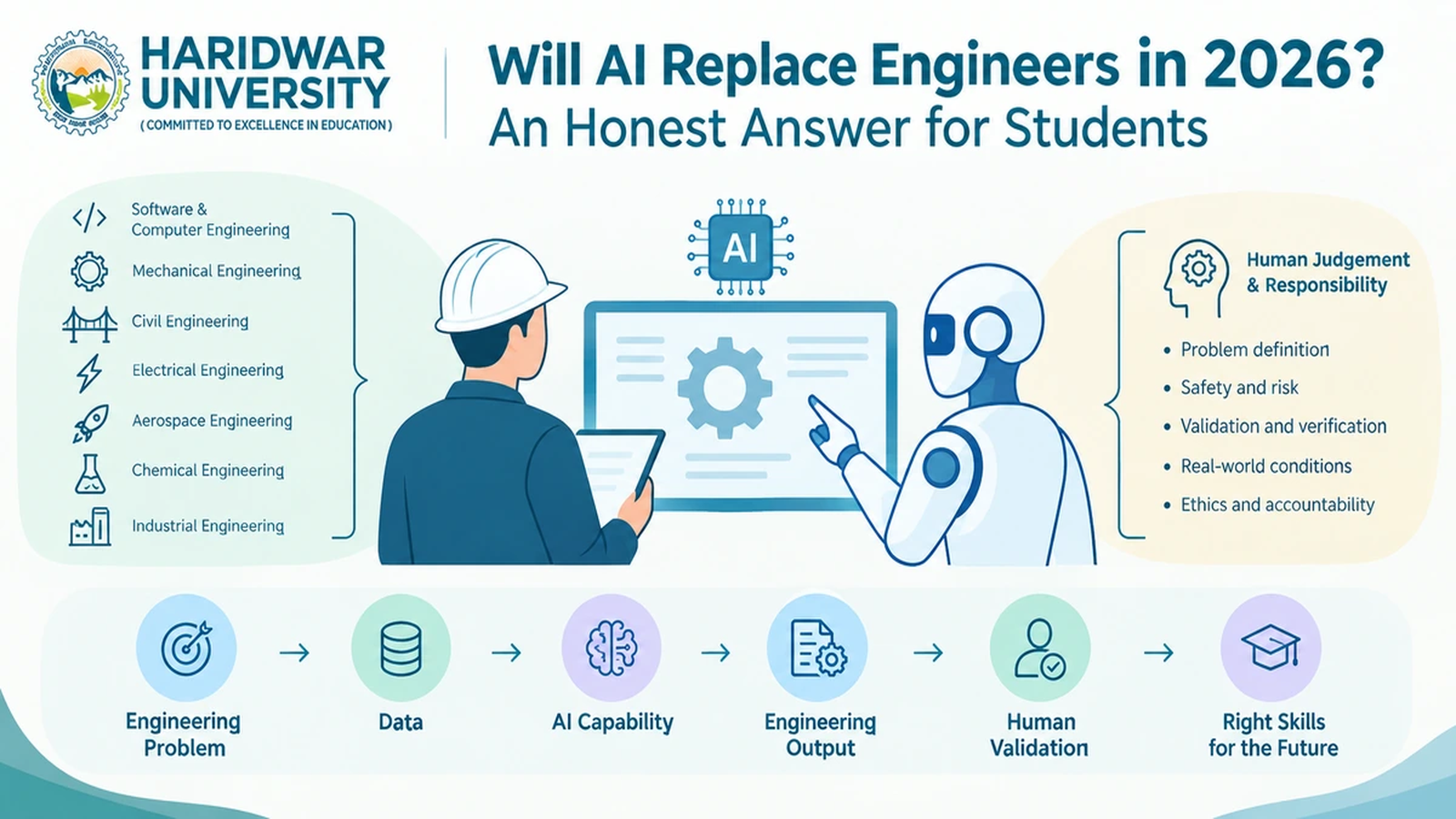
Will AI Replace Engineers in 2026? An Honest Answer for Students
Dr. Himanshu Verma
Associate Professor & HOD, Computer Science & Engineering, Haridwar University
When students ask me "will AI replace engineers?", I think the question is slightly too broad. The more useful question is: which parts of engineering work can AI perform, which responsibilities remain with engineers, and what skills will students need as that boundary moves?
AI can already generate code, analyse large datasets, identify patterns, assist with parametric design work and produce technical drafts. But an engineering role is not simply the production of a calculation, drawing, code fragment or prediction. It also involves defining the problem, setting operating constraints, validating results, understanding physical conditions and taking professional responsibility for decisions.
That distinction matters in 2026 because the evidence points towards changing engineering work rather than a simple disappearance of engineering careers. The U.S. Bureau of Labor Statistics' employment projections identify engineering occupations as potentially affected by AI while still projecting 6.8% employment growth across architecture and engineering occupations from 2023 to 2033. While these represent US directional indicators, India's expanding industrial and tech landscape similarly demands engineers who can effectively lead AI integration.
Table of Contents
- 1. What AI Can Actually Change in Engineering Work
- 2. Why AI Replaces Engineering Tasks Before Entire Engineering Roles
- 3. How AI Is Changing Different Engineering Disciplines
- 4. What Happens to Software and Computer Engineering Work
- 5. What Happens to Mechanical, Civil, Electrical and Other Engineering Work
- 6. Which Engineering Tasks Are Most Exposed to AI Automation
- 7. Which Engineering Responsibilities Still Need Human Judgement
- 8. How AI Changes the Skills Engineering Students Need
- 9. How Students Can Become AI-Ready Engineers
- 10. What Engineering Projects Can Demonstrate AI Readiness
- 11. How Engineering Careers May Change by 2030
- 12. Frequently Asked Questions (FAQs)
- 13. Build an Engineering Career That Works With AI
1. What AI Can Actually Change in Engineering Work
I would not describe AI as a single technology replacing an entire profession. It is better understood as an intelligent acceleration layer integrated inside existing engineering workflows:
Engineering Problem → Data → AI Capability → Engineering Output → Human Validation
AI can accelerate several stages within that chain: detecting anomalies in vibration telemetry, generating a preliminary boilerplate software service, classifying crack defects in drone imagery, or screening thousands of structural generative alternatives. However, the engineer still determines whether the problem was framed correctly, whether physical boundary assumptions hold, and whether the output is safe and usable.
The International Labour Organization's 2025 update on generative AI reaches a similar conclusion:
It estimates that one in four workers globally are in occupations with some degree of GenAI exposure, but says most jobs are more likely to be transformed than made redundant because human input remains necessary.
That is a much more useful starting point for students than either extreme: “AI will replace everyone” or “AI will change nothing.”
2. Why AI Replaces Engineering Tasks Before Entire Engineering Roles
A professional role contains dozens of distinct tasks. Some are highly structured and repetitive; others require context, physical presence, cross-functional negotiation, and safety liability.
OpenAI's AI Jobs Transition Framework makes this distinction explicit: automation capability over a discrete task does not mean the entire profession disappears. Accountability, domain judgement, and changing market demand fundamentally govern the outcome.
The World Economic Forum's Future of Jobs Report 2025 provides another useful signal. Employers surveyed for the report estimated that, by 2030, work would be distributed much more evenly between tasks performed mainly by humans, mainly by technology and by a combination of both. It also projects a net increase of 78 million jobs globally by 2030, after 170 million new roles and 92 million displaced roles are considered.
For an engineering student, the practical lesson is straightforward:
Do not prepare only for the engineering tasks AI can already perform. Prepare to supervise, evaluate and improve AI-assisted engineering work.
3. How AI Is Changing Different Engineering Disciplines
AI's impact is not uniform across engineering branches. Here is how assistance and core responsibilities divide across fields:
| Engineering Area | What AI Can Assist With | What the Engineer Remains Responsible For |
|---|---|---|
| Software & CSE | Code generation, boilerplate scaffolding, unit tests, bug localisation | System architecture, user requirements, security auditing, production verification |
| Mechanical | Generative design optimisation, predictive maintenance, thermal simulation | Physical tolerances, material fatigue, field testing, manufacturing safety |
| Civil & Structural | Drone image inspection, hydrological forecasting, BIM model coordination | Site soil conditions, statutory codes, seismic judgement, public structural safety |
| Electrical & EEE | Grid load forecasting, harmonic fault detection, PCB routing assistance | High-voltage protection, system redundancy, standards compliance, hardware testing |
| Aerospace | CFD simulation support, sensor telemetry anomaly detection | Aviation regulatory certification, fail-safe architecture, physical wind tunnel validation |
| Chemical | Yield forecasting, reaction process monitoring, spectroscopic analysis | Exothermic runaway safety, environmental compliance, pilot plant operating limits |
| Industrial & Production | Assembly line bottleneck forecasting, inventory demand prediction | Workflow redesign, ergonomics, supplier relationship management, capital decisions |
This is also why I would hesitate to tell a student that one engineering branch is simply “AI-proof”. The better question is how much of the work is digital, repetitive, physical, safety-critical or dependent on contextual judgement.
HU's own guide on how AI is transforming engineering education in India, makes a similar point: AI applications now extend across computer science, mechanical, civil, electrical, electronics and other engineering areas.
4. What Happens to Software and Computer Engineering Work
Software engineering is one of the clearest areas where students can already see the change.
AI coding systems can generate functions, explain unfamiliar code, write tests, identify likely bugs and accelerate documentation. That means some traditional entry-level tasks may take less time.
But software development is not equivalent to typing code.
Someone still has to decide what the system should do, understand users and business constraints, choose an architecture, evaluate security, test edge cases and maintain the resulting system.
The BLS analysis of AI impacts on employment projections provides an interesting data point here. Although it identifies software development as an occupation exposed to potential AI impacts, it projects 17.9% employment growth from 2023 to 2033, compared with 4.0% across all occupations. BLS also notes that AI may increase demand for software developers needed to build AI-based solutions and maintain AI systems.
For students, that does not mean software engineering is risk-free. It means the definition of a capable software engineer is changing.
Strong fundamentals in programming, algorithms, databases, systems and software engineering still matter. AI becomes an additional development capability rather than a substitute for understanding the system being built.
Students considering this direction can also review HU's B.Tech CSE programme information, which discusses core computing foundations alongside AI, cloud, cybersecurity and other emerging areas.
5. What Happens to Mechanical, Civil, Electrical and Other Engineering Work
Physical engineering branches offer an even clearer demonstration of the task-versus-role distinction.
A mechanical engineer uses machine learning for predictive maintenance and digital twins. Yet an algorithm predicting bearing failure cannot inspect physical alignment, detect unusual thermal friction by hand, or sign off on safety certifications. For detailed mechanical case studies, consult our guide on AI applications in Mechanical Engineering.
Civil engineering follows the same dynamic: computer vision can detect pavement distress or concrete spalling from drone feeds, but site conditions, foundation settling, and regulatory approvals depend on licensed civil engineers. See our breakdown of AI in Civil Engineering for real-world infrastructure workflows.
6. Which Engineering Tasks Are Most Exposed to AI Automation
The highest automation exposure occurs where a task exhibits these characteristics:
- Repetitive and procedural execution
- Highly structured digital input formats
- Based on large volumes of standardised information
- Straightforward to evaluate against known deterministic answers
- Low physical interaction or site-specific ambiguity
Crucial qualification: exposure does not equal replacement. An engineer who spent four hours writing basic scripts might now draft them in 30 minutes, spending the remaining three and a half hours auditing edge cases, hardening system resilience, and validating real-world physical interfaces.
7. Which Engineering Responsibilities Still Need Human Judgement
Engineering cannot be automated when problems involve uncertainty, high consequences and physical reality. Human judgement remains essential for:
- Defining the true root problem rather than symptoms
- Establishing operating boundaries and environmental constraints
- Evaluating incomplete, noisy or biased field data
- Interpreting anomalous real-world edge conditions
- Validating and stress-testing AI outputs
- Managing life-critical safety, liability and environmental ethics
- Taking personal, legal and professional responsibility for deployed solutions
Verification is becoming one of the defining engineering skills of the modern era: a convincing AI output is still merely a hypothesis until an engineer proves it works.
8. How AI Changes the Skills Engineering Students Need
The core engineering formula has evolved:
Traditional: Engineering Knowledge + Conventional CAD/Tools
Modern: Engineering Fundamentals + Data Literacy + AI Literacy + Verification + Communication
The World Economic Forum projects that 39% of core worker skills will transform by 2030, with analytical thinking, AI, and systems resilience leading demand. In India specifically, NASSCOM's AI skills study highlights that technical AI capabilities must pair with foundational engineering problem-solving to deliver economic value.
I recommend students construct their competencies in this disciplined sequence:
- Core Engineering Fundamentals (physics, mathematics, mechanics, circuits, data structures)
- Programming & Computational Thinking (Python, C++, algorithmic problem solving)
- Data Handling & Statistics (cleaning datasets, probability, exploratory analysis)
- AI & Machine Learning Foundations (supervised/unsupervised models, neural networks)
- Discipline-Specific Applications (computer vision in civil, predictive maintenance in mechanical, NLP in software)
- Verification & Responsible AI (error bounds, bias detection, failure testing)
- Technical Documentation & Communication (translating findings for teams and clients)
9. How Students Can Become AI-Ready Engineers
You do not need to memorize every viral tool. A disciplined methodology works far better: Learn → Apply → Evaluate → Verify → Document
For students wanting a structured roadmap in artificial intelligence, review our comprehensive B.Tech AI & ML guide. Furthermore, when using generative assistants, learn the engineering discipline outlined in our Prompt Engineering guide for engineering students: frame the technical context, set mathematical constraints, and rigorously test the answer.
10. What Engineering Projects Can Demonstrate AI Readiness
A project that simply states "I built an AI model" provides minimal insight to an interviewer. Outstanding engineering portfolios demonstrate rigour:
| Project Element | What It Demonstrates to Recruiters |
|---|---|
| Clearly Defined Problem | Domain understanding and realistic scoping |
| Dataset Provenance & Preprocessing | Data literacy, sanitization, handling noise and sensor dropouts |
| Baseline Benchmarking | Technical discipline (comparing simple heuristics against deep models) |
| Evaluation Metrics | Evidence-based thinking (precision/recall trade-offs over simple accuracy) |
| Error Analysis & Failure Modes | Critical judgement, edge condition investigation |
| Physical Validation & Documentation | Engineering responsibility and clear technical communication |
11. How Engineering Careers May Change by 2030
The most visible transformation will be in the composition of engineering time. Engineers will spend less time on routine drafting and repetitive manual recalculations, and significantly more time on system integration, simulation validation, safety auditing and cross-functional decision-making.
Simultaneously, vast opportunities are opening in renewable energy systems, industrial robotics, embedded Edge AI, cybersecurity, and smart manufacturing. Do not choose an engineering branch hoping it will never see computational tools. Choose a field whose physical problems you are eager to master, then add the AI skills that make you 10x more capable.
12. Frequently Asked Questions (FAQs)
Will AI replace engineers?
AI is more likely to automate or transform specific engineering tasks before replacing entire engineering occupations. Engineering judgement, validation, physical constraints, safety and accountability remain important.
Will AI replace software engineers?
AI is already automating parts of coding, testing and documentation, but software engineering also involves architecture, requirements, security, system integration and verification. Current BLS projections still show strong projected growth for software developers.
Which engineering jobs are most at risk from AI?
Tasks that are repetitive, digital, highly structured and easy to evaluate are generally more exposed. Exposure varies considerably within the same engineering occupation.
Can AI replace mechanical engineers?
AI can assist with design optimisation, predictive maintenance, simulation support and inspection, but physical constraints, testing, safety and engineering judgement remain essential.
Can AI replace civil engineers?
AI can support infrastructure monitoring, image analysis, forecasting and other tasks, but civil engineering decisions often depend on site conditions, safety requirements and professional validation.
Will AI make engineering jobs harder to get?
It may raise the skill expectations for some entry-level work. Students who can combine engineering fundamentals with AI, data skills, practical projects and verification are better positioned for this changing environment.
What should engineering students learn to stay relevant with AI?
Build strong engineering fundamentals first, then add programming, data analysis, AI fundamentals, discipline-specific applications, responsible AI and the ability to test and verify AI-generated outputs.
13. Build an Engineering Career That Works With AI
The defining question is not whether AI will change engineering—it already has. The defining question is whether you will be the engineer who knows when to use AI, knows when not to trust it, and understands how to verify what it produces.
Engineering Fundamentals → AI Literacy → Practical Application → Rigorous Verification → Professional Judgement
AI may automate parts of what engineers draft each day. It does not replace the human responsibility to understand, optimize, and safely deliver the engineering solutions society depends upon.
Shape the Future of Technology at Haridwar University
Become an AI-ready engineer with industry-focused B.Tech programmes across Computer Science, AI & ML, Mechanical, Civil, and Electrical Engineering at Roorkee College of Engineering. Gain hands-on project experience, state-of-the-art laboratory access, and placement excellence.