

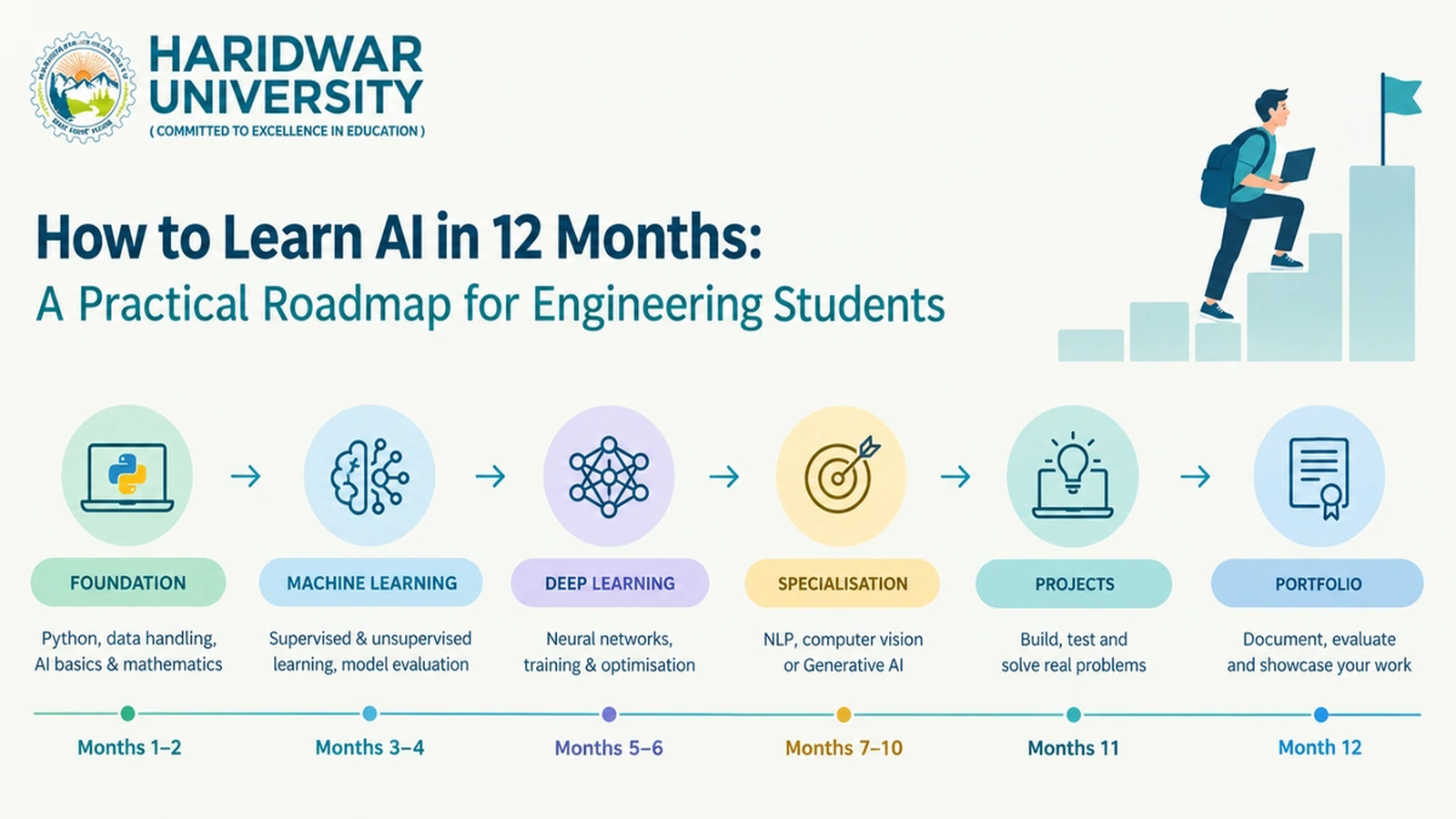
How to Learn AI in 12 Months: A Practical Roadmap for Engineering Students
Dr. Himanshu Verma
Head of Department, Computer Science & Engineering, Haridwar University
Roadmap Table of Contents
- What Learning AI From Scratch Actually Means
- Build the Technical Foundation Before Chasing Advanced AI
- Follow a 12-Month AI Learning Roadmap
- Align AI Learning With Your Engineering Semester
- Use Projects as Checkpoints for Technical Progress
- Choose an AI Specialisation After the Common Foundation
- Learn Tools When the Project Requires Them
- Build Evidence of Your AI Skills Through Evaluation and Documentation
- Create a Sustainable AI Study Routine Alongside College
- Avoid Common Mistakes in an AI Learning Roadmap
- Build Your AI Skills One Stage at a Time
- Frequently Asked Questions (FAQs)
Learning AI is not difficult because there are too few resources. The problem is that there are too many of them.
When I speak with engineering students who want to learn AI, I often see the exact same frustrating pattern. They begin with Python syntax, jump into an ad-hoc machine-learning tutorial, discover deep learning, and suddenly encounter Large Language Models (LLMs), Retrieval-Augmented Generation (RAG), autonomous agents, computer vision, and dozens of trending frameworks. Within a few weeks, their roadmap degenerates into an exhausting list of technologies rather than a cohesive learning plan.
I prefer a fundamentally different, engineering-led approach.
A truly useful AI roadmap should answer four questions at every single stage: What should I learn? How deeply should I learn it? What should I build? How do I know I am ready to move forward?
This guide provides a 12-month structure designed around an engineering student's academic schedule at Haridwar University. It is not an unrealistic promise that someone will master artificial intelligence in one year. Rather, it is a practical first cycle for establishing immutable foundations, completing progressively challenging projects, and assembling defensible proof of what you can actually build.
What Learning AI From Scratch Actually Means
“Learning AI” can mean very different things depending on career objectives. One student may want enough AI literacy to use generative AI responsibly in technical workflows. Another wants to build AI-powered web applications. A third aspires to train novel machine-learning models or pursue AI research.
For engineering students, I strongly recommend categorising the journey into three distinct levels:
| Level | Main Goal | Typical Skills |
|---|---|---|
| AI Literacy | Understand and use AI effectively & responsibly | AI concepts, prompt engineering, output verification, ethical & responsible use |
| AI Development | Build AI-enabled applications, pipelines, and models | Python, tabular data handling, classical ML, deep learning, REST APIs, model frameworks |
| AI Project Capability | Solve and demonstrate a complete engineering problem | Problem definition, data provenance, architecture design, evaluation metrics, deployment, documentation |
The critical insight is that these levels overlap. You do not need to finish every theoretical textbook derivation before building something useful. The right question is not “How many AI topics have I completed?” It is: “What can I now produce, test, and explain?”
Build the Technical Foundation Before Chasing Advanced AI
I advise every undergraduate student to master four non-negotiable technical pillars:
1. Python for Engineering
Comfort with functions, list comprehensions, exceptions, file I/O, OOP, and virtual environments. Avoid memorising syntax; focus on clean modular code.
2. Pragmatic Mathematics
Applied linear algebra (vectors, matrices, dot products), multivariate calculus (gradients), and fundamental probability distributions and Bayes' theorem.
3. Data Handling & EDA
Ingesting raw CSV/JSON, identifying missing values, data type coercion, feature encoding, scaling, and distribution plotting before touching algorithms.
4. Core Computer Science
Algorithmic complexity (Big-O), search/sorting structures, version control with Git, and RESTful API consumption.
Our curriculum guide on Python Libraries for Machine Learning highlights this precise progression—beginning with NumPy and pandas for numerical and tabular fluency before advancing to scikit-learn, PyTorch, and specialized ecosystem tooling.
🎯 Foundation Checkpoint: Before writing a single line of neural network code, you must be capable of loading a messy tabular dataset, handling missing entries, computing summary statistics, plotting correlations, and training a simple linear or tree baseline independently.
Follow a 12-Month AI Learning Roadmap
The 12-month timeline is deliberately structured as six progressive engineering milestones rather than a rigid calendar. The sequence matters far more than the exact week:
| Months | Core Learning Focus | Practical Milestone / Artifact |
|---|---|---|
| Months 1–2 | Python fundamentals, NumPy/pandas, linear algebra, basic statistics, and exploratory data analysis (EDA). | Small Python/Data Project: Automated EDA script producing statistical summaries and visualization plots. |
| Months 3–4 | Supervised & unsupervised ML: linear/logistic regression, decision trees, random forests, k-means, PCA, cross-validation. | Evaluated ML Project: Predictive classifier comparing tree ensembles against baseline models with precision/recall curves. |
| Months 5–6 | Advanced feature engineering, hyperparameter tuning (Grid/RandomSearchCV, Optuna), leak prevention, and model evaluation metrics. | End-to-End ML Pipeline: Scikit-learn Pipeline encapsulating preprocessing, model training, and serialisation via joblib. |
| Months 7–8 | Neural networks from scratch (forward/backward pass), PyTorch fundamentals, optimisers (SGD, Adam), regularisation, loss curves. | PyTorch Deep Learning Project: Multi-layer perceptron or CNN trained on public benchmarks with TensorBoard logging. |
| Months 9–10 | Selected Specialisation: Computer Vision (CNNs, YOLO), NLP/Transformers (BERT, Hugging Face), or Generative AI (LLMs, RAG). | Domain-Focused AI Application: Fine-tuned transformer, object detection pipeline, or vector-search retrieval system. |
| Months 11–12 | FastAPI endpoints, Docker containerisation, benchmark evaluation, error analysis, technical documentation, and portfolio assembly. | Production Capstone & Portfolio: Public GitHub repository, live web demo, documented trade-offs, and video walkthrough. |
Align AI Learning With Your Engineering Semester
A 12-month roadmap becomes sustainable only when it complements university academic cycles rather than competing against them. At Haridwar University, we teach engineering students to synchronize technical sprints with their semester cadence:
| Semester Phase | AI Priority | What to Produce |
|---|---|---|
| Early Semester | Foundations & Concepts | Modular Python exercises and preliminary data cleaning scripts. |
| Mid-Semester (Exams) | Core ML / Light Reading | One focused ML script; reduce hours to avoid academic stress. |
| Semester Break | Intensive Build & Consolidation | Refactor pipelines, run ablation studies, and perfect GitHub documentation. |
| Next Semester | Deep Learning & Specialisation | Domain-specific model training (Computer Vision, NLP, or GenAI). |
| Final Capstone Phase | Deployment & Packaging | Containerised production build, REST API, and defensible placement proof. |
Accelerate AI Competencies at Haridwar University
Haridwar University offers specialised undergraduate programmes in B.Tech. Hons. Artificial Intelligence & Machine Learning under the Roorkee College of Smart Computing. Learn in advanced AI labs with industry curricula.
Use Projects as Checkpoints for Technical Progress
Treating projects as an afterthought at the end of the year is a guaranteed recipe for shallow knowledge. We mandate a stepped progression:
Students can draw extensive inspiration from our faculty-curated project repositories:
- For introductory builds, consult 20 Machine Learning Projects for Beginners, structured around distinct datasets, problem formulations, and evaluation metrics.
- For complex neural architectures, our guide on Deep Learning Project Ideas for Final-Year Students provides realistic scopes, compute requirements, baseline models, and data provenance frameworks.
⚠️ The Explanatory Litmus Test: If you cannot explain on a whiteboard what engineering problem your model solves, how the dataset was acquired, how your evaluation baseline was established, and under what edge cases your model fails, you are not ready to advance to more complicated architectures.
Choose an AI Specialisation After the Common Foundation
Premature specialisation leads to brittle understanding. Build the foundational core first (Months 1–8), then select a focused specialisation based on your engineering passions:
| AI Path | Target Learning Focus | Recommended HU Guide |
|---|---|---|
| Machine Learning | Classical algorithms, feature engineering, model explainability, pipeline automation. | 20 ML Projects Guide |
| Computer Vision | OpenCV, convolutional neural networks (CNNs), YOLO object detection, image segmentation. | Computer Vision Projects |
| NLP & Text Processing | Tokenisation, sequence models, Transformers (BERT), sentiment analysis, text classification. | NLP Project Ideas |
| Generative AI & LLMs | Retrieval-Augmented Generation (RAG), vector embeddings, agentic workflows, fine-tuning. | Generative AI Ideas 2026 |
| Deep Learning | Advanced optimisers, custom loss functions, recurrent & attention models, compute scaling. | Deep Learning Ideas |
Learn Tools When the Project Requires Them
One of the easiest ways to derail an AI roadmap is to collect tools obsessively. A student may try to learn PyTorch, TensorFlow, OpenCV, Hugging Face, FAISS, Docker, LangChain, and MLflow all in a single weekend before writing a single working model.
The Just-in-Time Tooling Principle:
- Need numerical matrix operations? → Learn NumPy
- Need tabular dataframe manipulations? → Learn pandas
- Need classical supervised algorithms? → Learn scikit-learn
- Need gradient backpropagation & deep neural nets? → Learn PyTorch
- Need computer vision augmentations & image feeds? → Learn OpenCV
- Need pretrained LLMs, tokenisers, and embeddings? → Learn Hugging Face
- Need to expose model inferences to web clients? → Learn FastAPI
This disciplined rule keeps every study hour rooted directly in solving real engineering problems.
Build Evidence of Your AI Skills Through Evaluation and Documentation
By the final quarter of your 12-month cycle, stop measuring progress by certificates completed. The real evidence must be visible inside your repository. For every major project, document the following 10 artifacts:
For detailed portfolio layout templates, review our guide on How to Build an AI Portfolio for Job Applications. A project that transparently explains trade-offs and error analyses always commands the respect of enterprise engineering recruiters.
Create a Sustainable AI Study Routine Alongside College
A practical weekly cadence is vastly superior to an intense daily sprint that collapses after two weeks. Divide your dedicated weekly hours into four structured blocks:
Learn (25%)
Read documentation, mathematical intuition, and foundational concepts.
Practise (25%)
Write standalone Python functions, test synthetic datasets, and verify algorithms.
Build (35%)
Implement the active milestone project, refactor modules, and train models.
Review (15%)
Document results, inspect error logs, commit clean code to Git, and update READMEs.
Avoid Common Mistakes in an AI Learning Roadmap
- Starting With Advanced GenAI Too Soon: Trying to master RAG, fine-tuning, and multi-agent systems before understanding loss functions, overfitting, or evaluation metrics leads to fragile implementations.
- Tutorial Traps (Passive Learning): Watching hours of video tutorials builds recognition, not capability. Write code from scratch to expose genuine knowledge gaps.
- Framework Hoarding: Knowing the API signatures of twenty libraries does not equal knowing how to clean messy data or debug a vanishing gradient.
- Skipping Evaluation: A notebook that spits out 98% accuracy on a training split without cross-validation or confusion matrix analysis is misleading.
- Following Roadmaps Blindly: Adjust pacing dynamically. Accelerate through stages where you already have fluency; slow down when learning complex mathematical foundations.
Build Your AI Skills One Stage at a Time
Do not measure your worth as an engineering student by the number of certificates stored on your hard drive. The hallmark of true engineering capability is disciplined progression: Learn → Practise → Build → Evaluate → Document → Progress. After 12 focused months, you will possess a verified portfolio demonstrating that you can formulate an engineering problem, engineer an AI solution, measure its limitations, and defend your architectural choices with authority.
Frequently Asked Questions (FAQs)
1. Can I learn AI from scratch in 12 months?
Yes, you can build a substantial foundation in 12 months with consistent study and practical work. The depth you reach depends on your programming background, available time, and chosen specialisation.
2. What should I learn first to start AI?
Start with Python, basic mathematics, data handling, and fundamental AI concepts. Move into machine learning after you can work comfortably with data and basic programming.
3. Do I need mathematics to learn AI?
You need some mathematics, particularly statistics, probability, vectors, and matrices, as your technical depth increases. The amount depends on whether you are building applications, training models, or pursuing deeper research.
4. Should I learn machine learning before Generative AI?
For students who want strong technical foundations, I recommend learning core machine-learning concepts before moving deeply into advanced AI systems. However, basic GenAI applications can be explored earlier alongside foundational study.
5. How many hours should I study AI every week?
There is no universal number. A consistent schedule that fits alongside college is more useful than an aggressive timetable that cannot be maintained. Your available time should be divided between learning, practice, projects, and review.
6. Which AI specialisation should engineering students choose?
Choose based on the problems you enjoy solving and the type of systems you want to build. Machine learning, computer vision, NLP/GenAI, and AI engineering require overlapping foundations but increasingly different specialised skills.
7. What should I build after learning AI for one year?
Build one well-scoped capstone that demonstrates the complete workflow from problem definition and data preparation through modelling, evaluation, and documentation. The project should be realistic enough to explain and defend.
Build Your AI Career at Haridwar University
Join industry-aligned AI and machine learning engineering programmes with hands-on lab infrastructure, faculty research mentorship, and high-impact placement support in Roorkee.