

Department of Computer Science & Engineering | AI Credential Evaluation Guide
How engineering and computing students can evaluate, select, and support free and paid AI certifications with verifiable codebase evidence.
Artificial intelligence certifications have become much easier to find. There are now short introductory programmes, professional certificates, cloud credentials, vendor examinations and specialised machine learning certifications competing for a student's time and money.
That creates a different problem.
The question is no longer simply which AI certification is popular? A better question is what the credential actually proves, how it was assessed, whether it matches the role you want and whether you can support it with practical evidence.
I encourage students to look at certification as one component of a technical profile, not as a replacement for programming ability, projects, internships or academic foundations. This is also why certification selection needs to happen alongside project and portfolio planning.
For example, AWS describes its Certified AI Practitioner as a foundational credential covering AI, machine learning and generative AI concepts on AWS. It explicitly does not expect candidates to develop or code AI/ML models as part of the exam scope.
That distinction matters when you are deciding what to put on a CV.
Table of Contents
- What Makes an AI Certification Worth Doing in 2026
- Understand What Different AI Credentials Actually Prove
- Compare the Best AI Certifications by Cost, Level and Career Use
- Evaluate Free AI Certifications Before Adding Them to Your CV
- Match an AI Certification to the Skills You Want to Demonstrate
- Check the Assessment, Practical Work and Verification Method
- Check Certification Cost, Expiry and Renewal Requirements (2026 Transitions)
- Use Projects and Portfolios to Support an AI Certification
- Know When an AI Certification Is Not the Right Investment
- Build a Certification Path Around Your Target AI Role
- Frequently Asked Questions (7 In-Depth FAQs)
- Turn a Certification Into Evidence of What You Can Do
1. What Makes an AI Certification Worth Doing in 2026
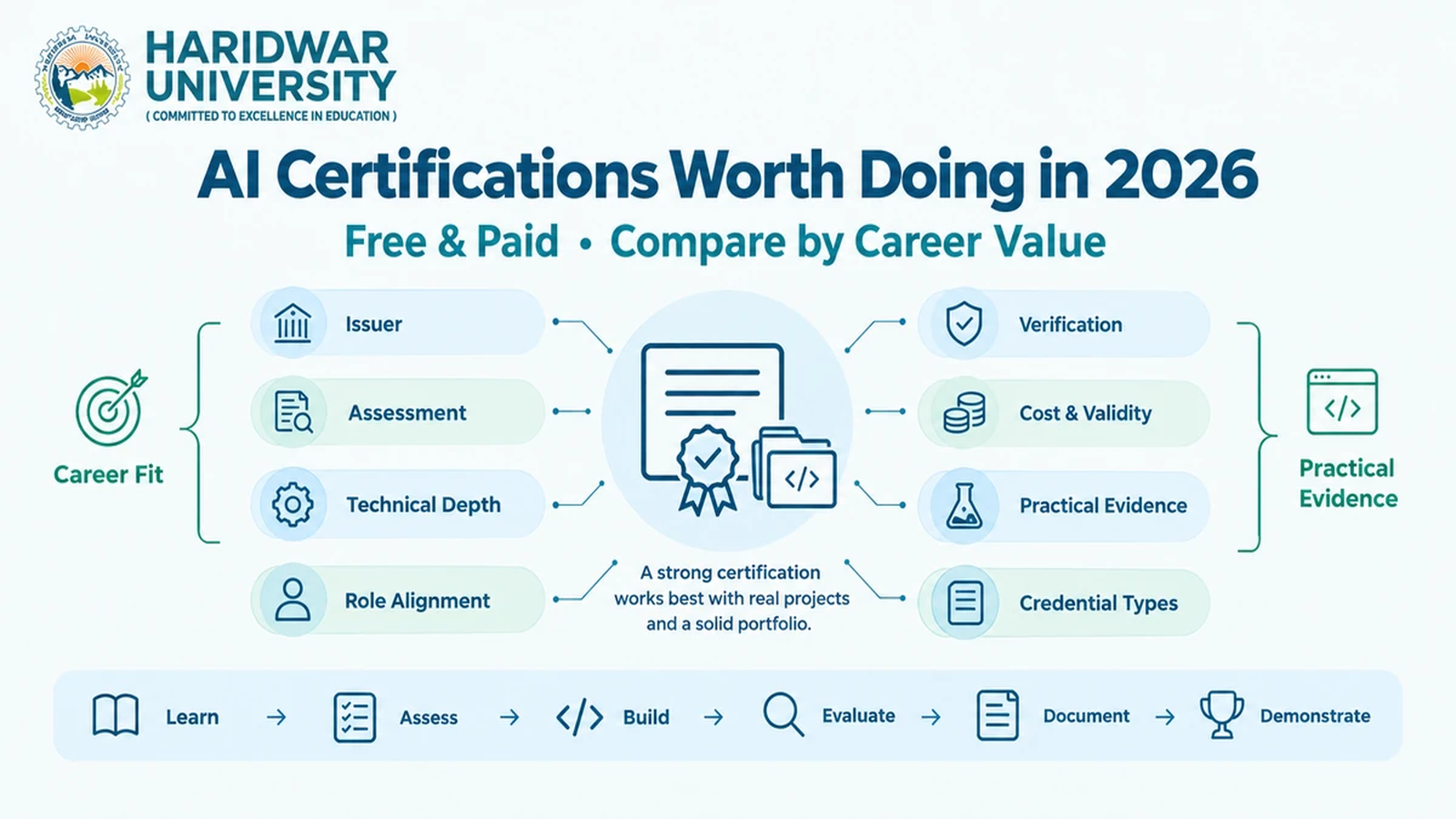
Before investing either time or financial resources into an examination, apply this 10-point diagnostic test. A high-value AI credential must answer these criteria transparently:
This approach is more useful than treating every certificate as equivalent.
A completion certificate from a learning platform may demonstrate that you finished a structured course. A proctored vendor examination can demonstrate that you passed an externally assessed credential. A project-based programme may provide evidence of implementation skills.
Those are different signals.
Current certification pages illustrate this distinction. Microsoft describes Azure AI Fundamentals as an exam-based certification assessing foundational AI concepts and implementation using Microsoft Foundry, while AWS positions AI Practitioner as a foundational examination covering AI, ML and generative AI concepts and AWS services.
2. Understand What Different AI Credentials Actually Prove
Not every certificate bearing the letters “AI” carries equivalent weight in technical recruitment. Credentials fall into four distinct categories:
Course Completion Certificates
Awarded for finishing video lectures on platforms like Coursera or edX. They signal curiosity and study discipline, but do not prove independent engineering problem-solving.
Professional Multi-Course Certificates
Multi-month specialization tracks combining peer-graded assignments and capstones. High pedagogical value, especially when paired with tangible code repositories.
Vendor Cloud Certifications
Formally administered by cloud providers (AWS, Microsoft, Google Cloud) via proctored testing centers. Validates operational competence against defined industry benchmarks.
Skills Badges & Micro-Credentials
Focused verification of a specific framework, tool, or API (e.g., Hugging Face, DeepLearning.AI badges). Highly targeted evidence when backing a specific project feature.
3. Compare the Best AI Certifications by Cost, Level and Career Use
Rather than constructing an arbitrary “top 10” ranking, evaluate credentials by the specific evidence they supply to an engineering interview panel:
This table should be treated as a framework rather than a league table.
For instance, AWS currently describes its Machine Learning Engineer - Associate credential as validating technical ability to implement ML workloads in production and operationalise them. The certification page also records a 2026 examination transition, making the official page particularly important before booking an exam.
Microsoft's current Azure AI Fundamentals certification is aimed at people at the beginning of their AI solution-development journey and covers AI concepts, machine learning, computer vision, NLP and generative AI workloads on Azure.
The right comparison therefore depends on the skill you need to demonstrate.
4. Evaluate Free AI Certifications Before Adding Them to Your CV
Free does not automatically mean low quality, but it certainly does not guarantee recruiter recognition. Before listing a free AI credential on your resume, verify these five essentials:
- Verified Issuer Reputation: Was the badge awarded by a recognized global body (e.g., Kaggle, Hugging Face, Harvard CS50, Stanford Online) or an anonymous content aggregator?
- Rigor of Assessment: Did you have to write unit tests, complete coding notebooks, and pass timed evaluations, or merely click through video modules?
- Audit vs. Credential Distinction: Many platforms provide free course access (“audit mode”) but require payment for identity-verified credentials. Recognize the difference.
- Independent Digital Verification: Does the certificate provide an immutable verification URL that prospective employers can click and validate directly?
- Relevance to Target Position: Does the free credential reinforce the specific stack in the job description, or does it clutter your resume with introductory noise?
There is another distinction students often miss: free learning and a free credential are not always the same thing.
A programme may allow you to study its material without charge but require payment for a final examination or certificate. Another programme may provide both learning and a digital badge without an examination. A vendor may provide free preparation resources while charging for the certification examination.
That is why I would never judge a certification simply from the word "free".
For example, Microsoft provides learning resources and practice assessments around its Azure AI Fundamentals examination, but the certification itself is tied to the AI-901 exam and its associated examination fee.
5. Match an AI Certification to the Skills You Want to Demonstrate
A common pitfall among engineering students is collecting half a dozen entry-level credentials across disconnected topics. Instead, align your certification directly with your targeted technical specialty:
- AI Fundamentals: Focus on core AI terminology, ethics, bias detection, and cloud service architectures.
- Applied Machine Learning: Focus on supervised/unsupervised learning, validation hygiene, feature engineering, and Python libraries like Scikit-learn, Pandas, and XGBoost.
- Generative AI Engineering: Focus on Large Language Models, prompt engineering, vector databases (RAG), and generative AI application architectures.
- Computer Vision: Focus on convolutional neural networks, object detection pipelines, and computer vision project implementations.
- MLOps & Cloud Deployment: Focus on model containerization (Docker), API serving, continuous monitoring, and automated retraining pipelines.
A student interested in machine learning should not collect five introductory AI certificates simply because they are available. One well-matched credential combined with a serious ML project can provide a clearer story.
The same principle applies to generative AI. If your objective is to demonstrate practical GenAI development, your evidence should eventually include things such as retrieval, evaluation, prompt design, application architecture or model adaptation rather than only a certificate.
Students can explore our guides on Python libraries for machine learning and generative AI project ideas when planning the technical side of that learning path.
6. Check the Assessment, Practical Work and Verification Method
Two certifications may demand identical preparation time but convey vastly different signals to technical interviewers. Understanding the scope of an exam protects you from misrepresenting your capabilities on your resume.
For example, AWS explicitly notes in its official AI Practitioner (AIF-C01) exam guide that coding AI/ML models, fine-tuning neural architectures, and deploying production pipelines are outside the exam scope. Passing a foundational test validates conceptual literacy on AWS managed services; it does not prove you can build an ML model from scratch. Your resume should accurately reflect what was assessed.
AWS's AI Practitioner examination, for example, uses multiple question formats and has a defined passing standard. Its exam guide also specifies areas that are outside the examination's scope, including developing or coding AI/ML models and implementing ML pipelines.
That last point is particularly useful for students.
Passing a foundational examination does not mean you should describe yourself as an AI engineer who can independently build production ML systems. Your CV should reflect the actual evidence behind the credential.
Microsoft makes a similar distinction through its role-based certifications. Its AI-103 study guide, for example, describes an AI engineer profile involving development and deployment of AI applications and agents, along with practical experience in Python and Azure services.
7. Check Certification Cost, Expiry and Renewal Requirements
Do not calculate your budget based solely on the published registration fee. Factor in the complete lifecycle cost:
Also check:
- Exam fee in your country
- Taxes, where applicable
- Training subscription
- Practice examination fees
- Retake policy
- Certification validity
- Renewal requirements
- Exam retirement dates
- Current exam code
Certification programmes change. AWS is currently moving its Machine Learning Engineer - Associate examination from MLA-C01 towards MLA-C02. As of September 28, 2026, the English MLA-C01 examination ends on September 28, MLA-C02 beta delivery begins on September 29, and general availability is scheduled for January 14, 2027. MLA-C01 remains available in Japanese, Korean and Simplified Chinese until MLA-C02 reaches general availability.
Microsoft also states that certification examinations are updated periodically as skills and technology change.
For this reason, do not rely on an old blog post for price, exam code or validity information. Always open the official certification page before paying.
8. Use Projects and Portfolios to Support an AI Certification
A certification becomes a compelling talking point in a placement interview when it is supported by demonstrable software artifacts. An optimal machine learning project portfolio demonstrates this complete lifecycle:
Our machine learning projects guide provides examples of how projects can progress from beginner builds to more substantial implementations.
For computer vision students, a documented image-classification, detection or deployment project can demonstrate practical understanding beyond a certificate. Our computer vision projects guide follows this project-oriented progression.
The same principle applies to your GitHub repository. A strong repository should explain:
- What problem the project solves
- Why the dataset was selected
- How the system works
- Which technologies were used
- How the model was evaluated
- What the limitations are
- How another person can run it
- What could be improved
I have discussed this distinction in our AI portfolio guide for job applications. A certificate tells someone that you completed or passed a defined learning assessment. A project can show what you actually built.
9. Know When an AI Certification Is Not the Right Investment
There are clear scenarios where pursuing another certification should not be your priority:
- Weak Programming Fundamentals: If you struggle with Python object-oriented design, time complexity, or memory management, spending money on advanced cloud credentials will not mask those gaps during technical live-coding interviews.
- Zero Project Evidence: If you already hold multiple badges but possess no public GitHub repositories with original code, another certificate will not fix your profile.
- Misaligned Vendor Ecosystems: If your target companies operate primarily on open-source frameworks or Google Cloud, spending heavily on proprietary niche vendor tools offers diminishing returns.
10. Build a Certification Path Around Your Target AI Role
At Haridwar University, we guide engineering students across four progressive development phases:
1. Foundation Stage
Master Python, discrete math, linear algebra, and basic data manipulation. Explore our comprehensive B.Tech AI & ML roadmap.
2. Application Stage
Select an introductory cloud credential (AWS AI Practitioner or Azure AI Fundamentals) that aligns with your preferred cloud environment.
3. Evidence Stage
Construct 2-3 substantial projects inside our high-performance computing labs that apply the concepts tested in your exams.
4. Specialization Stage
Undertake role-based certifications (e.g., Azure AI Engineer Associate or AWS ML Engineer) ahead of final-year campus placements.
The goal is not to collect certificates throughout your degree. The goal is to create a coherent technical profile.
Haridwar University's broader AI projects guide for engineering students can also help students connect project selection with skills and career direction. The university's existing certification guide for HU students covers certifications across multiple disciplines, while this article focuses specifically on evaluating AI credentials.
11. Frequently Asked Questions (7 In-Depth FAQs)
1. What is an AI certification?
An AI certification is a verified credential awarded upon completing a structured learning or assessment curriculum in artificial intelligence, machine learning, or related cloud tooling. Its true marketplace value depends on the testing standards, proctoring rigor, and reputation of the issuing body.
2. Are free AI certifications useful for students?
Yes, when issued by authoritative entities (such as Kaggle, deeplearning.ai, or academic universities) and backed by meaningful coding assignments. Always assess the actual technical depth required rather than assuming price correlates with quality.
3. Should beginners start with an AI certification?
A beginner can take a foundational exam (e.g., Azure AI Fundamentals) provided they possess baseline programming familiarity. A certification should consolidate structured learning, not serve as a substitute for learning how to code.
4. Is a machine learning certification different from an AI certification?
Yes. AI certifications generally evaluate high-level cognitive services, conversational systems, and ethics across broad domains. Machine learning credentials typically demand rigorous mathematical formulation, loss optimization, feature engineering, and MLOps deployment pipelines.
5. Do AI certifications guarantee a job?
No certification guarantees employment. Hiring managers evaluate complete engineering profiles: problem-solving capability, data structures and algorithms, public project repositories, internships, and communication skills.
6. How many AI certifications should a student complete?
Quality and relevance strictly supersede quantity. One or two role-aligned, proctored certifications backed by deep GitHub repositories create a far more credible engineering impression than a collection of superficial certificates.
7. Should an AI certification be included on a CV?
Yes, when the credential is verifiable and directly supports the job role. Include the exact credential title, issuing authority, completion date, and an active digital verification link (such as Credly).
12. Turn a Certification Into Evidence of What You Can Do
The strongest technical candidates follow a disciplined engineering sequence:
For an engineering student, the objective is never to amass digital badges. It is to construct an authentic technical portfolio where academic foundation, certification standards, and functional code reinforce one another. That is the standard we uphold across our B.Tech Computer Science and B.Tech Hons. AI & ML curricula at Haridwar University.
Ready to Build Real AI Engineering Capabilities?
Explore Haridwar University’s industry-aligned computing programs, advanced laboratory infrastructure, and transparent fee structures with merit scholarships up to 80%.