

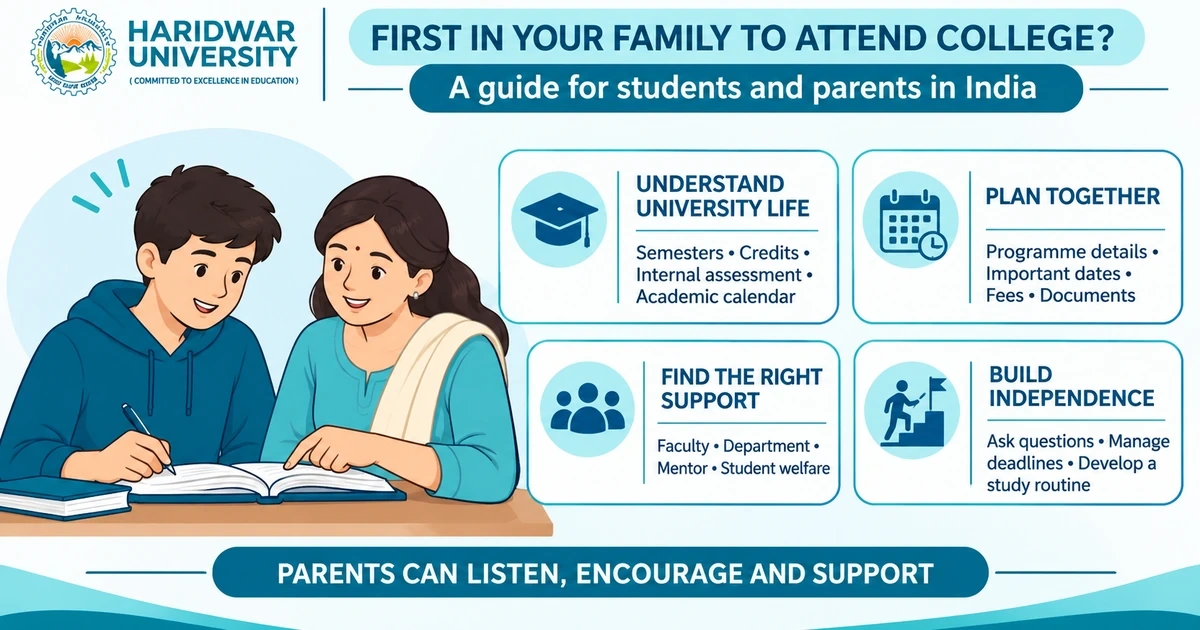
First in Your Family to Attend College? A Guide for Students and Parents in India
Mrs. Nisha Dhiman
Student Welfare Officer, Haridwar University
Being the first person in a family to attend college is a significant milestone. It can also bring questions that other students may never need to ask: How does a semester work? Whom should a parent contact about a fee payment? What happens if a student struggles with a subject? Where can a family find reliable information about scholarships or academic rules?
These questions do not reflect a lack of ability. They arise because higher education has its own language, procedures and expectations, and families may be encountering them for the first time.
As Student Welfare Officer, I believe the first-generation college student journey should be understood as a shared transition. Students learn to manage a new academic environment, while parents learn how to support decisions and responsibilities that may be unfamiliar to them. Both deserve clear information and practical guidance.
This guide explains what being a first-generation college student can mean in India, the challenges that may arise and how families can help students make a confident start.
Table of Contents
- 1. Who Is a First-Generation College Student?
- 2. What Makes the First University Experience Different?
- 3. Challenges First-Generation Students May Face
- 4. A Parent's Guide to Supporting a First-Generation Student
- 5. Understanding University Life: What Students and Parents Should Know
- 6. Finding Financial, Academic and Campus Support
- 7. Preparing for the First Year: A Practical Checklist
- 8. Frequently Asked Questions (FAQs)
- 9. Helping the Next Generation Move Forward
1. Who Is a First-Generation College Student?
A first-generation college student is generally understood to be someone whose parents have not completed a college or university degree. However, the definition is not identical across every country, institution, research study or scholarship programme.
Some definitions consider whether either parent attended higher education; others focus on whether a parent completed a degree. This distinction matters. A student whose parent enrolled in college but left before graduating may be classified differently under different definitions.
In India, the term is also used in research and discussions about first-generation learners. It should not, however, be treated as a universal eligibility category for admission, financial assistance or scholarships.
Consider these situations:
- Neither parent has attended college: the student would commonly fit the first-generation description.
- A parent attended college but did not complete a degree: the classification may depend on the definition being used.
- A grandparent or sibling attended university: this does not automatically determine whether the student is first-generation; the relevant definition may focus specifically on parents.
The most sensible approach is to check the definition used by the institution or scheme concerned. A family should not assume that a student qualifies for a particular benefit simply because they are the first person in the household to enter university.
2. What Makes the First University Experience Different?
For many families, the difficulty is not understanding the value of education. It is knowing how the university system operates.
At school, teachers and parents often share responsibility for reminding students about assignments, examinations and important dates. At university, students are expected to take greater responsibility for monitoring academic notices, communicating with faculty and managing their schedules.
The terminology can also be unfamiliar. A parent may understand the importance of examination marks but not know how credits, internal assessment, electives or semester registration work.
Financial planning introduces another adjustment. Families may need to understand tuition fees, examination charges, hostel expenses, scholarships and payment deadlines together rather than considering a single annual amount.
There is also a social transition. Students meet peers with different educational experiences, learn to approach faculty and begin making decisions about internships, further study and careers.
I would encourage families to see this transition as a learning process, not a test of whether a student already knows everything about university life.
3. Challenges First-Generation Students May Face
Not every first-generation college student faces the same difficulties. Family income, school education, location, language, programme choice and the availability of support all influence the experience. Still, several areas deserve attention.
- Understanding academic expectations: University study requires regular participation, independent reading, assignments and preparation across a semester. Students who are unfamiliar with this pattern may initially struggle to organise their work.
- Managing financial responsibilities: Tuition is only one part of the possible cost of higher education. Students and families may also need to plan for accommodation, transport, books, equipment and examination-related expenses. Unclear payment schedules can add unnecessary pressure.
- Knowing whom to approach: A student may not know whether an academic problem should be discussed with a subject teacher, department office, mentor or student welfare team. Delaying the conversation can make a manageable problem more difficult.
- Building confidence and belonging: Students may compare themselves with peers who appear more familiar with university procedures. They may hesitate to ask basic questions or participate in unfamiliar activities. A supportive environment can make it easier to become involved.
- Balancing family expectations and independence: Parents naturally want to protect their children and may be concerned about academic performance, expenses or living away from home. Students, meanwhile, need room to make decisions and develop responsibility.
These challenges should not define a student's ability or future. They are areas where timely information, encouragement and appropriate institutional support can make a difference.
4. A Parent's Guide to Supporting a First-Generation Student
Parents do not need a university degree to provide meaningful support. Their experience, encouragement and willingness to learn can be valuable throughout the student's education.
I suggest starting with five practical habits:
- Understand the programme together. Read the programme information, duration, eligibility requirements and published academic details before admission. The Haridwar University academic programmes page is a starting point for exploring the courses offered at HU.
- Keep a shared record of important dates. Note admission deadlines, fee instalments, scholarship applications, examination periods and document requirements. A simple calendar can prevent avoidable last-minute problems.
- Discuss money openly. Agree on a realistic budget for academic and living expenses. Review the published fee schedule and ask the university for clarification if a charge or payment condition is unclear.
- Encourage questions rather than making assumptions. If a student is unsure about attendance, an assignment or an examination rule, encourage them to contact the appropriate university office or faculty member. Do not rely solely on informal advice from other students.
- Allow independence to develop. Parents can help students think through decisions without making every decision on their behalf. Learning to communicate with faculty, manage a budget and meet deadlines is part of becoming an independent adult.
Parents should also remember that emotional support matters. A student may need someone to listen after a difficult examination or an unfamiliar experience on campus, not an immediate solution to every problem.
5. Understanding University Life: What Students and Parents Should Know
A few basic concepts can make university communication much easier.
| University term | What it means in practice |
|---|---|
| Semester | One of the academic periods into which a programme's year is divided |
| Credits | Units assigned to courses under the approved academic structure |
| Internal assessment | Evaluation conducted during the semester through the methods prescribed for a course |
| End-semester examination | Examination conducted at the end of the academic period |
| Academic calendar | Schedule of important academic dates and activities |
| Faculty mentor | A faculty member who may guide students on academic progress and related concerns |
| Scholarship | Financial assistance offered under specified eligibility and award conditions |
The exact academic structure and assessment requirements vary by programme and institution. Students should consult their own university's published regulations rather than assume that a rule followed by a friend applies to their course.
For a practical introduction to the transition, HU's First-Year Survival Guide explains attendance, internal assessment, campus routines and student resources. Students can also use the Semester Exam Preparation Guide to understand how to organise study across an academic term.
6. Finding Financial, Academic and Campus Support
Asking for help is not a sign that a student is unprepared. Knowing where to find reliable assistance is an important part of navigating higher education.
- Financial support: Families should examine the eligibility conditions, application dates and required documents for each scholarship. The National Scholarship Portal provides access to central scholarship schemes, eligibility information and application services. A scheme's availability does not mean every student qualifies; applicants must meet its specific conditions. At HU, families can review the published Fees and Scholarships information for programme-wise fee details and the scholarship provisions listed by the university. For payment records, our guide on how to read a university fee receipt explains how to check fee components and recorded payments.
- Academic support: Students who find a subject difficult should speak to the relevant faculty member or department early. Regular use of books, reference material and digital resources can also strengthen independent learning. HU's Library and Digital Learning Resources guide introduces students to available learning resources.
- Student welfare: Students should identify the appropriate student support contact during their first weeks. HU's Student Welfare Service describes its Students Care Centre, administrative assistance, education-loan support and other student services. Students should contact the university directly to understand which service is appropriate for their particular concern.
The important lesson for families is simple: identify the official source of information before acting on advice that could affect fees, examinations or academic progress.
7. Preparing for the First Year: A Practical Checklist
A little preparation before the semester begins can make the transition less confusing. Students and parents can use this checklist together.
| Before or during the first semester | What to do |
|---|---|
| Programme information | Save the course details, duration and academic requirements |
| Documents | Organise admission, identity and previous academic records |
| Fees | Review the fee schedule, payment dates and applicable scholarship conditions |
| Academic calendar | Record registration, teaching and examination dates |
| University contacts | Save department, faculty and student welfare contact details |
| Learning resources | Identify the library, laboratories and digital learning facilities |
| Study routine | Set aside regular time for classes, assignments and revision |
| Support network | Identify a faculty contact, mentor or appropriate student support office |
Students should also read the university's examination and academic guidelines. If a subject becomes difficult, the HU backlog and re-examination guide offers further guidance on understanding academic setbacks and responding to them.
Parents can support this process by checking in regularly, while allowing the student to take responsibility for communicating with the university.
8. Frequently Asked Questions (FAQs)
1. What is a first-generation college student?
The term generally describes a student whose parents have not completed a college or university degree. However, definitions vary, so students should check the criteria used by a particular institution, research study or scholarship scheme.
2. Am I a first-generation college student if my parents attended college but did not graduate?
Possibly. Some definitions focus on whether parents completed a degree, while others consider whether they attended college. The relevant institution or scheme determines which definition applies.
3. Does having grandparents who attended university affect first-generation status?
Not necessarily. Many commonly used definitions focus on parents' educational experience rather than grandparents'. Check the specific definition being applied.
4. What challenges can first-generation college students face?
Some may find academic expectations, university procedures, financial planning, campus adjustment and access to guidance unfamiliar. These experiences differ between individuals and should not be assumed for every student.
5. How can parents support a first-generation college student?
Parents can help organise documents and deadlines, discuss education costs, encourage regular communication with faculty and provide emotional support while allowing students to develop independence.
6. Are there scholarships specifically for first-generation college students in India?
Scholarship eligibility varies by scheme. Students should check official scholarship portals and individual scheme conditions rather than assume that first-generation status alone provides eligibility.
7. Where should a student seek help when struggling at university?
The first point of contact may be the subject faculty member, department, faculty mentor or student welfare office, depending on the issue. Students should use official university channels and seek help before a problem becomes harder to resolve.
9. Helping the Next Generation Move Forward
Being the first in a family to attend college is not simply an individual achievement. It can also give a family its first opportunity to understand university education from the inside. That experience can make it easier for younger siblings and future generations to approach higher education with greater confidence.
My advice to students is to ask questions, use the resources available and take responsibility for your academic journey one step at a time. To parents, I would say that you do not need to know every university rule or academic term. Your willingness to listen, learn and encourage your child is already valuable.
The goal is not for families to know everything before a student enters university. It is for students to know where to find the right guidance as they move forward.
Start Your University Journey With Confidence at Haridwar University
Explore undergraduate programmes, transparent fee schedules, merit and sports scholarships, and dedicated Student Care Centre support for first-generation learners.