

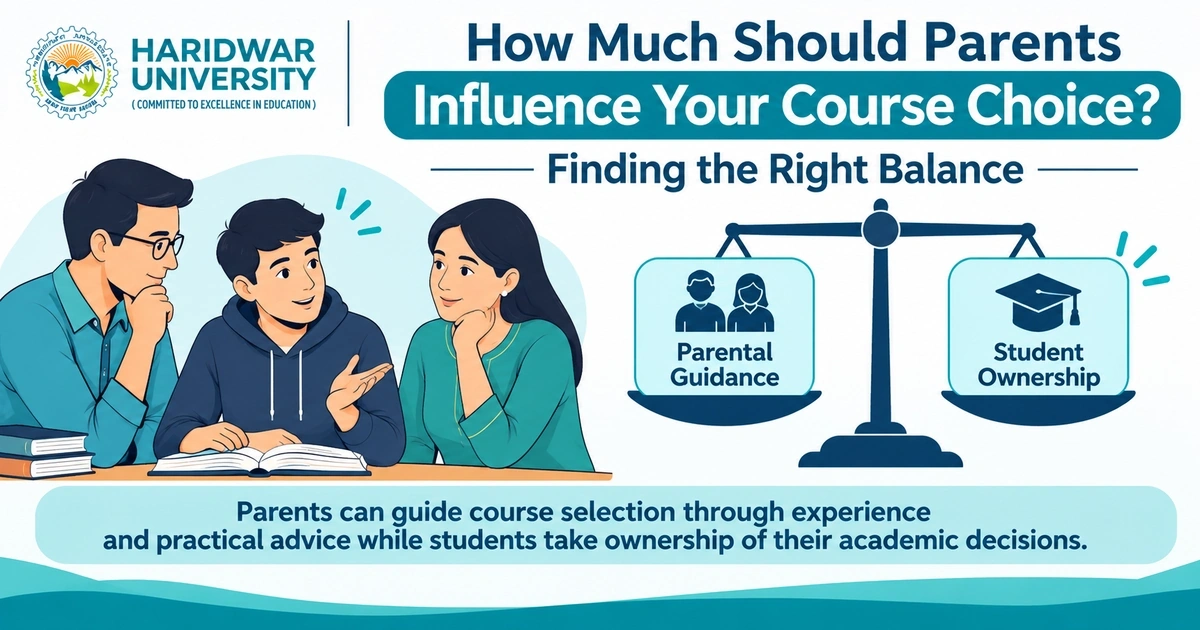
How Much Should Parents Influence Your Course Choice? Finding the Right Balance
Mrs. Nisha Dhiman
Student Welfare Officer, Haridwar University
Choosing a university course is rarely an individual decision in the Indian family setting. Parents may contribute financially, share their experience, research institutions and worry about employment prospects. Students, meanwhile, must consider the subjects they enjoy, the work they can see themselves doing and the kind of future they want to build. These priorities can complement one another, but they can also lead to disagreements.
I believe parents should have a meaningful place in course selection, but not an unlimited one. Their experience can help a student avoid rushed decisions; it should not replace the student's own interests and judgement. The question is not whether parents should be involved, but how much influence is appropriate at each stage.
A good course decision is one that a student understands and takes ownership of, with parents providing informed guidance rather than choosing on their behalf.
Table of Contents
- 1. Why Parents Matter in Course Selection
- 2. How Much Should Parents Be Involved in Choosing a Course?
- 3. Understand Your Child's Interests, Strengths and Aspirations
- 4. Balance Career Aspirations with Practical Considerations
- 5. What to Do When Parents and Students Disagree on a Course
- 6. Common Mistakes Parents Should Avoid During Course Selection
- 7. How Parents and Students Can Make the Final Course Decision Together
- 8. Frequently Asked Questions (FAQs)
- 9. Let Guidance Support the Student's Own Decision
1. Why Parents Matter in Course Selection
Parents often see parts of a decision that students may overlook. They may understand the family's financial position, know how much time and commitment a programme requires, or recognise practical concerns about location and accommodation. Their experience can help a student ask better questions before applying.
However, experience is not the same as knowing which course will suit another person. A parent's own educational journey, career preferences or ideas about job security may not reflect the opportunities and interests of a student today.
The University Grants Commission's Curriculum and Credit Framework for Undergraduate Programmes supports a student-centric approach, with flexible course choices and a multidisciplinary structure intended to help learners pursue subjects and fields that interest them. This is an important principle for families to understand: higher education should allow students to shape their learning, not simply inherit somebody else's preference.
Parents can contribute context, resources and perspective. Students must contribute their interests, questions and willingness to study the subject. Both are necessary, but they do not have identical roles.
2. How Much Should Parents Be Involved in Choosing a Course?
I find it useful to divide parental involvement into three levels: guidance, shared evaluation and student ownership. This makes the boundary clearer than simply advising parents to be supportive.
- Parents guide: Parents can introduce career possibilities, discuss financial limits, help locate reliable information and encourage students to explore unfamiliar subjects. They can also share their experience, provided they do not present it as the only route to success.
- Parents and students evaluate together: Course comparisons, eligibility, university selection, fees, location and admission requirements deserve joint discussion. These decisions affect the family financially and the student academically. Both perspectives should be heard.
- Students take ownership: The student should have the strongest voice when deciding which subject they are willing to study and which academic direction genuinely interests them. Parents can question an unrealistic assumption or point out a risk, but imposing a course simply because it is prestigious or familiar can create resentment and disengagement.
The balance may vary with a student's age, maturity and circumstances. A younger student may need more structured guidance. A student approaching undergraduate admission should be increasingly involved in researching, comparing and defending their own choices.
The principle is straightforward: parents should increase a student's ability to make a sound decision, not make the student dependent on parental approval for every decision.
3. Understand Your Child's Interests, Strengths and Aspirations
A course should not be selected only because a subject has high marks, a career is popular or relatives recommend it. Marks are useful evidence of academic performance, but they do not reveal the full picture.
I encourage parents to discuss four areas before narrowing the options:
- Subject interests: Which subjects does the student enjoy studying beyond examination requirements? What topics do they explore voluntarily?
- Academic strengths: Which areas show consistent understanding or aptitude? Where does the student need additional support?
- Preferred activities: Does the student enjoy analysing information, solving technical problems, working with people, designing, conducting experiments or organising business activities?
- Longer-term aspirations: What kind of work or contribution does the student imagine pursuing? Are they aware of the education and training that may be required?
These conversations should be open-ended. Instead of asking, "Why don't you want to become an engineer?", a parent might ask, "Which parts of engineering interest you, and which do not?"
Families can also use structured career-exploration resources. The Ministry of Education, NCERT-PSSCIVE and Wadhwani Foundation have developed My Career Advisor to help students, parents, teachers and counsellors explore career information and pathways. NCERT also publishes career guidance resources for school students.
Such resources can broaden a student's understanding, but they should support discussion rather than dictate a final choice.
4. Balance Career Aspirations with Practical Considerations
Interest matters, but a course decision also needs practical examination. A student may be attracted to a profession without knowing what its degree programme involves. Parents can help turn a broad ambition into a realistic academic plan.
Before selecting a course, compare:
- Curriculum: Read the actual subjects and semester structure. Does the programme teach what the student expects?
- Eligibility: Check subject requirements, minimum marks and entrance examination conditions in the current admission notification.
- Learning approach: Consider practical work, laboratory exposure, projects, internships and other learning components where relevant.
- Institution: Verify the institution's legal status, programme approvals or recognition requirements, affiliation where applicable and the qualification it awards.
- Financial commitment: Discuss tuition, examination charges, accommodation, travel, learning materials and other likely expenses. Check scholarship conditions rather than assuming assistance is guaranteed.
- Future pathways: Explore possible employment areas, professional qualifications and higher-study options. Avoid treating a course as a promise of a particular job or salary.
Parents can help with financial planning and verification, while students should read the curriculum and understand what they are committing to study.
Families exploring options at Haridwar University can consult the academic programmes directory to review the programmes listed across its academic units. The purpose of reviewing a university's course information should be to compare the actual programme with the student's interests and eligibility, not to select an institution before deciding what the student wants to study.
5. What to Do When Parents and Students Disagree on a Course
Disagreement does not necessarily mean that either side is being unreasonable. A parent may be concerned about affordability or employment prospects, while a student may be trying to choose a subject that feels more suitable.
Consider a student interested in business studies whose parents prefer engineering because they believe it offers a more secure future. Repeating the same arguments will not resolve the issue. A structured discussion is more useful.
I suggest the following approach:
- Hear the reasons on both sides. Ask the student why the course appeals to them. Parents should explain their concerns without turning them into ultimatums.
- Separate facts from assumptions. Claims such as "there are no jobs in this field" or "this course guarantees a high salary" need evidence.
- Compare actual programmes. Review curricula, eligibility, costs, learning requirements and possible next steps.
- Consider more than one option. A related programme or a different specialisation may address some concerns without dismissing the student's interests.
- Seek neutral guidance when needed. A qualified career counsellor, teacher or subject professional can help the family examine options without taking sides.
The National Career Service, operated by the Ministry of Labour and Employment, provides career counselling and vocational guidance services to registered users. Families can consider such support when they need help understanding career options and matching them with a student's qualifications, skills and interests.
A useful discussion should leave both sides better informed, even if they do not agree immediately.
6. Common Mistakes Parents Should Avoid During Course Selection
Good intentions can still lead to poor decisions when family expectations take priority over the student's suitability. I would encourage parents to watch for these common mistakes:
- Choosing by social prestige: A well-known course is not automatically the right course for every student.
- Comparing siblings or relatives: Another person's marks, admission or career path cannot establish what will suit this student.
- Prioritising salary alone: Earnings matter, but they should be considered alongside the nature of the work, qualifications required and the student's interests.
- Imposing an unfulfilled ambition: A parent's missed opportunity should not become a child's compulsory career plan.
- Ignoring the curriculum: A programme title can sound attractive while its actual subjects and learning requirements may be quite different from what the student expects.
- Rushing because of admission deadlines: Deadlines matter, but families should still verify eligibility, fees and institutional information before paying or accepting an offer.
A course decision deserves research and conversation. Pressure may produce a quick answer, but it does not necessarily produce a suitable one.
7. How Parents and Students Can Make the Final Course Decision Together
Once the family has shortlisted options, put the information in one place. A simple comparison can prevent a decision from being driven by one emotional argument or a single impressive claim.
| Decision factor | Questions to consider |
|---|---|
| Interest and suitability | Does the student want to study this subject? |
| Academic readiness | Does the student meet the eligibility requirements? |
| Curriculum | Do the subjects match the student's expectations? |
| Institution | Have recognition and programme requirements been verified? |
| Cost | Can the family manage the full academic and living expenses? |
| Future pathways | What further study or career routes may follow? |
| Student ownership | Can the student explain why this is their preferred option? |
Ask the student to explain their preferred choice in their own words. Parents should also be able to explain any financial or practical conditions that affect the decision. If important information is missing, pause and verify it.
I would also avoid treating the final choice as a lifelong contract. Interests and circumstances can change. HU's related guide, How to Switch Careers After a Wrong Degree Choice, discusses how students can reassess an unsuitable academic direction and plan a transition. It is better to make a careful decision now while recognising that future decisions may require fresh evaluation.
8. Frequently Asked Questions (FAQs)
1. Should parents decide which course their child studies?
Parents should guide and participate in important discussions, but the student should have meaningful ownership of the final academic choice. The decision should reflect the student's interests, abilities, eligibility and informed understanding of the programme.
2. How much influence should parents have on career choices?
Parents can influence a decision through experience, financial guidance and access to information. Their influence becomes counterproductive when advice turns into pressure or prevents the student from expressing a different interest.
3. What should parents do if their child chooses a course they do not approve of?
First, understand the reasons behind the choice. Discuss practical concerns such as eligibility, curriculum, cost and future pathways. If disagreement continues, seek an independent opinion from a qualified career counsellor or subject expert.
4. Should parents prioritise job prospects over a child's interests?
Job prospects deserve consideration, but they should not be the only deciding factor. A suitable choice considers the student's interests and abilities alongside the course requirements, costs and possible career pathways.
5. How can students explain their course choice to their parents?
Students should research the curriculum, eligibility, fees and possible future pathways before discussing their preference. Explaining why a course fits their interests and strengths can make the conversation more constructive.
6. When should families seek career counselling?
Consider career counselling when a student has several interests, feels uncertain about suitable options, or faces repeated disagreement with parents. A qualified counsellor can help assess interests, skills and possible pathways without making the decision on the student's behalf.
7. Can a student change their course choice later?
A change may be possible, but the process depends on the institution's regulations, programme structure, admission rules and credit-transfer arrangements. Students should check these conditions with the relevant institution before making a transition.
9. Let Guidance Support the Student's Own Decision
Parents have an important role in course selection. They can help students research institutions, understand financial commitments, question unrealistic expectations and consider opportunities beyond the most familiar career paths. That contribution should make the student more informed, not less independent.
In my view, the best outcome is not a course chosen entirely by parents or one selected without listening to them. It is a decision reached through honest discussion, reliable information and a clear understanding of what the student is ready to pursue.
A parent's experience can help illuminate the options. The student must still be able to see themselves in the choice they make.
Choose the Right Degree Together at Haridwar University
Compare undergraduate and postgraduate programmes, review transparent fee structures and scholarships, and speak with our academic counsellors to make a confident, shared decision.