

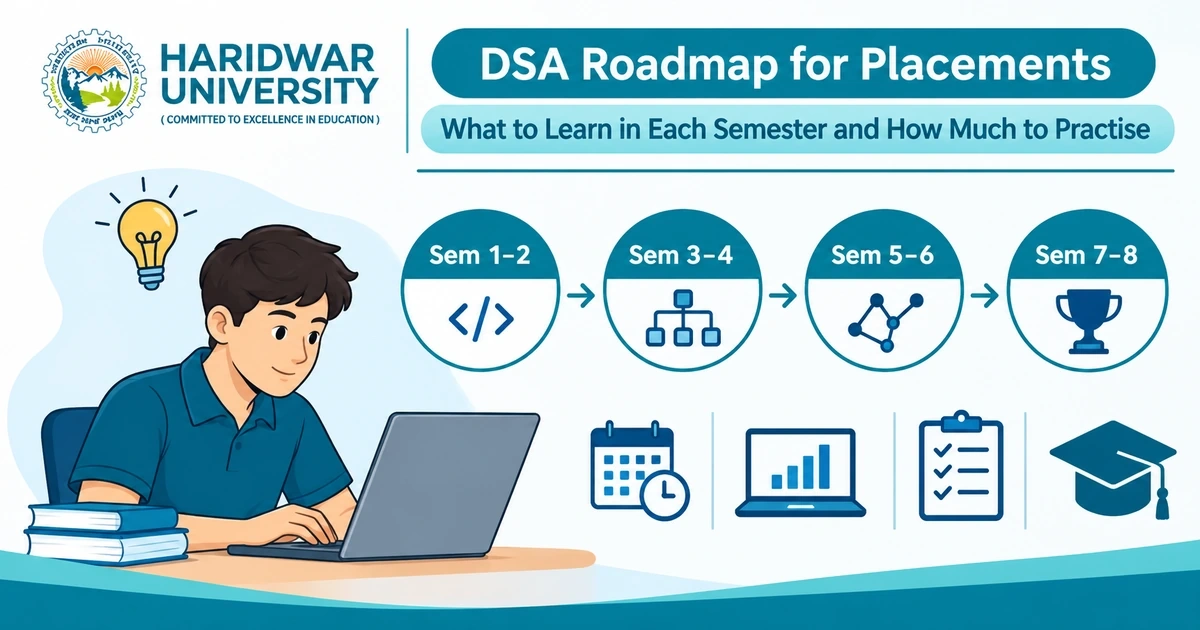
DSA Roadmap for Placements: What to Learn in Each Semester and How Much to Practise
Dr. Himanshu Verma
Associate Professor & HOD, Computer Science & Engineering, Haridwar University
Students often ask me when they should start preparing for coding placements. My answer is usually earlier than they expect, but not because they should begin solving difficult interview questions in their first year. The more important decision is learning the right topics in the right order.
A useful DSA roadmap for placements connects programming fundamentals, data structures, algorithms and timed problem-solving across the eight semesters of an engineering degree. It also leaves room for core Computer Science subjects, projects and revision. The aim is not to complete the largest number of coding questions. It is to become capable of solving unfamiliar problems independently and explaining the reasoning behind a solution.
Here is how I would organise that progression, including a realistic weekly time budget.
Table of Contents
- 1. Build the Foundation Before Advanced DSA
- 2. Follow a Semester-wise DSA Roadmap for Placements
- 3. Allocate Weekly Practice Time Realistically
- 4. Use Coding Platforms with a Clear Purpose
- 5. Measure Progress Beyond the Number of Problems Solved
- 6. Prepare for the Complete Technical Selection Process
- 7. Frequently Asked Questions (FAQs)
- 8. Make Consistent Practice Part of Your Engineering Journey
1. Build the Foundation Before Advanced DSA
Data Structures and Algorithms (DSA) is easier to understand when students already know how to write, trace and debug basic programs. Arrays, loops, functions and conditional statements are not topics to rush through. They are the tools used to understand more complex problems later.
The progression should be deliberate:
Programming fundamentals → Linear data structures → Algorithmic techniques → Trees and graphs → Advanced problem-solving → Placement assessments
This order also reflects the broad academic progression of Computer Science Engineering. HU's B.Tech Hons. CSE programme provides the programme structure, while our B.Tech CSE curriculum and career guide explains how programming, core subjects and practical learning develop through the degree.
One recommendation I give students is to choose a primary programming language early. C++, Java and Python can all be used for problem-solving. The important point is to become comfortable with one language, its built-in collections and its debugging tools before switching between languages.
2. Follow a Semester-wise DSA Roadmap for Placements
The following roadmap is a recommended learning and practice sequence, not a replacement for the university's prescribed syllabus. Students should align it with their actual subjects, examination calendar and available time.
| Semester | Topics to prioritise | Practice milestone |
|---|---|---|
| 1 | C or another introductory language, variables, loops, functions, arrays, strings and debugging | Write small programs without copying solutions |
| 2 | Arrays, linked lists, stacks, queues, searching and elementary sorting | Understand operations and implement basic structures |
| 3 | OOP, recursion, Big-O notation, hashing, collections and problem decomposition | Solve easy problems independently and explain complexity |
| 4 | Binary search, merge sort, quick sort, two pointers, sliding window and divide and conquer | Recognise patterns across different problem statements |
| 5 | Trees, BSTs, traversals, heaps, priority queues, greedy methods, graph basics and introductory DP | Solve mixed easy and medium problems |
| 6 | Graph traversal, shortest-path concepts, backtracking, dynamic programming and timed assessments | Practise under assessment conditions and revise core CS |
| 7 | Company-oriented problem sets, mock tests, advanced DSA revision and project explanation | Improve speed, accuracy and interview communication |
| 8 | Revision of weak topics, previously failed problems, mock interviews and technical project discussions | Consolidate knowledge and prepare for interviews |
Semesters 1 and 2: Establish Programming and Data Structure Basics
In the first semester, concentrate on writing correct programs. Practise loops, functions, arrays and strings through small exercises. Learn to trace code manually and identify why a program produces an incorrect result.
In the second semester, move towards linear data structures. Understand how linked lists differ from arrays, why stacks follow the last-in, first-out principle, and how queues manage first-in, first-out operations. Implement basic searching and sorting algorithms rather than memorising their definitions.
Semesters 3 and 4: Develop Algorithmic Thinking
This is where DSA preparation becomes more structured. Learn recursion and object-oriented programming, then study time and space complexity. Big-O notation helps compare solutions and understand why an approach that works for a small input may become inefficient for a larger one.
Next, practise hashing, binary search, sorting techniques, two-pointer problems and sliding-window patterns. Do not treat these as isolated tricks. Ask what property of the problem makes a particular technique suitable.
Semesters 5 and 6: Move to Non-linear Structures and Intermediate Problems
Trees, heaps and graphs introduce relationships that cannot be represented as a simple sequence. Start with tree traversals and binary search trees before moving to breadth-first search (BFS) and depth-first search (DFS).
Dynamic programming should follow a sound understanding of recursion and overlapping subproblems. Begin with simple one-dimensional problems, then progress to two-dimensional states and common patterns such as knapsack.
By Semester 6, students should also attempt timed coding assessments. Continue revising DBMS, Operating Systems and Computer Networks alongside DSA. Coding ability alone does not cover every part of a technical selection process.
Semesters 7 and 8: Convert Knowledge into Interview Readiness
Use this period for mixed problem sets, company-oriented practice and mock assessments. Review the kinds of problems you struggle with instead of repeatedly solving only familiar questions.
Students should also be ready to explain their projects: the problem addressed, technology choices, data flow, important functions and limitations. An interviewer may ask why a particular approach was selected, not simply whether the project runs.
3. Allocate Weekly Practice Time Realistically
The right number of hours depends on the semester, academic workload and how comfortable a student is with the current topics. I would rather see a student complete five focused hours consistently than plan twelve hours and abandon the routine after two weeks.
| Stage | Suggested DSA practice per week |
|---|---|
| Semesters 1–2 | 2–4 hours |
| Semesters 3–4 | 4–6 hours |
| Semesters 5–6 | 6–8 hours |
| Semester 7 | 8–10 hours |
| Semester 8 | 6–8 hours, with more time for revision and interviews |
For a student with eight hours available in a week, a workable split is:
- 2 hours: Learn or revise concepts.
- 2 hours: Work through guided examples and understand solutions.
- 2 hours: Solve problems independently.
- 1 hour: Review errors, edge cases and alternative approaches.
- 1 hour: Attempt a timed set or revisit older problems.
This is a planning guide, not a fixed rule. During examinations or project submissions, reduce the practice load rather than sacrificing essential academic work or rest.
Students who struggle to maintain a routine can adapt the principles in our guide to building a study schedule around a busy college timetable. The useful habit is to protect a few repeatable practice windows.
4. Use Coding Platforms with a Clear Purpose
Coding platforms provide questions and practice environments, but they should not decide the entire learning sequence.
- HackerRank: Use its Interview Preparation Kit for structured practice across areas such as arrays, hashmaps, sorting, strings, graphs and trees.
- LeetCode: Use Study Plans to work through curated interview and topic-based problem sets.
- CodeChef: Explore its learning roadmaps for guided programming and DSA practice.
I suggest beginning with topic-wise exercises and moving towards mixed questions only after understanding the underlying concepts. A platform streak can show consistency, but it cannot tell you whether you can solve a new problem without assistance.
A useful learning cycle is: understand the concept, solve a few guided examples, attempt an unfamiliar problem, review the mistakes and revisit the topic later. Students can strengthen this process through active recall and spaced repetition for engineering subjects.
5. Measure Progress Beyond the Number of Problems Solved
A high problem count is not automatically evidence of strong preparation. Students should record whether they can solve a problem independently, explain its complexity and recognise the pattern in a different question.
A simple tracker can include:
| What to record | Why it matters |
|---|---|
| Topic and problem link | Shows what has been covered |
| Attempted and solved independently | Separates practice from actual understanding |
| Time taken | Helps identify speed and accuracy issues |
| Mistake or missed edge case | Prevents repeating the same error |
| Revision date | Keeps older concepts active |
Keep a short explanation of each important mistake. Was the issue an incorrect assumption, an inefficient algorithm, an indexing error or a missed boundary condition? This record is often more useful than collecting another list of solved questions.
6. Prepare for the Complete Technical Selection Process
DSA is important for many software-development assessments, but it is only one part of preparation. Depending on the role and employer, students may also face aptitude tests, technical questions, project discussions and communication-based assessments.
Alongside coding, revise:
- DBMS: SQL queries, joins, keys, normalisation and transactions.
- Operating Systems: Processes, threads, scheduling, memory and deadlocks.
- Computer Networks: TCP/IP, HTTP, network layers and basic communication concepts.
- Projects: Architecture, code decisions, testing, challenges and individual contribution.
- Communication: Explaining the approach before writing code and discussing trade-offs clearly.
For a wider view of career preparation, students can refer to HU's B.Tech CSE programme and career guide and the university's Training and Placement support.
7. Frequently Asked Questions (FAQs)
1. When should students start DSA preparation for placements?
Students can begin building programming fundamentals in Semester 1. Structured DSA practice usually becomes more relevant once they have basic programming confidence and begin studying data structures.
2. Which DSA topics are most important for campus placements?
Arrays, strings, hashing, linked lists, stacks, queues, searching, sorting, trees, graphs, recursion and dynamic programming form a useful preparation base. The depth required varies by role and employer.
3. Can I prepare for DSA in 90 days?
A focused 90-day plan can help revise core topics and establish a consistent problem-solving routine. It may not be enough to master every advanced topic, particularly for someone starting without programming fundamentals.
4. How many DSA problems should I solve every day?
There is no universal daily target. One or two carefully reviewed problems can be more useful than several questions solved by copying the approach. Prioritise independent reasoning and revision.
5. Which programming language is best for DSA and placements?
C++, Java and Python are commonly used for problem-solving. Choose a language accepted by your target employers and become comfortable with its syntax, collections and standard libraries.
6. Is DSA enough to clear a technical interview?
No. DSA preparation should be supported by core Computer Science knowledge, project understanding and the ability to explain technical decisions. Employer selection processes differ.
7. Should beginners start with LeetCode?
Beginners should first become comfortable with programming basics and simple data structures. They can then use LeetCode Study Plans or other structured practice tracks, beginning with problems suited to their current level.
8. Make Consistent Practice Part of Your Engineering Journey
A strong DSA roadmap for placements is not a race to finish every topic before the final year. It is a progression from writing simple programs to understanding data structures, choosing efficient algorithms and solving unfamiliar problems under time constraints.
My advice is to keep the sequence clear: build fundamentals early, practise core DSA in the middle semesters, and use the later semesters for timed assessments, revision and technical interviews. Keep track of mistakes, continue building projects and make time for subjects beyond coding.
Students who develop these habits gradually are better placed to approach placement preparation with a clear understanding of what they know, what still needs work and how to improve it.
Build Your Software Engineering Career at Haridwar University
Join our B.Tech Hons. CSE programme with structured coding labs, dedicated Training & Placement support, and merit scholarships up to 80%.